Dioscorea praehensilis

Un igname. C'est une herbe grimpante. Les vignes mesurent 8 à 15 m de long. Il produit un tubercule chaque année. Il mesure 5 cm de diamètre et 60 cm de long. Il descend da ... (traduction automatique)
→suite


Affich., herbiers & co.
Dioscorea praehensilis
Un igname. C'est une herbe grimpante. Les vignes mesurent 8 à 15 m de long. Il produit un tubercule chaque année. Il mesure 5 cm de diamètre et 60 cm de long. Il descend dans le sol. Les tiges s'enroule... (traduction automatique) →suite

Pas d'illustration
pour le moment 😕
Classification
- Classique : en haut de l'écran, sous le coeur.
- Phylogénétique :
- Clade 4 : Angiospermes ;
- Clade 3 : Monocotylédones ;
- Ordre APN : Dioscoreales ;
- Famille APN : Dioscoreaceae ;
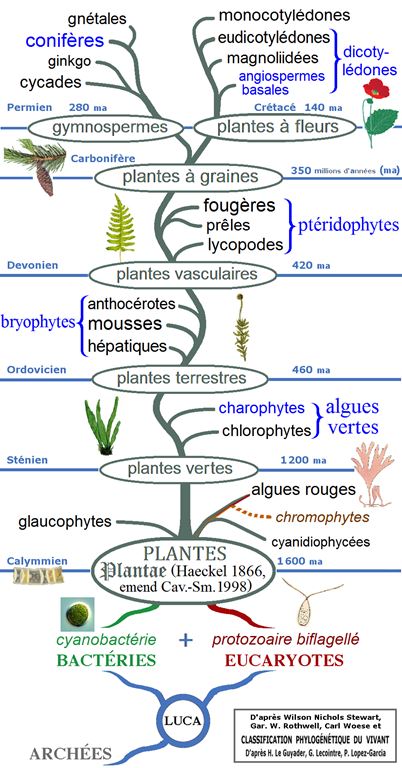
À droite, cet arbre phylogénétique des plantes montre les principaux clades et groupes traditionnels (monophylétiques en noir et paraphylétiques en bleu).
Dénominations
- Nom botanique : Dioscorea praehensilis Benth.
- Synonymes : Dioscorea angustiflora Rendle, Dioscorea cayenensis Lam. var. praehensilis (Benth.) A. Chev, Dioscorea costermansiana De Wild. & T. Durand, Dioscorea liebrechtsiana De Willd, Dioscorea odoratissima Pax
- Noms anglais et locaux : Forest yam
Description et culture
Tableau récapitulatif
Parties comes-tibles Note comest. (1-5) Note medic. (1-5) (Zones de) Rusticité Besoins en 
Besoins en  (1-3)
(1-3)Périodes de semis et récoltes Graines au gramme Durée de viabilité Profon-deur semis Espace-ment plants Espace-ment lignes Durée germi-native Durée avant récolte J F M A M J
J A S O N D
J F M A M J
J A S O N D
- dont infos de 0FPI ("FOOD PLANTS INTERNATIONAL", en anglais) :
Description :
Un igname. C'est une herbe grimpante. Les vignes mesurent 8 à 15 m de long. Il produit un tubercule chaque année. Il mesure 5 cm de diamètre et 60 cm de long. Il descend dans le sol. Les tiges s'enroulent vers la droite. Il a des piquants brun pâle. Ceux-ci sont plus courants près de la base. Les feuilles sont opposées. Ils mesurent 4 à 10 cm de long sur 3 à 5 cm de large. Ils sont en forme de cœur à la base. Les feuilles sont entières et effilées jusqu'à la pointe. La pointe peut être longue. Les tubercules se développent chaque année. Les fleurs sont en épi à l'aisselle des feuilles. Les fleurs mâles et femelles sont séparées et les fleurs femelles pendent{{{0(+x) (traduction automatique).
Original : A yam. It is a climbing herb. The vines are 8-15 m long. It produces one tuber each year. This is 5 cm across and 60 cm long. It extends down into the ground. The stems twine to the right. It has pale brown prickles. These are more common near the base. The leaves are opposite. They are 4-10 cm long by 3-5 cm wide. They are heart shaped at the base. The leaves are entire and taper to the tip. The tip can be long. The tubers develop annually. The flowers are in a spike in the axils of leaves. Male and female flowers are separate and female flowers hang down{{{0(+x).
Production :
Les tubercules sont récoltés peu après la fin de la saison des pluies. Ils peuvent être tranchés, séchés et réduits en poudre et stockés pendant plusieurs mois{{{0(+x) (traduction automatique).
Original : Tubers are harvested soon after the end of the rainy season. They can be sliced, dried and powdered and stored for several months{{{0(+x).
Culture :
Un morceau du tubercule est utilisé pour la replantation. Il vaut mieux avec un support pour grimper{{{0(+x) (traduction automatique).
Original : A piece of the tuber is used for replanting. It is best with a support to climb over{{{0(+x).
 Consommation (rapports de comestibilité, parties utilisables et usages alimentaires correspondants)
Consommation (rapports de comestibilité, parties utilisables et usages alimentaires correspondants)Parties comestibles :
tubercules, racines, bulbes, feuilles, légumes{{{0(+x) (traduction automatique). Original : Tubers, Root, Bulbils, Leaves, Vegetable{{{0(+x).Détails :
Les tubercules sont cuits et consommés comme un aliment de base féculent. Les tubercules peuvent être amers et doivent ensuite être soigneusement préparés. Ils doivent être pelés et trempés avant utilisation. Les jeunes tubercules sont choisis. Les jeunes feuilles sont également enregistrées comme consommées. (Mise en garde{{{0(+x) (traduction automatique).
Original : The tubers are cooked and eaten as a starchy staple. The tubers can be bitter and then need careful preparation. They need to be peeled and soaked before using. Young tubers are chosen. The young leaves are also recorded as eaten. (Caution){{{0(+x).
Partie testée :
tubercule{{{0(+x) (traduction automatique). Original : Tuber{{{0(+x) Risques et précautions à prendre
Risques et précautions à prendrenéant, inconnus ou indéterminés.
Autres infos
dont infos de 0FPI ("FOOD PLANTS INTERNATIONAL", en anglais) :
Statut :
C'est l'igname comestible la plus importante d'Afrique australe. C'est un aliment de base au Bénin{{{0(+x) (traduction automatique).
Original : It is the most important edible yam of Southern Africa. It is a staple food in Benin{{{0(+x).
Distribution :
Une plante tropicale. Il pousse dans les forêts et les prairies. En Afrique centrale, il pousse de 600 à 1 700 m d'altitude. Il pousse dans les zones plus sèches. Au Malawi, il pousse à 600-700 m d'altitude. En Tanzanie, il pousse entre 800 et 1 800 m au-dessus du niveau de la mer. Il pousse dans les zones avec des précipitations comprises entre 1 400 et 2 400 mm. Il est préférable dans un sol riche en humus{{{0(+x) (traduction automatique).
Original : A tropical plant. It grows in forest and grassland. In Central Africa it grows from 600-1,700 m altitude. It grows in drier areas. In Malawi it grows at 600-700 m altitude. In Tanzania it grows between 800-1,800 m above sea level It grows in areas with rainfall between 1,400-2,400 mm. It is best in humus rich soil{{{0(+x).
Localisation :
Afrique, Angola, Bénin, Burkina Faso, Cameroun, Afrique centrale, République centrafricaine, RCA, RD Congo, Congo R, Côte d'Ivoire, Afrique de l'Est, Éthiopie, Gabon, Gambie, Ghana, Guinée, Guinée, Guinée-Bissau, Côte d'Ivoire, Libéria, Malawi, Mali, Mozambique, Nigéria, Rwanda, Sénégal, Sierra Leone, Afrique australe, Tanzanie, Togo, Ouganda, Afrique de l'Ouest, Zambie, Zimbabwe{{{0(+x) (traduction automatique).
Original : Africa, Angola, Benin, Burkkina Faso, Cameroon, Central Africa, Central African Republic, CAR, Congo DR, Congo R, Côte d'Ivoire, East Africa, Ethiopia, Gabon, Gambia, Ghana, Guinea, Guinée, Guinea-Bissau, Ivory Coast, Liberia, Malawi, Mali, Mozambique, Nigeria, Rwanda, Senegal, Sierra Leone, Southern Africa, Tanzania, Togo, Uganda, West Africa, Zambia, Zimbabwe{{{0(+x).
Notes :
Il existe environ 650 espèces de Dioscorée{{{0(+x) (traduction automatique).
Original : There are about 650 species of Dioscorea{{{0(+x).
Liens, sources et/ou références
Liens :
/ ;Sources et/ou références :
bibliographie (liste des sources et/ou références de l'encyclopédie)
dont classification : IPNI ("International Plant Names Index", en anglais) ; Kew (POWO - "Plant Of the World Online", "Royal Botanical Garden", en anglais) ;
dont livres et bases de données : 0FPI ("FOOD PLANTS INTERNATIONAL", en anglais) ;
dont bibliographie/références de 0FPI ("FOOD PLANTS INTERNATIONAL", en anglais) :
Abbiw, D.K., 1990, Useful Plants of Ghana. West African uses of wild and cultivated plants. Intermediate Technology Publications and the Royal Botanic Gardens, Kew. p 27 ; Avouhou, H. T., et al, 2012, Ethnobotanical Factors Influencing the Use and Management of Wild Edible Plants in Agricultural Environments in Benin. Ethnobotany Research & Applications Vol 10:571-592 ; Balemie, K., & Kebebew, F., 2006, Ethnobotanical study of wild edible plants in Derashe and Kucha Districts, South Ethiopia. Journal of Ethnobiology and Ethnomedicine. ; Berihun, T. & Molla, E., 2017, Study on the Diversity and Use of Wild Edible Plants in Bullen District Northwest Ethiopia. Hindawi Journal of Botany. Article ID 8383468 ; Bongers, F. et al (Eds), Forest Climbing Plants of West Africa: Diversity, Ecology and Management. CABI ; Bruschi, P., et al, 2014, Traditional use of plants in a rural community of Mozambique and possible links with Miombo degradation and harvesting sustainability. Journal of Ethnobiology and Ethnomedicine. 2014, 10:59 ; Burkill, H. M., 1985, The useful plants of west tropical Africa, Vol. 1. Kew. ; Busson, 1965, (As Dioscorea odoratissima) ; Codjia, J. T. C., et al, 2003, Diversity and local valorisation of vegetal edible products in Benin. Cahiers Agricultures 12:1-12 ; Dalziel, J. M., 1937, The Useful plants of west tropical Africa. Crown Agents for the Colonies London. ; Eilu, G. & Bukenya-Ziraba, R., 2004, Local Use of Climbing Plants of Budongo Forest Reserve, Western Uganda. Journal of Ethnobiology 24(2): 307-327 (As Dioscorea odoratissima) ; Grivetti, L. E., 1980, Agricultural development: present and potential role of edible wild plants. Part 2: Sub-Saharan Africa, Report to the Department of State Agency for International Development. p 32 ; Grubben, G. J. H. and Denton, O. A. (eds), 2004, Plant Resources of Tropical Africa 2. Vegetables. PROTA, Wageningen, Netherlands. p 287 ; J. D. Hooker & G. Bentham in W. J. Hooker, Niger Fl. 536. 1849 ; Idohou, I., et al, 2013, National inventory and prioritization of crop wild relatives: case study for Benin. Genet Resour Crop Evol (2013) 60:1337–1352 ; Jardin, C., 1970, List of Foods Used In Africa, FAO Nutrition Information Document Series No 2.p 14 (Also as Dioscorea liebrechtsiana), p 13 (As Dioscorea angustiflora) ; Koni, J. M. & Bostein, K., 2008, Noms et usages des plantes utiles chez les Nsong, DR Congo. University of Gothenburg. Department of Oriental and African Languages. p 32 ; Latham, P., 2004, Useful Plants of Bas-Congo province. Salvation Army & DFID p 112 ; Lautenschläger, T., et al, 2018, First large-scale ethnobotanical survey in the province of UÃge, northern Angola. Journal of Ethnobiology and Ethnomedicine (2018) 14:51 ; Lulekal, E., et al, 2011, Wild edible plants in Ethiopia: a review on their potential to combat food insecurity. Afrika Focus - Vol. 24, No 2. pp 71-121 ; Malaisse, F., 1997, Se nourrir en floret claire africaine. Approche ecologique et nutritionnelle. CTA., p 61 (Also as Dioscorea liebrechtsiana) ; Nkeoua, G. & Boundzanga, G. C., 1999, Donnees sur les produits forestieres non ligneux en Republique du Congo. FAO. p 25 (Also as Dioscorea liebrechtsiana) ; Nyadanu, D., et al, 2015, Agro-biodiversity and challenges of on-farm conservation: the case of plant genetic resources of neglected and underutilized crop species in Ghana. Genet. Resourc. Crop Evol. 62(7): ; Peters, C. R., O'Brien, E. M., and Drummond, R.B., 1992, Edible Wild plants of Sub-saharan Africa. Kew. p 17 (Also as Dioscorea odoratissima) ; Ruffo, C. K., Birnie, A. & Tengnas, B., 2002, Edible Wild Plants of Tanzania. RELMA p 274 (As Dioscorea odoratissima) ; Sato, H., 2001, The potential of edible wild yams and yam-like plants as a staple food resource in the African Tropical Rain Forest. African Study Monographs Suppl. 26:123-134 ; Tebkew, M. et al, 2014, Underutilized wild edible plants in the Chilga District, northwestern Ethiopia: focus on wild woody plants. Agriculture & Food Security 3:12 ; Tebkew, M., et al, 2018, Uses of wild edible plants in Quara district, northwest Ethiopia: implication for forest management. Agriculture and Food Security (2018) 7:12 ; Terashima, H., & Ichikawa, M., 2003, A comparative ethnobotany of the Mbuti and Efe hunter-gatherers in the Ituri Forest, Democratic Republic of Congo. African Study Monographs, 24 (1, 2): 1-168, March 2003 ; Termote, C., et al, 2011, Eating from the wild: Turumbu, Mbole and Bali traditional knowledge of non-cultivated edible plants, District Tshopo, DRCongo, Gen Resourc Crop Evol. 58:585-618 ; von Katja Rembold, 2011, Conservation status of the vascular plants in East African rain forests. Dissertation Universitat Koblenz-Landau p 165 ; White, F., Dowsett-Lemaire, F. and Chapman, J. D., 2001, Evergreen Forest Flora of Malawi. Kew. p 97 (As Dioscorea odoratissima) ; Wilkin, P., 2001, Dioscoreaceae of South-Central Africa. Kew Bulletin, Vol. 56, No. 2 (2001), pp 361-404 ; Yamada, T., 1999, A report of the Ethnobotany of the Nyindu in the Eastern part of the former Zaire. African Study Monographs 20(1):1-72 ; Yasuoka, H., 2006, Long-Term Foraging Expeditions (Molongo) among the Baka Hunter-Gatherers in the Northwestern Congo Basin, with Special Reference to the "Wild Yam Question". Human Ecology, Vol. 34, No. 2, April 2006, pp 275 ff ; Yasuoka, H., 2009, Concentrated Distribution of Wild Yam Patches: Historical Ecology and the Subsistence of African Rainforest Hunter-Gatherers. Human Ecology 37:577-587
Recherche de/pour :
- "Dioscorea praehensilis" sur Google (pages et
images) ;
TPL ("The Plant List", en anglais) ;
GRIN ("Germplasm Resources Information Network", en anglais) ;
TROPICOS (en anglais) ;
Tela Botanica ;
Pl@ntNet ;
Pl@ntUse ;
"Plants For A Future" (en anglais) ;
"Useful Tropical Plants" (en anglais) ou
"Useful Temperate Plants" (en anglais) ;
- "Dioscorea praehensilis" sur Google (pages et
images) ;
TPL ("The Plant List", en anglais) ;
GRIN ("Germplasm Resources Information Network", en anglais) ;
TROPICOS (en anglais) ;
Tela Botanica ;
Pl@ntNet ;
Pl@ntUse ;
"Plants For A Future" (en anglais) ;
"Useful Tropical Plants" (en anglais) ou
"Useful Temperate Plants" (en anglais) ;
Espèces du même genre (Dioscorea)
165 taxons
- Hoffe
- Igname ailée
- Igname amère
- Igname aplatie
- Igname blanc
- Igname cousse-couche
- Igname de chine
- Igname de Farges
- Igname de Zanzibar
- Igname des blancs
- Igname du japon
- Igname épineuse amère
- Igname jaune
- Igname khmer
- Igname rampant
- Igname rouge
- Igname sauvage
- Name dunguey
- Tamier commun
- Dioscorea abyssinica Hochst. ex Kunth
- Dioscorea acanthogene Rusby
- Dioscorea aculeata Balb. ex Kunth
- Dioscorea acuminata Steud.
- Dioscorea alata L. (Igname ailée)
- Dioscorea alatipes Burkill & H.Perrier
- Dioscorea altissima Lam. (Name dunguey)
- Dioscorea amaranthoides C.Presl
- Dioscorea amazonum Mart. ex Griseb.
- Dioscorea antaly Jum. & H.Perrier
- Dioscorea arachidna Prain & Burkill
- Dioscorea arcuatinervis Hochr.
- Dioscorea asteriscus Burkill
- Dioscorea bako Wilkin
- Dioscorea baya De Wild.
- Dioscorea belophylla (Prain) Voigt ex Haines
- Dioscorea bemandry Jum. & H.Perrier
- Dioscorea bemarivensis Jum. & H.Perrier
- Dioscorea birmanica Prain & Burkill
- Dioscorea brevipetiolata Prain & Burkill
- Dioscorea bridgesii Griseb. ex Kunth
- Dioscorea buckleyana Wilkin
- Dioscorea bulbifera L. (Hoffe)
- Dioscorea burkilliana J.Mige ex R.Hills & Wilkin
- Dioscorea calcicola Prain & Burkill
- Dioscorea campestris Griseb.
- Dioscorea cayenensis Lam. (Igname jaune)
- Dioscorea cinnamomifolia Hook.
- Dioscorea cirrhosa Lour.
- Dioscorea claessensii De Wild.
- Dioscorea cochleari-apiculata
- Dioscorea communis (L.) Caddick & Wilkin (Tamier commun)
- Dioscorea comorensis R.Knuth
- Dioscorea convolvulacea Schltdl. & Cham. (Igname rampant)
- Dioscorea cotinifolia Kunth
- Dioscorea cumingii Prain & Burkill
- Dioscorea daunea Prain & Burkill
- Dioscorea debilis Uline ex R.Knuth
- Dioscorea decaryana H.Perrier
- Dioscorea decipiens Hook.f.
- Dioscorea delavayi Franch.
- Dioscorea delicata R.Knuth
- Dioscorea deltoidea Wall. ex Griseb.
- Dioscorea depauperata Prain & Burkill
- Dioscorea divaricata Blanco
- Dioscorea dodecaneura Vell.
- Dioscorea dregeana (Kunth) T.Durand & Schinz
- Dioscorea dumetorum (Kunth) Pax (Igname amère)
- Dioscorea elegans R.Knuth
- Dioscorea elephantipes (L'Hr.) Engl.
- ...
Espèces de la même famille (Dioscoreaceae)
177 taxons
- Hoffe
- Igname ailée
- Igname amère
- Igname aplatie
- Igname blanc
- Igname cousse-couche
- Igname de chine
- Igname de Farges
- Igname de Zanzibar
- Igname des blancs
- Igname du japon
- Igname épineuse amère
- Igname jaune
- Igname khmer
- Igname rampant
- Igname rouge
- Igname sauvage
- Name dunguey
- Tamier commun
- Dioscorea abyssinica Hochst. ex Kunth
- Dioscorea acanthogene Rusby
- Dioscorea aculeata Balb. ex Kunth
- Dioscorea acuminata Steud.
- Dioscorea alata L. (Igname ailée)
- Dioscorea alatipes Burkill & H.Perrier
- Dioscorea altissima Lam. (Name dunguey)
- Dioscorea amaranthoides C.Presl
- Dioscorea amazonum Mart. ex Griseb.
- Dioscorea antaly Jum. & H.Perrier
- Dioscorea arachidna Prain & Burkill
- Dioscorea arcuatinervis Hochr.
- Dioscorea asteriscus Burkill
- Dioscorea bako Wilkin
- Dioscorea baya De Wild.
- Dioscorea belophylla (Prain) Voigt ex Haines
- Dioscorea bemandry Jum. & H.Perrier
- Dioscorea bemarivensis Jum. & H.Perrier
- Dioscorea birmanica Prain & Burkill
- Dioscorea brevipetiolata Prain & Burkill
- Dioscorea bridgesii Griseb. ex Kunth
- Dioscorea buckleyana Wilkin
- Dioscorea bulbifera L. (Hoffe)
- Dioscorea burkilliana J.Mige ex R.Hills & Wilkin
- Dioscorea calcicola Prain & Burkill
- Dioscorea campestris Griseb.
- Dioscorea cayenensis Lam. (Igname jaune)
- Dioscorea cinnamomifolia Hook.
- Dioscorea cirrhosa Lour.
- Dioscorea claessensii De Wild.
- Dioscorea cochleari-apiculata
- Dioscorea communis (L.) Caddick & Wilkin (Tamier commun)
- Dioscorea comorensis R.Knuth
- Dioscorea convolvulacea Schltdl. & Cham. (Igname rampant)
- Dioscorea cotinifolia Kunth
- Dioscorea cumingii Prain & Burkill
- Dioscorea daunea Prain & Burkill
- Dioscorea debilis Uline ex R.Knuth
- Dioscorea decaryana H.Perrier
- Dioscorea decipiens Hook.f.
- Dioscorea delavayi Franch.
- Dioscorea delicata R.Knuth
- Dioscorea deltoidea Wall. ex Griseb.
- Dioscorea depauperata Prain & Burkill
- Dioscorea divaricata Blanco
- Dioscorea dodecaneura Vell.
- Dioscorea dregeana (Kunth) T.Durand & Schinz
- Dioscorea dumetorum (Kunth) Pax (Igname amère)
- Dioscorea elegans R.Knuth
- Dioscorea elephantipes (L'Hr.) Engl.
- ...







 donne accès au menu
  - encyclopédies des plantes alimentaires ;
 - page de recherche - reconnaissance (identification) de plantes ;
 - page du calendrier lunaire et son générateur (au format PDF et JPG) ;
 - tableau récapitulatif ;
 - générateur de potées (soupes), avec estimation des apports nutrionnels et du coût;
 - générateur de codes QR ;
 - page des archives avec de nombreux documents sur différents thèmes complémentaires comme la botanique, les légumes,
les champignons, la cuisine, le bien-être ainsi que différents MOOC mais également des liens vers les archives de l'association ;
- page des archives avec de nombreux documents sur différents thèmes complémentaires comme la botanique, les légumes,
les champignons, la cuisine, le bien-être ainsi que différents MOOC mais également des liens vers les archives de l'association ;

 ou
ou
 permettant de passer du format standard à l'AMP (et vice-versa), lequel est simplifié et donc plus rapide.
 pour le fruit (et/ou les graines, la pulpe, etc...),
 pour les fleurs (et/ou pétales, calice...),
 pour les feuilles (et/ou la tige, les pousses...),
 pour les racines,
 pour le tronc (et/ou l'écorce, la sève...), et enfin
 pour les champignons,
puis les notes alimentaires et médicinales (de 1 à 5 étoiles), la rusticité (résistance au froid/gel)
et pour finir un résumé.
pour les champignons,
puis les notes alimentaires et médicinales (de 1 à 5 étoiles), la rusticité (résistance au froid/gel)
et pour finir un résumé. menant ici 🙂
 ,
,  et
et





 ,
,


 Encyclopédie(s)
 Recherche-Reconnaissance
 Tableau récapitulatif
 Codes QR
 Archives
 Calendrier(s) lunaire(s)
  Potées
 Re-naturation/naturalisation
 Affichettes, herbiers &
co.
Affichettes, herbiers &
co. menu
menu galerie







