Oryza rufipogon

C'est du riz sauvage. C'est une herbe rampante. Il a des racines enflées. Il continue de croître d'année en année. Il atteint 2,5 m de haut. Les fleurs sont brun clair. Il ... (traduction automatique)
→suite


Affich., herbiers & co.
Oryza rufipogon
C'est du riz sauvage. C'est une herbe rampante. Il a des racines enflées. Il continue de croître d'année en année. Il atteint 2,5 m de haut. Les fleurs sont brun clair. Ils sont en panicules de 13 à 25 cm de long (traduction automatique)

Pas d'illustration
pour le moment 😕
Classification
- Classique : en haut de l'écran, sous le coeur.
- Phylogénétique :
- Clade 4 : Angiospermes ;
- Clade 3 : Monocotylédones ;
- Clade 2 : Commelinidées ;
- Ordre APN : Poales ;
- Famille APN : Poaceae ;
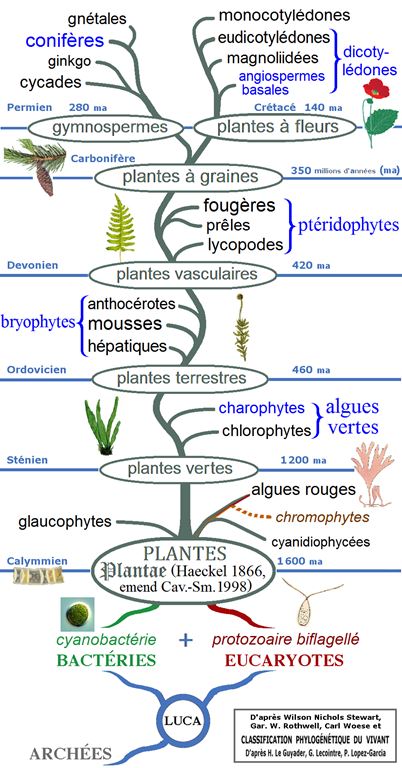
À droite, cet arbre phylogénétique des plantes montre les principaux clades et groupes traditionnels (monophylétiques en noir et paraphylétiques en bleu).
Dénominations
- Nom botanique : Oryza rufipogon Griff.
- Synonymes : Oryza fatua Koen. ex Trin, Oryza glumaepatula Steud, Oryza nivara S. D. Sharma & Shastry, Oryza sativa var. fatua Prain, Oryza sativa var. rufipogon Watt, Oryza sativa var. coarctata Watt, Oryza sativa var. abuensis Watt, et d'autres
- Noms anglais et locaux : Wild rice, Red rice
Description et culture
Tableau récapitulatif
Parties comes-tibles Note comest. (1-5) Note medic. (1-5) (Zones de) Rusticité Besoins en 
Besoins en  (1-3)
(1-3)Périodes de semis et récoltes Graines au gramme Durée de viabilité Profon-deur semis Espace-ment plants Espace-ment lignes Durée germi-native Durée avant récolte J F M A M J
J A S O N D
J F M A M J
J A S O N D
- dont infos de 0FPI ("FOOD PLANTS INTERNATIONAL", en anglais) :
Description :
C'est du riz sauvage. C'est une herbe rampante. Il a des racines enflées. Il continue de croître d'année en année. Il atteint 2,5 m de haut. Les fleurs sont brun clair. Ils sont en panicules de 13 à 25 cm de long{{{0(+x) (traduction automatique).
Original : It is wild rice. It is a creeping grass. It has swollen roots. It keeps growing from year to year. It grows 2.5 m high. The flowers are light brown. They are in panicles 13-25 cm long{{{0(+x).
Production :
Au Rajasthan en Inde, les graines sont produites de septembre à novembre{{{0(+x) (traduction automatique).
Original : In Rajasthan in India, seed are produced in September to November{{{0(+x).
Culture :
Parce qu'il se brise, les pauvres attachent les arêtes ensemble pour recueillir le grain{{{0(+x) (traduction automatique).
Original : Because it shatters, poor people tie the awns together to collect the grain{{{0(+x).
 Consommation (rapports de comestibilité, parties utilisables et usages alimentaires correspondants)
Consommation (rapports de comestibilité, parties utilisables et usages alimentaires correspondants)Parties comestibles :
graines, céréales{{{0(+x) (traduction automatique). Original : Seeds, Cereal{{{0(+x).Détails :
Les graines se mangent comme du riz. Ils sont séchés, retirés des peaux puis cuits. Il est utilisé comme réserve et nourriture de famine{{{0(+x) (traduction automatique).
Original : The seeds are eaten like rice. They are dried, have the skins removed and are then cooked. It is used as a reserve and famine food{{{0(+x).
Partie testée :
/ Risques et précautions à prendre
Risques et précautions à prendrenéant, inconnus ou indéterminés.
Autres infos
dont infos de 0FPI ("FOOD PLANTS INTERNATIONAL", en anglais) :
Statut :
C'est une plante sauvage{{{0(+x) (traduction automatique).
Original : It is a wild plant{{{0(+x).
Distribution :
C'est une plante tropicale. Il pousse sur les bords des étangs ou flotte sur l'eau. Il pousse dans les zones humides. Dans le sud de la Chine, il pousse en dessous de 700 m au-dessus du niveau de la mer. En Argentine, il pousse en dessous de 500 m au-dessus du niveau de la mer{{{0(+x) (traduction automatique).
Original : It is a tropical plant. It grows on the edges of ponds or floating on water. It grows in wetlands. In southern China it grows below 700 m above sea level. In Argentina it grows below 500 m above sea level{{{0(+x).
Localisation :
Argentine, Asie, Australie, Bangladesh, Brésil, Cambodge, Chine, Guyane, Guyane, Guyane, Inde, Indochine, Indonésie, Malaisie, Myanmar, Pacifique, Papouasie-Nouvelle-Guinée, PNG, Paraguay, Philippines, Asie du Sud-Est, Amérique du Sud, Sri Lanka , Suriname, Taiwan, Thaïlande, Venezuela, Vietnam{{{0(+x) (traduction automatique).
Original : Argentina, Asia, Australia, Bangladesh, Brazil, Cambodia, China, Guiana, Guianas, Guyana, India, Indochina, Indonesia, Malaysia, Myanmar, Pacific, Papua New Guinea, PNG, Paraguay, Philippines, SE Asia, South America, Sri Lanka, Suriname, Taiwan, Thailand, Venezuela, Vietnam{{{0(+x).
Notes :
Il existe environ 20 espèces d'Oryza. Il s'agit d'une espèce diploïde avec un génome AA{{{0(+x) (traduction automatique).
Original : There are about 20 Oryza species. This is a diploid species with AA genome{{{0(+x).
Liens, sources et/ou références
Liens :
/ ;Sources et/ou références :
bibliographie (liste des sources et/ou références de l'encyclopédie)
dont classification : IPNI ("International Plant Names Index", en anglais) ; Kew (POWO - "Plant Of the World Online", "Royal Botanical Garden", en anglais) ;
dont livres et bases de données : 0FPI ("FOOD PLANTS INTERNATIONAL", en anglais) ;
dont bibliographie/références de 0FPI ("FOOD PLANTS INTERNATIONAL", en anglais) :
Ambasta, S.P. (Ed.), 2000, The Useful Plants of India. CSIR India. p 415 ; Bengal pl. 2:1184. 1903 (As Oryza sativa var. fatua) ; Bortolotto, I. M., et al, 2015, Knowledge and use of wild edible plants in rural communities along Paraguay River, Pantanal, Brazil. Journal or Ethnobiology and Ethnomedicine. 11:46 (As Oryza glumaepatula) ; Bortolotto, I. M., et al, 2018, Lista preliminar das plantas alimenticias nativas de Mato Grosso do Sul, Brasil. Iheringia, Serie Botanica, Porto Alegre, 73 (supl.):101-116 (As Oryza glumaepatula) ; Chandrakumar, P., et al, 2015, Ethnobotanical studies of wild edible plants of Gond, Halba and Kawar tribes of Salekasa Taluka, Gondia District, Maharashtra State, India. International Research Journal of Pharmacy 6(8) ; Cribb, A.B. & J.W., 1976, Wild Food in Australia, Fontana. p 101 (As Oryza sativa var. fatua) ; Garde, M., et al, 2003, A Preliminary List of Kundedjnjenghmi Plant Names. Northern Land Council. (Arnhem Land, Australia) ; Hussey, B.M.J., Keighery, G.J., Cousens, R.D., Dodd, J., Lloyd, S.G., 1997, Western Weeds. A guide to the weeds of Western Australia. Plant Protection Society of Western Australia. p 60 ; Indian J. Genet. Pl. Breed. 25:157, fig. 2, 3. 1965 (As Oryza nivara) ; Isaacs, J., 1987, Bush Food, Aboriginal Food and Herbal Medicine. Weldons. p 115 (As Oryza sativa var. fatua) ; Lazarides, M. & Hince, B., 1993, Handbook of Economic Plants of Australia, CSIRO. p 177 ; Leach, G.J., & Osborne, P.L., 1985, Freshwater Plants of Papua New Guinea. UPNG Press, p 137 ; Mishra, N., et al, 2016, Indigenous knowledge in utilization of wetland plants in Bhadrak district, Odisha, India. Indian Journal of Natural Products and Resources. Vol. 7(1) pp. 82-89 ; Morley, B.D., & Toelken, H.R., (Eds), 1983, Flowering Plants in Australia. Rigby. p 391 ; Not. pl. asiat. 3:5, t. 144, fig. 2. 1851 ; Paczkowska, G. & Chapman, A.R., 2000, The Western Australian Flora. A Descriptive Catalogue. Western Australian Herbarium. p 111 ; Petheram, R.J. and Kok, B., 2003, Plants of the Kimberley Region of Western Australia. UWA Press p 179 ; Phon, P., 2000, Plants used in Cambodia. © Pauline Dy Phon, Phnom Penh, Cambodia. p 480 ; Prashanth Kumar, G.M. and Shiddamallayya, N., 2015, Ethnobotanical Study of Less Known Wild Edible Plants of Hakki Pikki Tribes of Angadihalli, Hassan District, Karnataka. Journal or Medicinal Plants Studies 3(5):80-85 ; PROSEA (Plant Resources of South East Asia) handbook Volume 10 Cereals. p 103 (As Oryza nivara) ; Pullaiah, Y., Krishnamurthy, K. V. & Bahadur, B., (Eds.), 2016, Ethnobotany of India, Volume 1: Eastern Ghats and Deccan. (Also as Oryza jeyporensis) ; Purseglove, J.W., 1972, Tropical Crops. Monocotyledons. Longmans p 162 ; Reddy, B. M., 2012, Wild edible plants of Chandrapur district, Maharashtra, India. Indian Journal of Natural Products and Resources. 3(1) pp 110-117 ; Shah, G.L., 1984, Some economically important plant of Salsette Island near Bombay. J. Econ. Tax. Bot. Vol. 5 No. 4 pp 753-765 ; Singh, H.B., Arora R.K.,1978, Wild edible Plants of India. Indian Council of Agricultural Research, New Delhi. p 84 ; Singh, V. and Singh, P., 1981, Edible Wild Plants of Eastern Rajasthan. J. Econ. Tax. Bot. Vol 2 pp 197-207 ; Wheeler, J.R.(ed.), 1992, Flora of the Kimberley Region. CALM, Western Australian Herbarium, p 1194 ; Wightman, Glenn et al. 1991.Alawa Ethnobotany: Aboriginal Plant Use from Minyerri, Northern Australia. Northern Territory Botanical Bulletin No 11. Parks and Wildlife Commission of the Northern Territory. p 22
Recherche de/pour :
- "Oryza rufipogon" sur Google (pages et
images) ;
TPL ("The Plant List", en anglais) ;
GRIN ("Germplasm Resources Information Network", en anglais) ;
TROPICOS (en anglais) ;
Tela Botanica ;
Pl@ntNet ;
Pl@ntUse ;
"Plants For A Future" (en anglais) ;
"Useful Tropical Plants" (en anglais) ou
"Useful Temperate Plants" (en anglais) ;
- "Oryza rufipogon" sur Google (pages et
images) ;
TPL ("The Plant List", en anglais) ;
GRIN ("Germplasm Resources Information Network", en anglais) ;
TROPICOS (en anglais) ;
Tela Botanica ;
Pl@ntNet ;
Pl@ntUse ;
"Plants For A Future" (en anglais) ;
"Useful Tropical Plants" (en anglais) ou
"Useful Temperate Plants" (en anglais) ;
Espèces du même genre (Oryza)
13 taxons
Espèces de la même famille (Poaceae)
881 taxons
- Agrostide blanche
- Alpiste
- Alpiste à épi court
- Alpiste de Rotgès
- Alpiste mineur
- Amidonnier
- Amidonnier sauvage
- Amourette commune
- Aristide
- Aristide de l'Ascension
- Aristide sétacée
- Avoine
- Avoine à fourrage
- Avoine à gruau
- Avoine barbue
- Avoine d'Espagne
- Avoine d'Orient
- Avoine de Ludovic
- Avoine élevée
- Avoine odorante
- Bambou
- Bambou à rayures jaunes
- Bambou asper
- Bambou bhaluka
- Bambou carré
- Bambou chocolat
- Bambou commun
- Bambou de Veitch
- Bambou doré
- Bambou fastuosa (p*)
- Bambou flexueux
- Bambou géant
- Bambou glauca
- Bambou hamiltonii
- Bambou makinoi (p*)
- Bambou marbré
- Bambou médicinal
- Bambou membranaceus
- Bambou moso
- Bambou noir
- Bambou nuda
- Bambou pagode
- Bambou sasa palmata
- Bambou soufré à tige verte
- Bambou violacé
- Bambou viridiglaucescens
- Bambou yunnanicus
- Bardanette
- Bardanette rameuse
- Blé de Khorasan
- Achnatherum hymenoides (Roem. & Schult.) Ricker ex Piper
- Acidosasa chinensis C.D.Chu & C.S.Chao ex Keng f.
- Acidosasa edulis (T.H.Wen) T.H.Wen
- Acidosasa purpurea (Hsueh & T.P.Yi) Keng f.
- Acroceras amplectens Stapf
- Aegilops geniculata Fig. & De Not. (Égilope genouillé)
- Aegilops speltoides Tausch. (Égilope faux épeautre)
- Aegilops triuncialis L. (Égilope à 3 arêtes)
- Aeluropus lagopoides (Élurope)
- Agrostis perennans
- Agrostis stolonifera L. (Agrostide blanche)
- Agrotriticum x sp
- Aira caespitosa Muhl.
- Alopecurus aequalis Sobol. (Vulpin fauve)
- Alopecurus pratensis Bourg. ex Lange (Vulpin des prés de Linné)
- Ammophila arenaria (L.) Link (Oyat)
- Amphipogon caricinus F.Muell.
- Andropogon canaliculatus Schumach.
- Andropogon gayanus Kunth
- Andropogon gerardii
- Andropogon pinguipes Stapf
- Andropogon pseudapricus Stapf
- Andropogon sorghum
- Andropogon tectorum Schumach. & Thonn.
- Anthephora nigritana Stapf & C.E.Hubb.
- Anthephora pubescens Nees
- Anthoxanthum odoratum L. (Flouve odorante)
- Aristida acuta S.T.Blake
- Aristida adscensionis L. (Aristide de l'Ascension)
- Aristida congesta Roem. & Schult. (Aristide)
- Aristida inaequiglumis Domin
- Aristida publifolia
- Aristida pungens Desf.
- Aristida setacea Steud. (Aristide sétacée)
- Aristida stipoides R.Br.
- Arrhenatherum elatius (Avoine élevée)
- Arundinaria faberi Rendle
- Arundinaria gigantea
- Arundinaria hookeriana Munro
- Arundinaria niitakayamensis Hayata
- Arundinaria spp
- Arundinella setosa Trin.
- Arundo donax L. (Roseau)
- Astrebla lappacea
- Astrebla pectinata
- Astrebla squarrosa C.E.Hubb.
- Avena abyssinica Hochst.
- Avena barbata Pott ex Link (Avoine barbue)
- Avena brevis Roth (Avoine à fourrage)
- Avena byzantina K.Koch
- ...







 donne accès au menu
  - encyclopédies des plantes alimentaires ;
 - page de recherche - reconnaissance (identification) de plantes ;
 - page du calendrier lunaire et son générateur (au format PDF et JPG) ;
 - tableau récapitulatif ;
 - générateur de potées (soupes), avec estimation des apports nutrionnels et du coût;
 - générateur de codes QR ;
 - page des archives avec de nombreux documents sur différents thèmes complémentaires comme la botanique, les légumes,
les champignons, la cuisine, le bien-être ainsi que différents MOOC mais également des liens vers les archives de l'association ;
- page des archives avec de nombreux documents sur différents thèmes complémentaires comme la botanique, les légumes,
les champignons, la cuisine, le bien-être ainsi que différents MOOC mais également des liens vers les archives de l'association ;

 ou
ou
 permettant de passer du format standard à l'AMP (et vice-versa), lequel est simplifié et donc plus rapide.
 pour le fruit (et/ou les graines, la pulpe, etc...),
 pour les fleurs (et/ou pétales, calice...),
 pour les feuilles (et/ou la tige, les pousses...),
 pour les racines,
 pour le tronc (et/ou l'écorce, la sève...), et enfin
 pour les champignons,
puis les notes alimentaires et médicinales (de 1 à 5 étoiles), la rusticité (résistance au froid/gel)
et pour finir un résumé.
pour les champignons,
puis les notes alimentaires et médicinales (de 1 à 5 étoiles), la rusticité (résistance au froid/gel)
et pour finir un résumé. menant ici 🙂
 ,
,  et
et





 ,
,


 Encyclopédie(s)
 Recherche-Reconnaissance
 Tableau récapitulatif
 Codes QR
 Archives
 Calendrier(s) lunaire(s)
  Potées
 Re-naturation/naturalisation
 Affichettes, herbiers &
co.
Affichettes, herbiers &
co. menu
menu galerie