Bambou noir
(Phyllostachys nigra)
![Illustration Phyllostachys nigra, Par Curtis, W., Botanical Magazine (1800-1948) Bot. Mag. vol. 131 (1905) [tt. 7992-8051] t. 7994, via plantillustrations](inc/images/illustrations/phyllostachys_nigra2.jpg)
 |
****
-
***
|
****
-
***
-22°C
Une grande herbe de bambou. Il atteint une hauteur de 1,5 à 3 m et une largeur de 1,8 à 3 m. Il peut mesurer de 10 à 15 m de haut et s'étendre de 6 à 15 m de large. Il fo ... (traduction automatique)
→suite


Affich., herbiers & co.
Bambou noir
Note alimentaire 
Note médicinale 
Note autre usage 

Une grande herbe de bambou. Il atteint une hauteur de 1,5 à 3 m et une largeur de 1,8 à 3 m. Il peut mesurer de 10 à 15 m de haut et s'étendre de 6 à 15 m de large. Il forme des touffes. Les cannes se... (traduction automatique) →suite

Phyllostachys nigra
Classification
- Classique : en haut de l'écran, sous le coeur.
- Phylogénétique :
- Clade 4 : Angiospermes ;
- Clade 3 : Monocotylédones ;
- Clade 2 : Commelinidées ;
- Ordre APN : Poales ;
- Famille APN : Poaceae ;
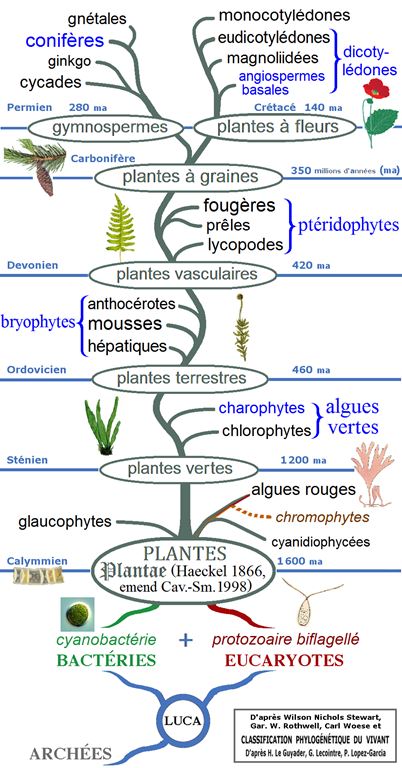
À droite, cet arbre phylogénétique des plantes montre les principaux clades et groupes traditionnels (monophylétiques en noir et paraphylétiques en bleu).
Dénominations
- Nom botanique : Phyllostachys nigra (Lodd. ex Lindl.) Munro (1868)
- Synonymes : Arundinaria stolonifera Kurz, Bambusa nigra Lodd. ex Lindl, Phyllostachys boryana Mitford, Phyllostachys filifera Mc Clure, Phyllostachys fulva Mitford, Phyllostachys nana Rendle, Phyllostachys nigra Munro var. nigra Bean, Phyllostachys nigra Munro f. nigra Schelle, Phyllostachys nigra - many forms and varieties.Phyllostachys nigripes Hayata, Phyllostachys nigropunctata Mitford, Phyllostachys punctata (Bean) A. H. Lawson, Sinoarundinaria nigra (Lodd. ex Lindl.) Ohwi ex Mayeb
- Noms anglais et locaux : black bamboo, purple bamboo
Description et culture
Tableau récapitulatif
Parties comes-tibles Note comest. (1-5) Note medic. (1-5) (Zones de) Rusticité Besoins en 
Besoins en  (1-3)
(1-3)Périodes de semis et récoltes Graines au gramme Durée de viabilité Profon-deur semis Espace-ment plants Espace-ment lignes Durée germi-native Durée avant récolte -22°C J F M A M J
J A S O N D
J F M A M J
J A S O N D
Types de feuillage :
Persistant
- dont infos de 0FPI ("FOOD PLANTS INTERNATIONAL", en anglais) :
Description :
Une grande herbe de bambou. Il atteint une hauteur de 1,5 à 3 m et une largeur de 1,8 à 3 m. Il peut mesurer de 10 à 15 m de haut et s'étendre de 6 à 15 m de large. Il forme des touffes. Les cannes se cambrent. Les cannes sont vertes la première année puis deviennent tachetées presque noires. Les cannes sont creuses et peuvent mesurer 3 cm d'épaisseur{{{0(+x) (traduction automatique).
Original : A large bamboo grass. It grows 1.5-3 m high and spreads 1.8-3 m wide. It can be 10-15 m tall and spread 6-15 m wide. It forms clumps. The canes arch over. The canes are green in the first year then turn mottled to almost black. The canes are hollow and can be 3 cm thick{{{0(+x).
Culture :
Il est généralement cultivé par division des rhizomes souterrains{{{0(+x) (traduction automatique).
Original : It is usually grown by division of the underground rhizomes{{{0(+x).
 Consommation (rapports de comestibilité, parties utilisables et usages alimentaires correspondants)
Consommation (rapports de comestibilité, parties utilisables et usages alimentaires correspondants)Partie(s) comestible(s){{{0(+x) : pousses0(+x)µ/turionsµ(dp*)µ.
Utilisation(s)/usage(s)µ{{{0(+x) culinaire(s) : les pousses sont consommées cuites mais l'eau doit être changée après 8-10 minutes{{{0(+x).
Partie testée :
/ Risques et précautions à prendre
Risques et précautions à prendrenéant, inconnus ou indéterminés.
Galerie(s)
Par Georges Seguin (Okki), via wikimedia
✖

Par Curtis, W., Botanical Magazine (1800-1948) Bot. Mag. vol. 131 (1905) [tt. 7992-8051] t. 7994, via plantillustrations
✖

Autres infos
dont infos de 0FPI ("FOOD PLANTS INTERNATIONAL", en anglais) :
Distribution :
C'est une plante tempérée. Il est résistant au gel. Au Hunan en Chine, il pousse dans les forêts ouvertes sur les pentes et dans les vallées entre 1 100 et 1 200 m d'altitude. Il convient aux zones de rusticité 7-10. Jardins botaniques du mont Cootha. Jardins botaniques de Wittunga{{{0(+x) (traduction automatique).
Original : It is a temperate plant. It is frost hardy. In Hunan in China it grows in open forests on slopes and in valleys between 1,100-1,200 m above sea level. It suits hardiness zones 7-10. Mt Cootha Botanical Gardens. Wittunga Botanical Gardens{{{0(+x).
Localisation :
Asie, Australie, Chine, Hawaï, Inde, Indochine, Indonésie, Japon, Malaisie, Pacifique, Asie du Sud-Est, Tasmanie, USA, Vietnam{{{0(+x) (traduction automatique).
Original : Asia, Australia, China, Hawaii, India, Indochina, Indonesia, Japan, Malaysia, Pacific, SE Asia, Tasmania, USA, Vietnam{{{0(+x).
Notes :
Il existe environ 80 espèces de Phyllostachys{{{0(+x) (traduction automatique).
Original : There are about 80 Phyllostachys species{{{0(+x).
Rusticité (résistance face au froid/gel, climat)
-22°C
Liens, sources et/ou références
Liens :
/ ;Sources et/ou références :
bibliographie (liste des sources et/ou références de l'encyclopédie)
dont classification : TPL ("The Plant List", en anglais) ; Tela Botanica ;
dont livres et bases de données : 5PFAF ("Plants For A Future", en anglais) ; 0FPI ("FOOD PLANTS INTERNATIONAL", en anglais) ;
dont bibliographie/références de 0FPI ("FOOD PLANTS INTERNATIONAL", en anglais) :
Ambasta, S.P. (Ed.), 2000, The Useful Plants of India. CSIR India. p 452 ; Bremness, L., 1994, Herbs. Collins Eyewitness Handbooks. Harper Collins. p 202 ; Chen, B. & Qiu, Z., Consumer's Attitudes towards Edible Wild Plants, Ishikawa Prefecture, Japan. p 24 www.hindawi.com/journals/ijfr/aip/872413.pdf ; Crouzet, I., Starosta, P., 1998, Bamboos. Evergreen. p 76f ; Cundall, P., (ed.), 2004, Gardening Australia: flora: the gardener's bible. ABC Books. p 1036 ; Facciola, S., 1998, Cornucopia 2: a Source Book of Edible Plants. Kampong Publications, p 46 ; Hibbert, M., 2002, The Aussie Plant Finder 2002, Florilegium. p 232 ; https://www.plantnames.unimelb.edu.au/sorting/Bamboos_Edible.html ; Joyce, D., 1998, The Garden Plant Selector. Ryland, Peters and Small. p 332 ; Ryan, S., 2008, Dicksonia. Rare Plants Manual. Hyland House. p 85 ; Slocum, P.D. & Robinson, P., 1999, Water Gardening. Water Lilies and Lotuses. Timber Press. p 130 ; Staples, G.W. and Herbst, D.R., 2005, A tropical Garden Flora. Bishop Museum Press, Honolulu, Hawaii. p 747 ; Trans. Linn. Soc. London 26:38. 1868 ; Valder, P., 1999, The Garden Plants of China. Florilegium. p 99 ; Woodward, P., 2000, Asian Herbs and Vegetables. Hyland House. p 27
Recherche de/pour :
- "Phyllostachys nigra" sur Google (pages et
images) ;
IPNI ("International Plant Names Index", en anglais) ;
GRIN ("Germplasm Resources Information Network", en anglais) ;
TROPICOS (en anglais) ;
Pl@ntNet ;
Pl@ntUse ;
"Useful Tropical Plants" (en anglais) ou
"Useful Temperate Plants" (en anglais) ;
- "Bambou noir" sur Google (pages, images et recettes) ;
- "Phyllostachys nigra" sur Google (pages et
images) ;
IPNI ("International Plant Names Index", en anglais) ;
GRIN ("Germplasm Resources Information Network", en anglais) ;
TROPICOS (en anglais) ;
Pl@ntNet ;
Pl@ntUse ;
"Useful Tropical Plants" (en anglais) ou
"Useful Temperate Plants" (en anglais) ;
Espèces du même genre (Phyllostachys)
40 taxons
- Bambou à rayures jaunes
- Bambou doré
- Bambou flexueux
- Bambou géant
- Bambou glauca
- Bambou moso
- Bambou nuda
- Bambou soufré à tige verte
- Bambou violacé
- Bambou viridiglaucescens
- Phyllostachys angusta McClure
- Phyllostachys arcana McClure
- Phyllostachys atrovaginata C.S.Chao & H.Y.Chou
- Phyllostachys aurea Rivière & C.Rivière (Bambou doré)
- Phyllostachys aureosulcata McClure (Bambou à rayures jaunes)
- Phyllostachys bambusoïdes Siebold & Zucc. (Bambou géant)
- Phyllostachys bissetii McClure
- Phyllostachys castillonis
- Phyllostachys congesta Rendle
- Phyllostachys decora McClure
- Phyllostachys dulcis McClure
- Phyllostachys edulis (Carrière) J. Houz. (Bambou moso)
- Phyllostachys elegans McClure
- Phyllostachys fimbriligula T.H.Wen
- Phyllostachys flexuosa Rivire & C.Rivire (Bambou flexueux)
- Phyllostachys glauca McClure (Bambou glauca)
- Phyllostachys heterocycla
- Phyllostachys incarnata T.H.Wen
- Phyllostachys iridescens C.Y.Yao & S.Y.Chen
- Phyllostachys makinoi Hayata
- Phyllostachys mannii Gamble
- Phyllostachys meyeri McClure
- Phyllostachys nidularia Munro
- Phyllostachys nuda McClure (Bambou nuda)
- Phyllostachys parvifolia C.D.Chu & H.Y.Chou
- Phyllostachys platyglossa C.P.Wang & Z.H.Yu
- Phyllostachys praecox C.D.Chu & C.S.Chao
- Phyllostachys prominens W.Y.Hsiung
- Phyllostachys propinqua McClure
- Phyllostachys pubescens
- Phyllostachys purpurata McClure
- Phyllostachys reticulata
- Phyllostachys rubromarginata McClure
- Phyllostachys sulphurea (Carrière) Rivière & C.Rivière
- Phyllostachys violascens Rivire & C.Rivire (Bambou violacé)
- Phyllostachys viridiglaucescens (Carrière) Rivière & C.Rivière (Bambou viridiglaucescens)
- Phyllostachys viridis (Bambou soufré à tige verte)
- Phyllostachys vivax McClure
- Phyllostachys yunhoensis S.Y.Chen & C.Y.Yao
Espèces de la même famille (Poaceae)
881 taxons
- Agrostide blanche
- Alpiste
- Alpiste à épi court
- Alpiste de Rotgès
- Alpiste mineur
- Amidonnier
- Amidonnier sauvage
- Amourette commune
- Aristide
- Aristide de l'Ascension
- Aristide sétacée
- Avoine
- Avoine à fourrage
- Avoine à gruau
- Avoine barbue
- Avoine d'Espagne
- Avoine d'Orient
- Avoine de Ludovic
- Avoine élevée
- Avoine odorante
- Bambou
- Bambou à rayures jaunes
- Bambou asper
- Bambou bhaluka
- Bambou carré
- Bambou chocolat
- Bambou commun
- Bambou de Veitch
- Bambou doré
- Bambou fastuosa (p*)
- Bambou flexueux
- Bambou géant
- Bambou glauca
- Bambou hamiltonii
- Bambou makinoi (p*)
- Bambou marbré
- Bambou médicinal
- Bambou membranaceus
- Bambou moso
- Bambou nuda
- Bambou pagode
- Bambou sasa palmata
- Bambou soufré à tige verte
- Bambou violacé
- Bambou viridiglaucescens
- Bambou yunnanicus
- Bardanette
- Bardanette rameuse
- Blé de Khorasan
- Blé de Perse
- Achnatherum hymenoides (Roem. & Schult.) Ricker ex Piper
- Acidosasa chinensis C.D.Chu & C.S.Chao ex Keng f.
- Acidosasa edulis (T.H.Wen) T.H.Wen
- Acidosasa purpurea (Hsueh & T.P.Yi) Keng f.
- Acroceras amplectens Stapf
- Aegilops geniculata Fig. & De Not. (Égilope genouillé)
- Aegilops speltoides Tausch. (Égilope faux épeautre)
- Aegilops triuncialis L. (Égilope à 3 arêtes)
- Aeluropus lagopoides (Élurope)
- Agrostis perennans
- Agrostis stolonifera L. (Agrostide blanche)
- Agrotriticum x sp
- Aira caespitosa Muhl.
- Alopecurus aequalis Sobol. (Vulpin fauve)
- Alopecurus pratensis Bourg. ex Lange (Vulpin des prés de Linné)
- Ammophila arenaria (L.) Link (Oyat)
- Amphipogon caricinus F.Muell.
- Andropogon canaliculatus Schumach.
- Andropogon gayanus Kunth
- Andropogon gerardii
- Andropogon pinguipes Stapf
- Andropogon pseudapricus Stapf
- Andropogon sorghum
- Andropogon tectorum Schumach. & Thonn.
- Anthephora nigritana Stapf & C.E.Hubb.
- Anthephora pubescens Nees
- Anthoxanthum odoratum L. (Flouve odorante)
- Aristida acuta S.T.Blake
- Aristida adscensionis L. (Aristide de l'Ascension)
- Aristida congesta Roem. & Schult. (Aristide)
- Aristida inaequiglumis Domin
- Aristida publifolia
- Aristida pungens Desf.
- Aristida setacea Steud. (Aristide sétacée)
- Aristida stipoides R.Br.
- Arrhenatherum elatius (Avoine élevée)
- Arundinaria faberi Rendle
- Arundinaria gigantea
- Arundinaria hookeriana Munro
- Arundinaria niitakayamensis Hayata
- Arundinaria spp
- Arundinella setosa Trin.
- Arundo donax L. (Roseau)
- Astrebla lappacea
- Astrebla pectinata
- Astrebla squarrosa C.E.Hubb.
- Avena abyssinica Hochst.
- Avena barbata Pott ex Link (Avoine barbue)
- Avena brevis Roth (Avoine à fourrage)
- Avena byzantina K.Koch
- ...
Par Curtis, W., Botanical Magazine (1800-1948) Bot. Mag. vol. 131 (1905) [tt. 7992-8051] t. 7994, via plantillustrations







 donne accès au menu
  - encyclopédies des plantes alimentaires ;
 - page de recherche - reconnaissance (identification) de plantes ;
 - page du calendrier lunaire et son générateur (au format PDF et JPG) ;
 - tableau récapitulatif ;
 - générateur de potées (soupes), avec estimation des apports nutrionnels et du coût;
 - générateur de codes QR ;
 - page des archives avec de nombreux documents sur différents thèmes complémentaires comme la botanique, les légumes,
les champignons, la cuisine, le bien-être ainsi que différents MOOC mais également des liens vers les archives de l'association ;
- page des archives avec de nombreux documents sur différents thèmes complémentaires comme la botanique, les légumes,
les champignons, la cuisine, le bien-être ainsi que différents MOOC mais également des liens vers les archives de l'association ;

 ou
ou
 permettant de passer du format standard à l'AMP (et vice-versa), lequel est simplifié et donc plus rapide.
 pour le fruit (et/ou les graines, la pulpe, etc...),
 pour les fleurs (et/ou pétales, calice...),
 pour les feuilles (et/ou la tige, les pousses...),
 pour les racines,
 pour le tronc (et/ou l'écorce, la sève...), et enfin
 pour les champignons,
puis les notes alimentaires et médicinales (de 1 à 5 étoiles), la rusticité (résistance au froid/gel)
et pour finir un résumé.
pour les champignons,
puis les notes alimentaires et médicinales (de 1 à 5 étoiles), la rusticité (résistance au froid/gel)
et pour finir un résumé. menant ici 🙂
 ,
,  et
et





 ,
,


 Encyclopédie(s)
 Recherche-Reconnaissance
 Tableau récapitulatif
 Codes QR
 Archives
 Calendrier(s) lunaire(s)
  Potées
 Re-naturation/naturalisation
 Affichettes, herbiers &
co.
Affichettes, herbiers &
co. menu
menu galerie







 (en bas à gauche).
