Mimusops kummel


Un arbre à feuilles persistantes. Il peut atteindre 35 m de haut. Le tronc peut mesurer 1 m de diamètre. La couronne de l'arbre est feuillue et ovale. L'écorce est gris fon ... (traduction automatique)
→suite


Affich., herbiers & co.
Mimusops kummel
Un arbre à feuilles persistantes. Il peut atteindre 35 m de haut. Le tronc peut mesurer 1 m de diamètre. La couronne de l'arbre est feuillue et ovale. L'écorce est gris foncé, rugueuse et profondément... (traduction automatique) →suite

Pas d'illustration
pour le moment 😕
Classification
- Classique : en haut de l'écran, sous le coeur.
- Phylogénétique :
- Clade 4 : Angiospermes ;
- Clade 3 : Dicotylédones_vraies ;
- Clade 2 : Astéridées ;
- Ordre APN : Ericales ;
- Famille APN : Sapotaceae ;
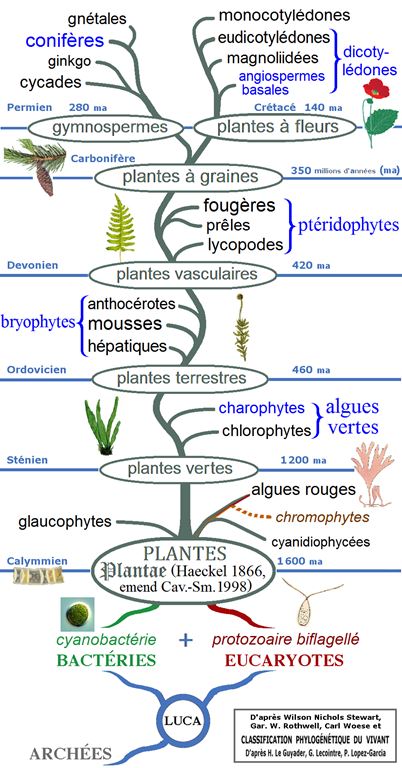
À droite, cet arbre phylogénétique des plantes montre les principaux clades et groupes traditionnels (monophylétiques en noir et paraphylétiques en bleu).
Dénominations
- Nom botanique : Mimusops kummel Bruce ex A.DC.
- Synonymes : Mimusops kilimandscharica Engl, Mimusops fragrans (Baker) Engl, Mimusops langenburgiana Engl, Mimusops pohlii Engl
- Noms anglais et locaux : Red milkwood
Description et culture
Tableau récapitulatif
Parties comes-tibles Note comest. (1-5) Note medic. (1-5) (Zones de) Rusticité Besoins en 
Besoins en  (1-3)
(1-3)Périodes de semis et récoltes Graines au gramme Durée de viabilité Profon-deur semis Espace-ment plants Espace-ment lignes Durée germi-native Durée avant récolte J F M A M J
J A S O N D
J F M A M J
J A S O N D
- dont infos de 0FPI ("FOOD PLANTS INTERNATIONAL", en anglais) :
Description :
Un arbre à feuilles persistantes. Il peut atteindre 35 m de haut. Le tronc peut mesurer 1 m de diamètre. La couronne de l'arbre est feuillue et ovale. L'écorce est gris foncé, rugueuse et profondément cannelée. Les petites branches ont des poils brun rouge. Les feuilles sont ovales et mesurent 10 cm de long. La pointe est émoussée. La nervure médiane sous la feuille est velue. La tige de la feuille mesure 15 mm de long. Les fleurs sont d'un blanc crème. Ils se présentent sous forme de 1 à 4 fleurs réunies à l'aisselle des feuilles. Ils sont sur des tiges de 2 à 5 cm de long. Les fleurs ont une odeur. Le fruit est charnu avec une pierre contenant un noyau. Il mesure 2 cm de diamètre. Le fruit est jaune orangé et pointu. Il contient une graine brun rouge{{{0(+x) (traduction automatique).
Original : An evergreen tree. It can grow to 35 m tall. The trunk can be 1 m across. The crown of the tree is leafy and oval. The bark is dark grey, rough and deeply grooved. The small branches have red brown hairs. The leaves are oval and 10 cm long. The tip is blunt. The midrib under the leaf is hairy. The leaf stalk is 15 mm long. The flowers are creamy white. They occur as 1-4 flowers together in the axils of the leaves. They are on stalks 2-5 cm long. The flowers have a smell. The fruit is fleshy with a stone containing a kernel. It is 2 cm across. The fruit is orange-yellow and pointed. It contains one red brown seed{{{0(+x).
Production :
En Tanzanie, les fruits mûrs sont disponibles d'octobre à décembre. Les fruits secs peuvent être conservés plusieurs mois{{{0(+x) (traduction automatique).
Original : In Tanzania ripe fruit are available from October to December. The dried fruit can be stored for several months{{{0(+x).
Culture :
Les plantes peuvent être cultivées à partir de graines. Il est préférable d'enlever l'enveloppe extérieure pour libérer la graine. Les plantes peuvent être taillées ou étêtées. Les graines germent après 18 à 45 jours{{{0(+x) (traduction automatique).
Original : Plants can be grown from seed. It is best to remove the outer coat to release the seed. Plants can be pruned or topped. Seeds germinate after 18-45 days{{{0(+x).
 Consommation (rapports de comestibilité, parties utilisables et usages alimentaires correspondants)
Consommation (rapports de comestibilité, parties utilisables et usages alimentaires correspondants)Parties comestibles :
fruits, écorce - thé, feuilles, graines{{{0(+x) (traduction automatique). Original : Fruit, Bark - tea, Leaves, Seeds{{{0(+x).Détails :
Le fruit mûr se mange cru. Les fruits non mûrs sont enterrés dans le sol jusqu'à ce qu'ils soient mûrs. L'écorce interne est utilisée pour le thé. Les jeunes feuilles sont cuites et consommées comme légume. Les graines sont grillées et mangées{{{0(+x) (traduction automatique).
Original : The ripe fruit is eaten raw. Unripe fruit are buried in the soil until ripe. The inner bark is used for tea. The young leaves are cooked and eaten as a vegetable. The seeds are roasted and eaten{{{0(+x).
Partie testée :
/ Risques et précautions à prendre
Risques et précautions à prendrenéant, inconnus ou indéterminés.
Autres infos
dont infos de 0FPI ("FOOD PLANTS INTERNATIONAL", en anglais) :
Statut :
Les fruits sont couramment consommés en Afrique de l'Est. Le fruit a tendance à dessécher la bouche{{{0(+x) (traduction automatique).
Original : The fruit are commonly eaten in East Africa. The fruit tends to dry out the mouth{{{0(+x).
Distribution :
Une plante tropicale. Il pousse près des rivières et dans les forêts sèches à feuilles persistantes en Afrique. Il préfère un climat sec. En Tanzanie, il pousse entre 500 et 2100 m au-dessus du niveau de la mer. Il se produit à travers le Sahara{{{0(+x) (traduction automatique).
Original : A tropical plant. It grows near rivers and in dry evergreen forest in Africa. It prefers a dry climate. In Tanzania it grows between 500-2,100 m above sea level. It occurs across the Sahara{{{0(+x).
Localisation :
Afrique, Bénin, Burkina Faso, Cameroun, Afrique centrale, République centrafricaine, RCA, Côte d'Ivoire, Afrique de l'Est, Érythrée, Éthiopie, Ghana, Côte d'Ivoire, Kenya, Malawi, Nigéria, Soudan, Tanzanie, Togo, Ouganda , Afrique de l'Ouest{{{0(+x) (traduction automatique).
Original : Africa, Benin, Burkina Faso, Cameroon, Central Africa, Central African Republic, CAR, Côte d'Ivoire, East Africa, Eritrea, Ethiopia, Ghana, Ivory Coast, Kenya, Malawi, Nigeria, Sudan, Tanzania, Togo, Uganda, West Africa{{{0(+x).
Notes :
Il existe 55 espèces de Mimusops{{{0(+x) (traduction automatique).
Original : There are 55 Mimusops species{{{0(+x).
Liens, sources et/ou références
Liens :
/ ;Sources et/ou références :
bibliographie (liste des sources et/ou références de l'encyclopédie)
dont classification : IPNI ("International Plant Names Index", en anglais) ; Kew (POWO - "Plant Of the World Online", "Royal Botanical Garden", en anglais) ;
dont livres et bases de données : 0FPI ("FOOD PLANTS INTERNATIONAL", en anglais) ;
dont bibliographie/références de 0FPI ("FOOD PLANTS INTERNATIONAL", en anglais) :
Addis, G., et al, 2005, Ethnobotanical Study of Edible Wild Plants in Some Selected Districts of Ethiopia. Human Ecology, Vol. 33, No. 1, pp. 83-118 ; Addis, G., Asfaw, Z & Woldu, Z., 2013, Ethnobotany of Wild and Semi-wild Edible Plants of Konso Ethnic Community, South Ethiopia. Ethnobotany Research and Applications. 11:121-141 ; Addis, G., et al, 2013, The Role of Wild and Semi-wild Edible Plants in Household Food Sovereignty in Hamer and Konso Communities, South Ethiopia. Ethnobotany Research & Applications. 11:251-271 ; Asfaw, Z. and Tadesse, M., 2001, Prospects for Sustainable Use and Development of Wild Food Plants in Ethiopia. Economic Botany, Vol. 55, No. 1, pp. 47-62 ; Atato, A., et al, 2010, Diversity of Edible Wild Fruit Tree Species of Togo. Global Science Books. ; Balemie, K., & Kebebew, F., 2006, Ethnobotanical study of wild edible plants in Derashe and Kucha Districts, South Ethiopia. Journal of Ethnobiology and Ethnomedicine. ; Bekele-Tesemma A., Birnie, A., & Tengnas, B., 1993, Useful Trees and Shrubs for Ethiopia. Regional Soil Conservation Unit. Technical Handbook No 5. p 314 ; Berihun, T. & Molla, E., 2017, Study on the Diversity and Use of Wild Edible Plants in Bullen District Northwest Ethiopia. Hindawi Journal of Botany. Article ID 8383468 ; Burkill, H. M., 1985, The useful plants of west tropical Africa, Vol. 5. Kew. ; Chapman, J. D. & Chapman, H. M., 2001, The Forest Flora of Taraba and Andamawa States, Nigeria. WWF & University of Canterbury. p 201 ; Glover et al, 1966b, ; Goode, P., 1989, Edible Plants of Uganda. FAO p 30 ; Grivetti, L. E., 1980, Agricultural development: present and potential role of edible wild plants. Part 2: Sub-Saharan Africa, Report to the Department of State Agency for International Development. p 45 ; Hedrick, U.P., 1919, (Ed.), Sturtevant's edible plants of the world. p 415 ; Jardin, C., 1970, List of Foods Used In Africa, FAO Nutrition Information Document Series No 2.p 148 ; Johns, T., and Kokwaro, J.O., 1991, Food Plants of the Luo of Siayo District, Kenya. Economic Botany 45(1), pp 103-113 ; Johns, T., Mhoro, E. B. and Sanaya, P., 1996, Food Plants and Masticants of the Batemi of Ngorongoro District, Tanzania. Economic Botany, Vol. 50, No. 1, pp. 115-121 ; Katende, A.B., Birnie, A & Tengnas B., 1995, Useful Trees and Shrubs for Uganda. Identification, Propagation and Management for Agricultural and Pastoral Communities. Technical handbook No 10. Regional Soil Conservation Unit, Nairobi, Kenya. p 426 ; Keay, R.W.J., 1989, Trees of Nigeria. Clarendon Press, Oxford. p 392 ; Kidane, B., et al, 2014, Ethnobotany of Wild and Semi-wild Edible Fruit Species used by Maale and Ari Ethnic Communities in South Ethiopia. Ethnobotany Research and Applications. Vol. 12, 1546-3465-12-455 ; Kokwaro, J. O. and Johns. T., Luo Biological Dictionary. p 66 ; Lemmens, R.H.M.J., 2005. Mimusops kummel Bruce ex A.DC. [Internet] Record from Protabase. Louppe, D., Oteng-Amoako, A.A. & Brink, M. (Editors). PROTA (Plant Resources of Tropical Africa), Wageningen, Netherlands. < http://database.prota.org/search.htm>. Accessed 19 October 2009. ; Lovett, J. C. et al, Field Guide to the Moist Forest Trees of Tanzania. p 164 ; Lulekal, E., et al, 2011, Wild edible plants in Ethiopia: a review on their potential to combat food insecurity. Afrika Focus - Vol. 24, No 2. pp 71-121 ; Maundu, P. et al, 1999, Traditional Food Plants of Kenya. National Museum of Kenya. 288p ; Mengistu, F. & Hager, H., 2008, Wild Edible Fruit Species Cultural Domain, Informant Species Competence and Preference in Three Districts of Amhara Region, Ethiopia. Ethnobotany Research & Applications 6:487-502 ; Peters, C. R., O'Brien, E. M., and Drummond, R.B., 1992, Edible Wild plants of Sub-saharan Africa. Kew. p 183 ; Ruffo, C. K., Birnie, A. & Tengnas, B., 2002, Edible Wild Plants of Tanzania. RELMA p 468 ; Seyoum, Y., et al, 2015, Edible Wild Fruit Trees and Shrubs and Their Socioeconomic Significance in Central Ethiopia. Ethnobotany Research & Applications. 14:183-197 ; Tebkew, M. et al, 2014, Underutilized wild edible plants in the Chilga District, northwestern Ethiopia: focus on wild woody plants. Agriculture & Food Security 3:12 ; Teklehaymanot, T., 2017, An ethnobotanical survey of medicinal and edible plants of Yalo Woreda in Afar regional state, Ethiopia. Journal of Ethnobiology and Ethnomedicine 13:40
Recherche de/pour :
- "Mimusops kummel" sur Google (pages et
images) ;
TPL ("The Plant List", en anglais) ;
GRIN ("Germplasm Resources Information Network", en anglais) ;
TROPICOS (en anglais) ;
Tela Botanica ;
Pl@ntNet ;
Pl@ntUse ;
"Plants For A Future" (en anglais) ;
"Useful Tropical Plants" (en anglais) ou
"Useful Temperate Plants" (en anglais) ;
- "Mimusops kummel" sur Google (pages et
images) ;
TPL ("The Plant List", en anglais) ;
GRIN ("Germplasm Resources Information Network", en anglais) ;
TROPICOS (en anglais) ;
Tela Botanica ;
Pl@ntNet ;
Pl@ntUse ;
"Plants For A Future" (en anglais) ;
"Useful Tropical Plants" (en anglais) ou
"Useful Temperate Plants" (en anglais) ;
Espèces du même genre (Mimusops)
23 taxons
- Mimusops andogensis
- Mimusops bagshawei S.Moore (Omuma)
- Mimusops balata Crueg. ex Griseb.
- Mimusops caffra E.Mey. ex A.DC.
- Mimusops coriacea (Mimusope coriace)
- Mimusops degan Chiov.
- Mimusops djave Engl.
- Mimusops elata Allemo ex Miq.
- Mimusops elengi L. (Cerisier espagnol)
- Mimusops laurifolia
- Mimusops lohindri Aubrv.
- Mimusops malabarica
- Mimusops maxima
- Mimusops monosperma
- Mimusops obovata Engl.
- Mimusops obtusifolia Lam.
- Mimusops parvifolia R.Br.
- Mimusops penduliflora Engl.
- Mimusops riparia Engl.
- Mimusops sieberii
- Mimusops somaliensis
- Mimusops zeyheri Sond.
Espèces de la même famille (Sapotaceae)
367 taxons
- Abiu
- Arganier
- Armadillo fruit
- Beurre d'Orère
- Caïmitier
- Caïmitier à fruit blanc
- Caïmitier africain
- Canistel
- Cerisier espagnol
- Fruit miracle
- Jacan
- Karité
- Lamut
- Lucuma
- Lucuma sauvage
- Makoré
- Mimusope coriace
- Munga
- Omuma
- Pomme noire
- Sapotier
- Sapotier vert
- Sapotillier
- Sapotillier kecik
- Satinleaf
- Argania spinosa (L.) Skeels (Arganier)
- Autranella congolensis
- Baillonella toxisperma Pierre (Beurre d'Orère)
- Beccariella brownlessiana
- Beccariella macrocarpa
- Beccariella papyracea
- Bumelia lanuginosa
- Bumelia lycioides
- Bumelia tenax
- Burckella banikiensis
- Burckella fijiensis
- Burckella macropoda
- Burckella majus
- Burckella obovata
- Burckella richii
- Burckella sorei P.Royen
- Burckella sp megahilum
- Burckella thurstonii
- Chromolucuma rubiflora
- Chrysophyllum africanum A.DC. (Caïmitier africain)
- Chrysophyllum albidum G.Don (Caïmitier à fruit blanc)
- Chrysophyllum amazonicum T.D.Penn.
- Chrysophyllum arenarium Allemo
- Chrysophyllum argenteum Jacq.
- Chrysophyllum bangweolense R.E.Fr. & Pellegr.
- Chrysophyllum boivinianum
- Chrysophyllum bombycinum T.D.Penn.
- Chrysophyllum brenesii Cronquist
- Chrysophyllum cainito L. (Caïmitier)
- Chrysophyllum cuneifolium
- Chrysophyllum eximium Ducke
- Chrysophyllum flexuosum Mart.
- Chrysophyllum giganteum A.Chev.
- Chrysophyllum gonocarpum
- Chrysophyllum gorungosanum Engl.
- Chrysophyllum imperiale
- Chrysophyllum inornatum Mart.
- Chrysophyllum lacourtianum De Wild.
- Chrysophyllum lucentifolium Cronquist
- Chrysophyllum macoucou Aubl.
- Chrysophyllum manaosense
- Chrysophyllum marginatum
- Chrysophyllum mexicanum Brandegee
- Chrysophyllum michino H. B. & Kunth
- Chrysophyllum obovatum Sabine & G.Don
- Chrysophyllum oliviforme L. (Satinleaf)
- Chrysophyllum ovale Rusby
- Chrysophyllum paranaense T.D.Penn.
- Chrysophyllum perpulchrum Mildbr. ex Hutch. & Dalziel
- Chrysophyllum pomiferum
- ...







 donne accès au menu
  - encyclopédies des plantes alimentaires ;
 - page de recherche - reconnaissance (identification) de plantes ;
 - page du calendrier lunaire et son générateur (au format PDF et JPG) ;
 - tableau récapitulatif ;
 - générateur de potées (soupes), avec estimation des apports nutrionnels et du coût;
 - générateur de codes QR ;
 - page des archives avec de nombreux documents sur différents thèmes complémentaires comme la botanique, les légumes,
les champignons, la cuisine, le bien-être ainsi que différents MOOC mais également des liens vers les archives de l'association ;
- page des archives avec de nombreux documents sur différents thèmes complémentaires comme la botanique, les légumes,
les champignons, la cuisine, le bien-être ainsi que différents MOOC mais également des liens vers les archives de l'association ;

 ou
ou
 permettant de passer du format standard à l'AMP (et vice-versa), lequel est simplifié et donc plus rapide.
 pour le fruit (et/ou les graines, la pulpe, etc...),
 pour les fleurs (et/ou pétales, calice...),
 pour les feuilles (et/ou la tige, les pousses...),
 pour les racines,
 pour le tronc (et/ou l'écorce, la sève...), et enfin
 pour les champignons,
puis les notes alimentaires et médicinales (de 1 à 5 étoiles), la rusticité (résistance au froid/gel)
et pour finir un résumé.
pour les champignons,
puis les notes alimentaires et médicinales (de 1 à 5 étoiles), la rusticité (résistance au froid/gel)
et pour finir un résumé. menant ici 🙂
 ,
,  et
et





 ,
,


 Encyclopédie(s)
 Recherche-Reconnaissance
 Tableau récapitulatif
 Codes QR
 Archives
 Calendrier(s) lunaire(s)
  Potées
 Re-naturation/naturalisation
 Affichettes, herbiers &
co.
Affichettes, herbiers &
co. menu
menu galerie