Ficus platyphylla
Pas d'illustration
pour le moment 😕

Une figue. C'est un grand arbre. Il atteint 15-20 m de haut. Il perd ses feuilles au cours de l'année. Il commence souvent par devenir attaché à d'autres arbres. L'écorce ... (traduction automatique)
→suite


Affich., herbiers & co.
Ficus platyphylla

Une figue. C'est un grand arbre. Il atteint 15-20 m de haut. Il perd ses feuilles au cours de l'année. Il commence souvent par devenir attaché à d'autres arbres. L'écorce est brune ou grise. Il a souve... (traduction automatique) →suite
Pas d'illustration
pour le moment 😕
Pas d'illustration
pour le moment 😕
Classification
- Classique : en haut de l'écran, sous le coeur.
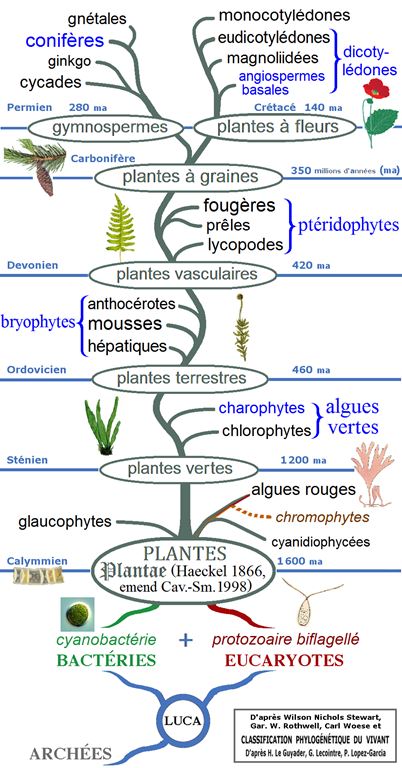
- Phylogénétique :
- Clade 4 : Angiospermes ;
- Clade 3 : Dicotylédones_vraies ;
- Clade 2 : Rosidées ;
- Clade 1 : Fabidées ;
- Ordre APN : Rosales ;
- Famille APN : Moraceae ;
À droite, cet arbre phylogénétique des plantes montre les principaux clades et groupes traditionnels (monophylétiques en noir et paraphylétiques en bleu).
Dénominations
- Nom botanique : Ficus platyphylla Delile
- Synonymes : Ficus umbrosa Warb, Ficus bibracteata Warb
- Noms anglais et locaux : Gutta perch tree
Description et culture
Tableau récapitulatif
Parties comes-tibles Note comest. (1-5) Note medic. (1-5) (Zones de) Rusticité Besoins en 
Besoins en  (1-3)
(1-3)Périodes de semis et récoltes Graines au gramme Durée de viabilité Profon-deur semis Espace-ment plants Espace-ment lignes Durée germi-native Durée avant récolte J F M A M J
J A S O N D
J F M A M J
J A S O N D
- dont infos de 0FPI ("FOOD PLANTS INTERNATIONAL", en anglais) :
Description :
Une figue. C'est un grand arbre. Il atteint 15-20 m de haut. Il perd ses feuilles au cours de l'année. Il commence souvent par devenir attaché à d'autres arbres. L'écorce est brune ou grise. Il a souvent de nombreuses racines superficielles. Les petites branches ont 1 à 2 cm d'épaisseur et sont blanches ou velues. La surface est squameuse quand ils sont secs et elle présente de grandes cicatrices foliaires. Les feuilles sont vert foncé et ovales. Ils sont grands et rigides. Ils peuvent mesurer 15 à 26 cm de long et 10 à 20 cm de diamètre. Le bord de la feuille est ondulé et la pointe peut être émoussée ou pointue. La base de la feuille est en forme de cœur. Il y a 9-11 (10-16) paires de veines latérales. La tige de la feuille mesure 4 à 10 cm de long. Les fruits sont des figues qui se produisent en grappes ou 2-5. Ils sont vers la pointe des petites branches. Ils sont sur des tiges de 1 à 2,5 cm de long et sous les feuilles. Les figues mesurent 1 à 2 cm de diamètre. Ils sont rouges (verts). Les figues sont comestibles{{{0(+x) (traduction automatique).
Original : A fig. It is a large tree. It grows up to 15-20 m tall. It loses its leaves during the year. It often starts by growing attached to others trees. The bark is brown or grey. It often has many surface roots. The small branches are 1-2 cm thick and white or hairy. The surface is flaky when they are dry and it has large leaf scars. The leaves are dark green and oval. They are large and stiff. They can be 15-26 cm long and 10-20 cm across. The edge of the leaf is wavy and the tip can be blunt or pointed. The base of the leaf is heart shaped. There are 9-11 (10-16) pairs of side veins. The leaf stalk is 4-10 cm long. The fruit are figs which occur in clusters or 2-5. They are towards the tip of the small branches. They are on stalks 1-2.5 cm long and below the leaves. The figs are 1-2 cm across. They are red (green). The figs are edible{{{0(+x).
Culture :
Les plantes poussent naturellement à partir de graines. Les plantes peuvent également être cultivées à partir de boutures. La graine doit être extraite des figues et séchée pour la plantation. Les graines peuvent être conservées pendant 2 mois{{{0(+x) (traduction automatique).
Original : Plants grow naturally from seed. Plants can also be grown from cuttings. The seed should be extracted from the figs and dried for planting. Seed can be stored fro 2 months{{{0(+x).
 Consommation (rapports de comestibilité, parties utilisables et usages alimentaires correspondants)
Consommation (rapports de comestibilité, parties utilisables et usages alimentaires correspondants)Fruit brut/cru{{{0(+x).
Partie testée :
fruits crus{{{0(+x) (traduction automatique). Original : Fruit raw{{{0(+x)| Taux d'humidité (%) | Énergie (kj) | Énergie (kcal) | Protéines (g) |
|---|---|---|---|
| 83 | 234 | 56 | 1.9 |
| Pro- vitamines A (µg) |
Vitamines C (mg) | Fer (mg) | Zinc (mg) |
| 0 | 0 | 4.0 | 0 |
 Risques et précautions à prendre
Risques et précautions à prendrenéant, inconnus ou indéterminés.
Autres infos
dont infos de 0FPI ("FOOD PLANTS INTERNATIONAL", en anglais) :
Statut :
Les fruits sont généralement consommés comme aliment de famine{{{0(+x) (traduction automatique).
Original : The fruit are usually eaten as a famine food{{{0(+x).
Distribution :
Une plante tropicale. Il pousse dans la savane sèche et les prairies boisées. Il pousse au Sahel. Il pousse entre 950 et 1200 m d'altitude. Il pousse dans les zones avec une pluviométrie annuelle comprise entre 600 et 1 300 mm. Il peut pousser dans des endroits arides{{{0(+x) (traduction automatique).
Original : A tropical plant. It grows in dry savannah and wooded grassland. It grows in the Sahel. It grows between 950-1,200 m above sea level. It grows in areas with an annual rainfall between 600-1,300 mm. It can grow in arid places{{{0(+x).
Localisation :
Africa, Burkina Faso, Cameroon, Central Africa, Côte d'Ivoire, East Africa, Egypt, Ethiopia, Gambia, Ghana, Guinea, Guinée, Guinea-Bissau, Ivory Coast, Mali, Mozambique, Niger, Nigeria, North Africa, Sahel, Senegal, Somalia, Southern Africa, South Sudan, Sudan, Uganda, West Africa, Zimbabwe{{{0(+x) (traduction automatique).
Original : Africa, Burkina Faso, Cameroon, Central Africa, Côte d'Ivoire, East Africa, Egypt, Ethiopia, Gambia, Ghana, Guinea, Guinée, Guinea-Bissau, Ivory Coast, Mali, Mozambique, Niger, Nigeria, North Africa, Sahel, Senegal, Somalia, Southern Africa, South Sudan, Sudan, Uganda, West Africa, Zimbabwe{{{0(+x).
Notes :
Il existe environ 800-1000 espèces de Ficus. Ils sont principalement sous les tropiques. Il existe 120 espèces de Ficus en Amérique tropicale{{{0(+x) (traduction automatique).
Original : There are about 800-1000 Ficus species. They are mostly in the tropics. There are 120 Ficus species in tropical America{{{0(+x).
Liens, sources et/ou références
Liens :
/ ;Sources et/ou références :
bibliographie (liste des sources et/ou références de l'encyclopédie)
dont classification : IPNI ("International Plant Names Index", en anglais) ; Kew (POWO - "Plant Of the World Online", "Royal Botanical Garden", en anglais) ;
dont livres et bases de données : 0FPI ("FOOD PLANTS INTERNATIONAL", en anglais) ;
dont bibliographie/références de 0FPI ("FOOD PLANTS INTERNATIONAL", en anglais) :
Abbiw, D.K., 1990, Useful Plants of Ghana. West African uses of wild and cultivated plants. Intermediate Technology Publications and the Royal Botanic Gardens, Kew. p 47 ; Abdel-Hameed, E. S., 2009, Total phenolic contents and free radical scavenging activity of certain Egyptian Ficus species leaf samples. Food Chemistry 114: 1271-1277 ; Addis, G., Asfaw, Z & Woldu, Z., 2013, Ethnobotany of Wild and Semi-wild Edible Plants of Konso Ethnic Community, South Ethiopia. Ethnobotany Research and Applications. 11:121-141 ; Addis, G., et al, 2013, The Role of Wild and Semi-wild Edible Plants in Household Food Sovereignty in Hamer and Konso Communities, South Ethiopia. Ethnobotany Research & Applications. 11:251-271 ; Burkill, H. M., 1985, The useful plants of west tropical Africa, Vol. 4. Kew. ; Centurie de plantes d'Afrique 62. 1826 (F. Cailliaud, Voy. Meroe; 4:355. 1827) ; Dalziel, J. M., 1937, The Useful plants of west tropical Africa. Crown Agents for the Colonies London. ; FAO, 1988, Traditional Food Plants, FAO Food and Nutrition Paper 42. FAO Rome p 283 ; Food Composition Tables for use in Africa FAO http://www.fao.org/infoods/directory No. 915 ; Gallagher, D. E., 2010, Farming beyond the escarpment: Society, Environment, and Mobility in Precolonial Southeastern Burkina Faso. PhD University of Michigan. ; Gilbert, T., et al, 2017, Diversity and local transformation of indigenous edible fruits in sahelian domain of Cameroon. Journal of Animal & Plant Sciences Vol. 26 (2): 5289-5300 ; Harris, F. M. A. and Salisu Mohammed, 2003, Relying on nature: Wild Foods in Northern Nigeria. AMBIO Vol. 32 No. 1, p 27 ; Jardin, C., 1970, List of Foods Used In Africa, FAO Nutrition Information Document Series No 2.p 137 ; Katende, A.B., Birnie, A & Tengnas B., 1995, Useful Trees and Shrubs for Uganda. Identification, Propagation and Management for Agricultural and Pastoral Communities. Technical handbook No 10. Regional Soil Conservation Unit, Nairobi, Kenya. p 320 ; Kidane, B., et al, 2014, Ethnobotany of Wild and Semi-wild Edible Fruit Species used by Maale and Ari Ethnic Communities in South Ethiopia. Ethnobotany Research and Applications. Vol. 12, 1546-3465-12-455 ; Le Houerou, H. N., (Ed.), 1980, Browse in Africa. The current state of knowledge. International Livestock Centre for Africa, Ethiopia. p 163 ; Lulekal, E., et al, 2011, Wild edible plants in Ethiopia: a review on their potential to combat food insecurity. Afrika Focus - Vol. 24, No 2. pp 71-121 ; Maydell, H. von, 1990, Trees and shrubs of the Sahel: their characteristics and uses. Margraf. p 279 ; MORTIMORE, ; Ocho, D. L., et al, 2012, Assessing the levels of food shortage using the traffic light metaphor by analyzing the gathering and consumption of wild food plants, crop parts and crop residues in Konso, Ethiopia. Journal of Ethnobiology and Ethnomedicine 8:30 ; Ojelel, S. & Kakudidi, E. K., 2015, Wild edible plant species utilized by a subsistence farming community in the Obalanga sub-county, Amuria district, Uganda. Journal of Ethnobiology and Ethnomedicine. 11:7 ; Ojelel, S., et al, 2019, Wild edible plants used by communities in and around selected forest reserves of Teso-Karamoja region, Uganda. Journal of Ethnobiology and Ethnomedicine (2019) 15:3 ; Peters, C. R., O'Brien, E. M., and Drummond, R.B., 1992, Edible Wild plants of Sub-saharan Africa. Kew. p 150 ; Royal Botanic Gardens, Kew (1999). Survey of Economic Plants for Arid and Semi-Arid Lands (SEPASAL) database. Published on the Internet; http://www.rbgkew.org.uk/ceb/sepasal/internet [Accessed 4th May 2011] ; Unwin, A. H., 1920, West African Forests and Forestry. Fisher Unwin Ltd. pdf on Internet p 107 ; Vivien, J., & Faure, J.J., 1996, Fruitiers Sauvages d'Afrique. Especes du Cameroun. CTA p 215 ; www.figweb.org
Recherche de/pour :
- "Ficus platyphylla" sur Google (pages et
images) ;
TPL ("The Plant List", en anglais) ;
GRIN ("Germplasm Resources Information Network", en anglais) ;
TROPICOS (en anglais) ;
Tela Botanica ;
Pl@ntNet ;
Pl@ntUse ;
"Plants For A Future" (en anglais) ;
"Useful Tropical Plants" (en anglais) ou
"Useful Temperate Plants" (en anglais) ;
- "Ficus platyphylla" sur Google (pages et
images) ;
TPL ("The Plant List", en anglais) ;
GRIN ("Germplasm Resources Information Network", en anglais) ;
TROPICOS (en anglais) ;
Tela Botanica ;
Pl@ntNet ;
Pl@ntUse ;
"Plants For A Future" (en anglais) ;
"Useful Tropical Plants" (en anglais) ou
"Useful Temperate Plants" (en anglais) ;
Espèces du même genre (Ficus)
242 taxons
- Figuier
- Figuier à caoutchouc
- Figuier à petites feuilles
- Figuier de la baie de moreton
- Figuier de Maurice
- Figuier du Bengale
- Figuier religieux
- Figuier sycomore
- Ficus abelii Miq.
- Ficus abutilifolia (Miq.) Miq.
- Ficus aculeata A.Cunn. ex Miq.
- Ficus adenosperma Miq.
- Ficus adhatodifolia Schott
- Ficus albipila (Miq.) King
- Ficus altissima Blume
- Ficus amadiensis De Wild.
- Ficus amazonica (Miq.) Andr
- Ficus americana Sess & Moc.
- Ficus ampelas
- Ficus amplissima Sm.
- Ficus annulata Blume
- Ficus arbuscula K.Schum. & Lauterb.
- Ficus arfakensis King
- Ficus arnottiana (Miq.) Miq.
- Ficus artocarpoides Warb.
- Ficus aspera G.Forst.
- Ficus asperifolia Miq.
- Ficus asperiuscula Kunth & C.D.Bouch
- Ficus atricha D.J.Dixon
- Ficus aurea Nutt.
- Ficus auriculata Lour.
- Ficus austrocaledonica Bureau
- Ficus awkeotsang Makino
- Ficus bakeri Elmer
- Ficus bambusifolia Seem.
- Ficus barclayana (Miq.) Miq.
- Ficus barraui Guillaumin
- Ficus barteri Sprague
- Ficus beecheyana Hook. & Arn.
- Ficus benghalensis L. (Figuier du Bengale)
- Ficus benjamina L.
- Ficus botryocarpa Miq.
- Ficus brachypoda Hutch.
- Ficus bubu Warb.
- Ficus burkei
- Ficus burtt-davyi Hutch.
- Ficus bussei Warb. ex Mildbr. & Burret
- Ficus caballina Standl.
- Ficus callosa Willd.
- Ficus calopilina Diels
- Ficus capreifolia Delile
- Ficus carica L. (Figuier)
- Ficus caulocarpa Miq.
- Ficus cereicarpa Corner
- Ficus cestrifolia Schott
- Ficus chartacea (Wall. ex Kurz) Wall. ex King
- Ficus chlorocarpa Miq.
- Ficus chrysocarpa Reinw. ex Blume
- ...
Espèces de la même famille (Moraceae)
414 taxons
- Amourette69
- Angily
- Arbre à lait
- Arbre à pain
- Benda
- Butong
- Cempedak
- Chaplaish
- Châtaigner pays
- Cudrane
- Entawak
- Fatoue velue
- Figuier
- Figuier à caoutchouc
- Figuier à petites feuilles
- Figuier de la baie de moreton
- Figuier de Maurice
- Figuier du Bengale
- Figuier religieux
- Figuier sycomore
- Jacquier
- Jacquier rigide
- Keledang
- Kwai muk
- Lakoocha
- Malawari
- Mama-cadela
- Marang
- Mûrier à papier
- Mûrier blanc
- Murier du pakistan
- Murier noir
- Mûrier rouge
- Mûrier-platane
- Noix-pain
- Oranger des Osages
- Pedalai
- Pingan
- Pudau
- Acanthosphaera ulei Warb.
- Antiaris toxicaria (J.F.Gmel.) Lesch.
- Artocarpus altilis (Parkinson ex F.A.Zorn) Fosberg (Arbre à pain)
- Artocarpus altilis x Artocarpus mariannensis
- Artocarpus altissimus (Miq.) J.J.Sm.
- Artocarpus anisophyllus Miq. (Entawak)
- Artocarpus asperula
- Artocarpus blancoi (Elmer) Merr.
- Artocarpus camansi Blanco (Châtaigner pays)
- Artocarpus chama Buch.-Ham.
- Artocarpus chaplasha Roxb. (Chaplaish)
- Artocarpus dadah Miq.
- Artocarpus elasticus Reinw. ex Blume (Benda)
- Artocarpus fretissii
- Artocarpus fulvicortex F.M.Jarrett
- Artocarpus glaucus Blume
- Artocarpus gomezianus Wall. ex Trcul
- Artocarpus heterophyllus Lam. (Jacquier)
- Artocarpus heterophyllus x
- Artocarpus hirsutus Lam. (Angily)
- Artocarpus hypargyreus Hance ex Benth. (Kwai muk)
- Artocarpus integer (Thunb.) Merr. (Cempedak)
- Artocarpus kemando Miq. (Pudau)
- Artocarpus lacucha Buch.-Ham. (Lakoocha)
- Artocarpus lanceifolius Roxb. (Keledang)
- Artocarpus lowii King
- Artocarpus maingayi King
- Artocarpus mariannensis Trcul
- Artocarpus melinoxylus Gagnep.
- Artocarpus nitidus Trécul (Butong)
- Artocarpus nobilis Thwaites
- Artocarpus obtusus F.M.Jarrett
- Artocarpus odoratissimus Blanco (Marang)
- Artocarpus ovatus Blanco
- Artocarpus petelotii Gagnep.
- Artocarpus reticulatus B.Heyne ex Wall.
- Artocarpus rigidus Blume (Jacquier rigide)
- Artocarpus sarawakensis F.M.Jarrett (Pingan)
- Artocarpus scortechinii King
- Artocarpus sepicanus Diels
- Artocarpus sericicarpus F.M.Jarrett (Pedalai)
- Artocarpus styracifolius Pierre
- Artocarpus tamaran Becc.
- Artocarpus tomentosulus F.M.Jarrett
- Artocarpus tonkinensis A.Chev. ex Gagnep.
- Artocarpus vriesianus
- Artocarpus x sp
- Artocarpus xanthocarpus Merr.
- Bagassa guianensis Aubl.
- Batocarpus amazonicus
- ...







 donne accès au menu
  - encyclopédies des plantes alimentaires ;
 - page de recherche - reconnaissance (identification) de plantes ;
 - page du calendrier lunaire et son générateur (au format PDF et JPG) ;
 - tableau récapitulatif ;
 - générateur de potées (soupes), avec estimation des apports nutrionnels et du coût;
 - générateur de codes QR ;
 - page des archives avec de nombreux documents sur différents thèmes complémentaires comme la botanique, les légumes,
les champignons, la cuisine, le bien-être ainsi que différents MOOC mais également des liens vers les archives de l'association ;
- page des archives avec de nombreux documents sur différents thèmes complémentaires comme la botanique, les légumes,
les champignons, la cuisine, le bien-être ainsi que différents MOOC mais également des liens vers les archives de l'association ;

 ou
ou
 permettant de passer du format standard à l'AMP (et vice-versa), lequel est simplifié et donc plus rapide.
 pour le fruit (et/ou les graines, la pulpe, etc...),
 pour les fleurs (et/ou pétales, calice...),
 pour les feuilles (et/ou la tige, les pousses...),
 pour les racines,
 pour le tronc (et/ou l'écorce, la sève...), et enfin
 pour les champignons,
puis les notes alimentaires et médicinales (de 1 à 5 étoiles), la rusticité (résistance au froid/gel)
et pour finir un résumé.
pour les champignons,
puis les notes alimentaires et médicinales (de 1 à 5 étoiles), la rusticité (résistance au froid/gel)
et pour finir un résumé. menant ici 🙂
 ,
,  et
et





 ,
,


 Encyclopédie(s)
 Recherche-Reconnaissance
 Tableau récapitulatif
 Codes QR
 Archives
 Calendrier(s) lunaire(s)
  Potées
 Re-naturation/naturalisation
 Affichettes, herbiers &
co.
Affichettes, herbiers &
co. menu
menu galerie