Sida à feuilles cordées
(Sida cordifolia)
Pas d'illustration
pour le moment 😕

Un arbuste ligneux dressé d'environ 0,4 à 1 m de haut. Il continue de croître d'année en année. Il est couvert de poils courts mélangés à de longs poils. Ceux-ci rende ... (traduction automatique)
→suite


Affich., herbiers & co.
Sida à feuilles cordées

Un arbuste ligneux dressé d'environ 0,4 à 1 m de haut. Il continue de croître d'année en année. Il est couvert de poils courts mélangés à de longs poils. Ceux-ci rendent la plante douce. La tige de... (traduction automatique) →suite
Pas d'illustration
pour le moment 😕
Pas d'illustration
pour le moment 😕
Sida cordifolia
Classification
- Classique : en haut de l'écran, sous le coeur.
- Phylogénétique :
- Clade 4 : Angiospermes ;
- Clade 3 : Dicotylédones_vraies ;
- Clade 2 : Rosidées ;
- Clade 1 : Malvidées ;
- Ordre APN : Malvales ;
- Famille APN : Malvaceae ;
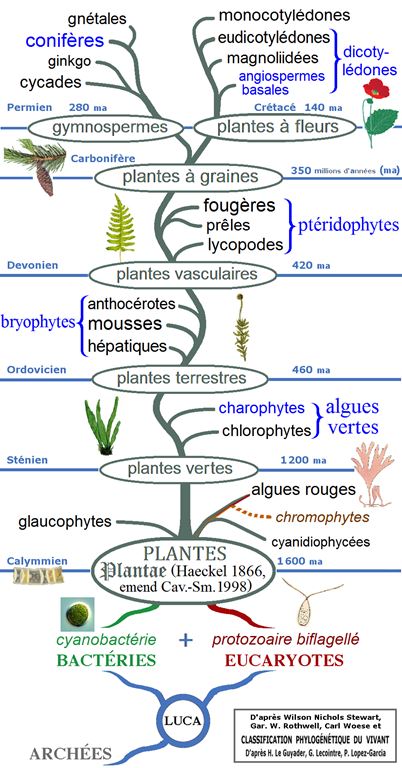
À droite, cet arbre phylogénétique des plantes montre les principaux clades et groupes traditionnels (monophylétiques en noir et paraphylétiques en bleu).
Dénominations
- Nom botanique : Sida cordifolia Forssk.
- Synonymes : Sida herbacea Cay, Sida holosericea Wind. ex Sprengel
- Noms anglais et locaux : Goat's horns, Flannel weed, Heart-leaf sida
Description et culture
Tableau récapitulatif
Parties comes-tibles Note comest. (1-5) Note medic. (1-5) (Zones de) Rusticité Besoins en 
Besoins en  (1-3)
(1-3)Périodes de semis et récoltes Graines au gramme Durée de viabilité Profon-deur semis Espace-ment plants Espace-ment lignes Durée germi-native Durée avant récolte J F M A M J
J A S O N D
J F M A M J
J A S O N D
- dont infos de 0FPI ("FOOD PLANTS INTERNATIONAL", en anglais) :
Description :
Un arbuste ligneux dressé d'environ 0,4 à 1 m de haut. Il continue de croître d'année en année. Il est couvert de poils courts mélangés à de longs poils. Ceux-ci rendent la plante douce. La tige de la feuille mesure 1 à 2,5 cm de long. Les feuilles sont l'une après l'autre et en forme de cœur à la base. Ils sont dentés sur le bord et mesurent 1,5 à 4,5 cm de long. Les fleurs sont jaunes et se produisent à l'aisselle des feuilles. Les fruits mesurent environ 6 à 8 mm de diamètre. Ils ont 20 poils fins sur le dessus{{{0(+x) (traduction automatique).
Original : An erect woody shrub about 0.4 to 1 m high. It keeps growing from year to year. It is covered with short hairs mixed with long hairs. These make the plant feel soft. The leaf stalk is 1-2.5 cm long. The leaves are one after the other and heart shaped at the base. They are toothed at the edge and 1.5 to 4.5 cm long. The flowers are yellow and occur in the axils of the leaves. The fruit are about 6-8 mm across. They have 20 fine bristles on the top{{{0(+x).
 Consommation (rapports de comestibilité, parties utilisables et usages alimentaires correspondants)
Consommation (rapports de comestibilité, parties utilisables et usages alimentaires correspondants)Parties comestibles :
feuilles, fleurs{{{0(+x) (traduction automatique). Original : Leaves, Flowers{{{0(+x).Détails :
Les feuilles sont comestibles cuites. Ils sont cuits avec une solution alcaline et du poisson séché et mangés au curry{{{0(+x) (traduction automatique).
Original : The leaves are edible cooked. They are cooked with alkali solution and dried fish and eaten in curry{{{0(+x).
Partie testée :
feuilles{{{0(+x) (traduction automatique). Original : Leaves{{{0(+x)| Taux d'humidité (%) | Énergie (kj) | Énergie (kcal) | Protéines (g) |
|---|---|---|---|
| 6.6 | 1296 | 310 | 24.2 |
| Pro- vitamines A (µg) |
Vitamines C (mg) | Fer (mg) | Zinc (mg) |
| 0 | 0 | 79.8 | 0 |
 Risques et précautions à prendre
Risques et précautions à prendrenéant, inconnus ou indéterminés.
Autres infos
dont infos de 0FPI ("FOOD PLANTS INTERNATIONAL", en anglais) :
Distribution :
Une plante tropicale. Ils se produisent dans des décharges ouvertes et sont communs et largement répandus aux Philippines. Il se produit dans les tropiques et les régions subtropicales. Il pousse sur le Deccan en Inde. Il pousse dans des endroits chauds et arides avec une saison sèche marquée. Il pousse dans les endroits où les précipitations annuelles sont inférieures à 520 mm. Il pousse dans les sols sableux secs. Il peut pousser dans les sols salés. Il pousse en dessous de 1100 m au-dessus du niveau de la mer. Il peut tolérer l'ombre. Il pousse dans la savane boisée et la savane herbeuse humide. Il peut pousser dans des endroits arides. Au Sichuan et au Yunnan{{{0(+x) (traduction automatique).
Original : A tropical plant. They occur in open waste places and are common and widely distributed in the Philippines. It occurs in the tropics and subtropics. It grows on the Deccan in India. It grows in hot arid places with a marked dry season. It grows in places with an annual rainfall below 520 mm. It grows in dry sandy soils. It can grow in salty soils. It grows below 1,100 m above sea level. It can tolerate shade. It grows in savannah woodland and wet grass savannah. It can grow in arid places. In Sichuan and Yunnan{{{0(+x).
Localisation :
Afrique, Angola, Argentine, Asie, Australie, Bangladesh, Bénin, Bhoutan, Bolivie, Botswana, Brésil, Burkina Faso, Burundi, Cameroun, Afrique centrale, République centrafricaine, RCA, Amérique centrale, Tchad, Chine, Colombie, Congo, CÃ ´te d'Ivoire, Cuba, Dominique, République dominicaine, Afrique de l'Est, Equateur, Eswatini, Guyane française, Ghana, Guyanes, Guinée, Guinée, Guinée-Bissau, Guyane, Haïti, Hawaï, Himalaya, Honduras, Inde, Indochine , Indonésie, Côte d'Ivoire, Jamaïque, Kenya, Laos, Libéria, Madagascar, Malawi, Malaisie, Mali, Martinique, Maurice, Mozambique, Myanmar, Namibie, Népal, Nouvelle-Calédonie, Niger, Nigéria, Nord-est de l'Inde, Pacifique, Pakistan, Papouasie Nouvelle Afrique du Sud, Guinée, PNG, Paraguay, Pérou, Philippines, Porto Rico, Réunion, Rwanda, Sao Tomé-et-Principe, Asie du Sud-Est, Sénégal, Seychelles, Sierra Leone, Socotra, Somalie, Afrique du Sud,Amérique du Sud, Sri Lanka, Soudan, Suriname, Swaziland, Taiwan, Tanzanie, Thaïlande, Togo, Tonga, Trinité-et-Tobago, Ouganda, Uruguay, USA, Venezuela, Vietnam, Afrique de l'Ouest, Antilles, Yémen, Zambie, Zimbabwe{{{0(+x) (traduction automatique).
Original : Africa, Angola, Argentina, Asia, Australia, Bangladesh, Benin, Bhutan, Bolivia, Botswana, Brazil, Burkina Faso, Burundi, Cameroon, Central Africa, Central African Republic, CAR, Central America, Chad, China, Colombia, Congo, Côte d'Ivoire, Cuba, Dominica, Dominican Republic, East Africa, Ecuador, Eswatini, French Guiana, Ghana, Guianas, Guinea, Guinée, Guinea-Bissau, Guyana, Haiti, Hawaii, Himalayas, Honduras, India, Indochina, Indonesia, Ivory Coast, Jamaica, Kenya, Laos, Liberia, Madagascar, Malawi, Malaysia, Mali, Martinique, Mauritius, Mozambique, Myanmar, Namibia, Nepal, New Caledonia, Niger, Nigeria, Northeastern India, Pacific, Pakistan, Papua New Guinea, PNG, Paraguay, Peru, Philippines, Puerto Rico, Reunion, Rwanda, Sao Tome and Principe, SE Asia, Senegal, Seychelles, Sierra Leone, Socotra, Somalia, South Africa, Southern Africa, South America, Sri Lanka, Sudan, Suriname, Swaziland, Taiwan, Tanzania, Thailand, Togo, Tonga, Trinidad & Tobago, Uganda, Uruguay, USA, Venezuela, Vietnam, West Africa, West Indies, Yemen, Zambia, Zimbabwe{{{0(+x).
Notes :
Il existe environ 100 espèces Sida. Il contient de l'éphédrine et est utilisé en médecine{{{0(+x) (traduction automatique).
Original : There are about 100 Sida species. It contains ephedrine and is used in medicine{{{0(+x).
Liens, sources et/ou références
Liens :
/ ;Sources et/ou références :
bibliographie (liste des sources et/ou références de l'encyclopédie)
dont classification : IPNI ("International Plant Names Index", en anglais) ; Kew (POWO - "Plant Of the World Online", "Royal Botanical Garden", en anglais) ;
dont livres et bases de données : 0FPI ("FOOD PLANTS INTERNATIONAL", en anglais) ;
dont bibliographie/références de 0FPI ("FOOD PLANTS INTERNATIONAL", en anglais) :
Ambasta, S.P. (Ed.), 2000, The Useful Plants of India. CSIR India. p 573 ; Ara, R. I. T., 2015, Leafy Vegetables in Bangladesh. Photon eBooks. p 107 ; Borrell, O.W., 1989, An Annotated Checklist of the Flora of Kairiru Island, New Guinea. Marcellin College, Victoria Australia. p 97 ; Burkill, I.H., 1966, A Dictionary of the Economic Products of the Malay Peninsula. Ministry of Agriculture and Cooperatives, Kuala Lumpur, Malaysia. Vol 2 (I-Z) p 2060 ; Cooper, W. and Cooper, W., 2004, Fruits of the Australian Tropical Rainforest. Nokomis Editions, Victoria, Australia. p 280 ; Ethnobotany of Karbis. Chapter 4 in p 101 ; Fowler, D. G., 2007, Zambian Plants: Their Vernacular Names and Uses. Kew. p 46 ; Goode, P., 1989, Edible Plants of Uganda. FAO p 36 ; Henty, E.E., & Pritchard, G.S., 1973, Weeds of New Guinea and their control. Botany Bulletin No 7, Division of Botany, Lae, PNG. p 125 ; Kenneally, K.E., Edinger, D. C., and Willing T., 1996, Broome and Beyond, Plants and People of the Dampier Peninsula, Kimberley, Western Australia. Department of Conservation and Land Management. p 124 ; Lamp, C & Collet F., 1989, Field Guide to Weeds in Australia. Inkata Press. p 266 ; Lazarides, M. & Hince, B., 1993, Handbook of Economic Plants of Australia, CSIRO. p 218 ; Monsalud, M.R., Tongacan, A.L., Lopez, F.R., & Lagrimas, M.Q., 1966, Edible Wild Plants in Philippine Forests. Philippine Journal of Science. p 491 ; Paczkowska, G. & Chapman, A.R., 2000, The Western Australian Flora. A Descriptive Catalogue. Western Australian Herbarium. p 292 ; Pham-Hoang Ho, 1999, An Illustrated Flora of Vietnam. Nha Xuat Ban Tre. p 518 ; Pickering, H., & Roe, E., 2009, Wild Flowers of the Victoria Falls Area. Helen Pickering, London. p 82 ; Plants of Haiti Smithsonian Institute http://botany.si.edu/antilles/West Indies ; Roodt, V., 1998, Common Wild Flowers of the Okavango Delta. Medicinal Uses and Nutritional value. The Shell Field Guide Series: Part 2. Shell Botswana. p 117 ; Royal Botanic Gardens, Kew (1999). Survey of Economic Plants for Arid and Semi-Arid Lands (SEPASAL) database. Published on the Internet; http://www.rbgkew.org.uk/ceb/sepasal/internet [Accessed 3rd May 2011] ; Sp. pl. 2:684. 1753 ; Swaziland's Flora Database http://www.sntc.org.sz/flora ; Tang ya, Malvaceae. Flora of China. p ; Teron, R. & Borthakur, S. K., 2016, Edible Medicines: An Exploration of Medicinal Plants in Dietary Practices of Karbi Tribal Population of Assam, Northeast India. In Mondal, N. & Sen, J.(Ed.) Nutrition and Health among tribal populations of India. p 152 ; Vernon, R., 1983, Field Guide to Important Arable Weeds of Zambia. Dept of Agriculture, Chilanga, Zambia. p 54 ; WATT, ; Wehmeyer, A. S, 1986, Edible Wild Plants of Southern Africa. Data on the Nutrient Contents of over 300 species ; Wheeler, J.R.(ed.), 1992, Flora of the Kimberley Region. CALM, Western Australian Herbarium, p 227 ; Yuncker, T.G., 1959, Plants of Tonga, Bernice P. Bishop Museum, Hawaii, Bulletin 220. p 81
Recherche de/pour :
- "Sida cordifolia" sur Google (pages et
images) ;
TPL ("The Plant List", en anglais) ;
GRIN ("Germplasm Resources Information Network", en anglais) ;
TROPICOS (en anglais) ;
Tela Botanica ;
Pl@ntNet ;
Pl@ntUse ;
"Plants For A Future" (en anglais) ;
"Useful Tropical Plants" (en anglais) ou
"Useful Temperate Plants" (en anglais) ;
- "Sida à feuilles cordées" sur Google (pages, images et recettes) ;
- "Sida cordifolia" sur Google (pages et
images) ;
TPL ("The Plant List", en anglais) ;
GRIN ("Germplasm Resources Information Network", en anglais) ;
TROPICOS (en anglais) ;
Tela Botanica ;
Pl@ntNet ;
Pl@ntUse ;
"Plants For A Future" (en anglais) ;
"Useful Tropical Plants" (en anglais) ou
"Useful Temperate Plants" (en anglais) ;
Espèces du même genre (Sida)
18 taxons
- Sida acuta Burm.f. (Sida aigu)
- Sida alba Cav.
- Sida collina Schltdl.
- Sida cordata (Sida cordé)
- Sida garckeana Pol.
- Sida glabra Nutt. (Sida glabre)
- Sida goniocarpa
- Sida macropoda F.Muell. ex Benth.
- Sida ovata G.Don
- Sida platycalyx F.Muell. ex Benth.
- Sida rhombifolia L. (Abutilon à feuilles en losange)
- Sida rohlenae Domin
- Sida spinosa E.Mey. ex C.Muell. (Abutilon épineux)
Espèces de la même famille (Malvaceae)
686 taxons
- Abutilon
- Abutilon à feuilles de vigne
- Abutilon à feuilles en losange
- Abutilon comestible (tp* de "Abutilon esculentum"
- Abutilon d'avicenne
- Abutilon de Sherard
- Abutilon du Chili
- Abutilon épineux
- Abutilon grimpant
- Abutilon hérissé
- Abutilon Miller
- Abutilon pourpre
- Abutilon strié
- Aibika
- Ambrette
- Anode
- Baobab
- Baobab de grandidier
- Bâton ivre
- Cacao de monte
- Cacao du Pérou
- Cacaoti
- Cacaoyer
- Chanvre ambari
- Chanvre de Calcutta
- Corchore à trois loges
- Corète potagère
- Cotonnier
- Cotonnier créole
- Cotonnier herbacé
- Cotonnier mexicain
- Cupuassu
- Cupui
- Dian bala{{{69
- Durian
- Durian manjit
- Faux colatier
- Flamme
- Flamme australienne
- Fromager
- Gombo
- Gombo ouest-africain
- Gouane à feuilles de tilleul
- Grewie occidentale
- Guazume à feuilles d'orme
- Guimauve officinale
- Héritière littorale
- Hibiscus à cinq fruits
- Hibiscus d'Afrique
- Hibiscus des marais
- Abelmoschus angulosus Wall. ex Wight & Arn.
- Abelmoschus caillei (A.Chev.) Stevels (Gombo ouest-africain)
- Abelmoschus crinitus Wall.
- Abelmoschus esculentus (L.) Moench (Gombo)
- Abelmoschus ficulneus (L.) Wight & Arn. (Ketmie faux ficus)
- Abelmoschus manihot (L.) Medik (Aibika)
- Abelmoschus mauritianum (Jacq.) Medic.
- Abelmoschus moschatus Medik (Ambrette)
- Abelmoschus pannosum (Forst. f.) Schlechtend.
- Abroma angusta (L) Willd.
- Abutilon angulatum (Guill. & Perr.) Mast.
- Abutilon cabrae De Wild. et Th.Dur.
- Abutilon fruticosum Guill. & Perr.
- Abutilon glaucum (Cav.) Sweet
- Abutilon grandifolium (Willd.) Sweet (Abutilon)
- Abutilon hirtum (Lam.) Sweet (Abutilon hérissé)
- Abutilon indicum (L.) Sweet (Mauve pays)
- Abutilon leucopetalum (F. Muell.) Benth.
- Abutilon longicuspe Hochst. ex A. Rich.
- Abutilon mauritianum (Jacq.) Medic.
- Abutilon megapotamicum (Spreng.) A. St.-Hil. & Naudin. (Abutilon grimpant)
- Abutilon ochsenii
- Abutilon otocarpum F.Muell.
- Abutilon pannosum (Forst. f.) Schlechtend.
- Abutilon pictum Gillies. ex Hook. & Arn.) Walp. (Abutilon strié)
- Abutilon purpurascens
- Abutilon ramosum (Cav.) Guill. & Perr.
- Abutilon species
- Abutilon theophrasti Medik. (Abutilon d'avicenne)
- Abutilon vitifolium (Abutilon à feuilles de vigne)
- Abutilon x hybridum hort. ex Siebert. & Voss. (Lanterne chinoise)
- Abutilon x milleri auct./hort. (Abutilon Miller)
- Abutilon x suntense
- Adansonia digitata L. (Baobab)
- Adansonia grandidieri Baill. (Baobab de grandidier)
- Adansonia gregorii F.Muell.
- Adansonia madagascariensis Baill.
- Adansonia perrieri Capuron
- Adansonia suarezensis H.Perrier
- Adansonia za Baill.
- Alcea apterocarpa
- Alcea flavovirens
- Alcea hohenacheri
- Alcea kurdica
- Alcea pallida
- Alcea rosea L. (Rose trémière)
- Alcea rugosa Alef.
- Alcea setosa (Rose-trémière)
- Althaea armeniaca Ten.
- Althaea officinalis L. (Guimauve officinale)
- ...







 donne accès au menu
  - encyclopédies des plantes alimentaires ;
 - page de recherche - reconnaissance (identification) de plantes ;
 - page du calendrier lunaire et son générateur (au format PDF et JPG) ;
 - tableau récapitulatif ;
 - générateur de potées (soupes), avec estimation des apports nutrionnels et du coût;
 - générateur de codes QR ;
 - page des archives avec de nombreux documents sur différents thèmes complémentaires comme la botanique, les légumes,
les champignons, la cuisine, le bien-être ainsi que différents MOOC mais également des liens vers les archives de l'association ;
- page des archives avec de nombreux documents sur différents thèmes complémentaires comme la botanique, les légumes,
les champignons, la cuisine, le bien-être ainsi que différents MOOC mais également des liens vers les archives de l'association ;

 ou
ou
 permettant de passer du format standard à l'AMP (et vice-versa), lequel est simplifié et donc plus rapide.
 pour le fruit (et/ou les graines, la pulpe, etc...),
 pour les fleurs (et/ou pétales, calice...),
 pour les feuilles (et/ou la tige, les pousses...),
 pour les racines,
 pour le tronc (et/ou l'écorce, la sève...), et enfin
 pour les champignons,
puis les notes alimentaires et médicinales (de 1 à 5 étoiles), la rusticité (résistance au froid/gel)
et pour finir un résumé.
pour les champignons,
puis les notes alimentaires et médicinales (de 1 à 5 étoiles), la rusticité (résistance au froid/gel)
et pour finir un résumé. menant ici 🙂
 ,
,  et
et





 ,
,


 Encyclopédie(s)
 Recherche-Reconnaissance
 Tableau récapitulatif
 Codes QR
 Archives
 Calendrier(s) lunaire(s)
  Potées
 Re-naturation/naturalisation
 Affichettes, herbiers &
co.
Affichettes, herbiers &
co. menu
menu galerie