Chrysophyllum argenteum

 |
***
|
***
Un arbre. Il atteint une hauteur de 5 à 8 m. Le tronc mesure 10 à 20 cm de diamètre. Les feuilles varient en forme. Ils sont oblongs et sont gris argenté en dessous. Ils s ... (traduction automatique)
→suite


Affich., herbiers & co.
Chrysophyllum argenteum
Note alimentaire 

Un arbre. Il atteint une hauteur de 5 à 8 m. Le tronc mesure 10 à 20 cm de diamètre. Les feuilles varient en forme. Ils sont oblongs et sont gris argenté en dessous. Ils sont alternes et mesurent 8 à ... (traduction automatique) →suite
Pas d'autre illustration
pour le moment 😕
Classification
- Classique : en haut de l'écran, sous le coeur.
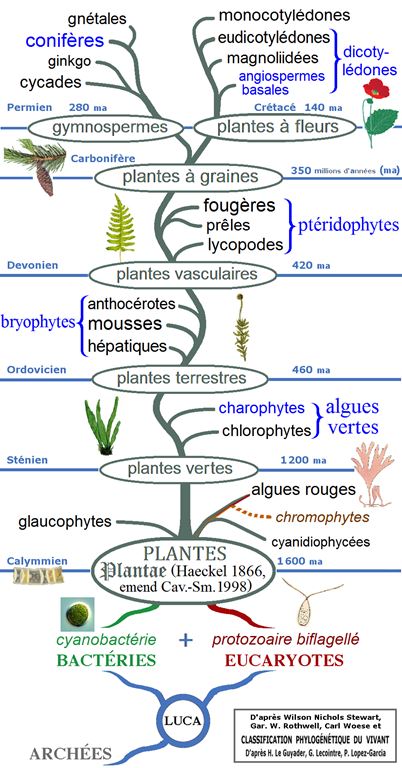
- Phylogénétique :
- Clade 4 : Angiospermes ;
- Clade 3 : Dicotylédones_vraies ;
- Clade 2 : Astéridées ;
- Ordre APN : Ericales ;
- Famille APN : Sapotaceae ;
À droite, cet arbre phylogénétique des plantes montre les principaux clades et groupes traditionnels (monophylétiques en noir et paraphylétiques en bleu).
Dénominations
- Nom botanique : Chrysophyllum argenteum Jacq. (1760)
- Synonymes : Chrysophyllum dubium Steud, Chrysophyllum glabrum Jacq, Chrysophyllum immersum Urb, et d'autres
- Noms anglais et locaux : Lechecillo, Bwi, Bwi kayamit, Caimito blanco, Caimito de mono, Milky iron, Wild kaimit
Description et culture
Tableau récapitulatif
Parties comes-tibles Note comest. (1-5) Note medic. (1-5) (Zones de) Rusticité Besoins en 
Besoins en  (1-3)
(1-3)Périodes de semis et récoltes Graines au gramme Durée de viabilité Profon-deur semis Espace-ment plants Espace-ment lignes Durée germi-native Durée avant récolte J F M A M J
J A S O N D
J F M A M J
J A S O N D
- dont infos de 0FPI ("FOOD PLANTS INTERNATIONAL", en anglais) :
Description :
Un arbre. Il atteint une hauteur de 5 à 8 m. Le tronc mesure 10 à 20 cm de diamètre. Les feuilles varient en forme. Ils sont oblongs et sont gris argenté en dessous. Ils sont alternes et mesurent 8 à 12 cm de long sur 3 à 6 cm de large. Les fleurs sont en forme de cloche et jaune verdâtre. Ils sont en grappes à la base des feuilles. Le fruit a la taille d'une prune. La pulpe est bleuâtre{{{0(+x) (traduction automatique).
Original : A tree. It grows 5-8 m tall. The trunk is 10-20 cm across. The leaves vary in shape. They are oblong and are silvery grey underneath. They are alternate and 8-12 cm long by 3-6 cm wide. The flowers are bell shaped and greenish-yellow. They are in clusters at the base of the leaves. The fruit is the size of a plum. The pulp is bluish{{{0(+x).
 Consommation (rapports de comestibilité, parties utilisables et usages alimentaires correspondants)
Consommation (rapports de comestibilité, parties utilisables et usages alimentaires correspondants)Fruit (fruits27(+x)) comestible27(+x).
Détails :
Plante cultivée localement{{{27(+x).
Partie testée :
/ Risques et précautions à prendre
Risques et précautions à prendrenéant, inconnus ou indéterminés.
Galerie(s)
Par Zorn, J. & Jacquin N.J.F. von (Dreyhundert auserlesene amerikanische Gewa?chse, vol. 1, t. 60, 1785), via plantillustrations
✖
Autres infos
dont infos de 0FPI ("FOOD PLANTS INTERNATIONAL", en anglais) :
Statut :
Les fruits sont surtout consommés par les enfants{{{0(+x) (traduction automatique).
Original : The fruit are eaten especially by children{{{0(+x).
Distribution :
Une plante tropicale. Il pousse dans une forêt saisonnière semi-persistante. C'est souvent au bord des rivières{{{0(+x) (traduction automatique).
Original : A tropical plant. It grows in semi-evergreen seasonal forest. It is often by rivers{{{0(+x).
Localisation :
Antigua, Barbade, Caraïbes, Amérique centrale, Cuba, Dominique, République dominicaine, Équateur, Grenade, Guadeloupe, Guyane, Guyane, Guyane, Haïti, Hispaniola, Martinique, Montserrat, Panama, Porto Rico, Amérique du Sud, Sainte-Lucie, Saint-Vincent et Grenadines, Suriname, Trinité-et-Tobago, Venezuela, Antilles{{{0(+x) (traduction automatique).
Original : Antigua, Barbados, Caribbean, Central America, Cuba, Dominica, Dominican Republic, Ecuador, Grenada, Guadeloupe, Guiana, Guianas, Guyana, Haiti, Hispaniola, Martinique, Montserrat, Panama, Puerto Rico, South America, St Lucia, St. Vincent and Grenadines, Suriname, Trinidad & Tobago, Venezuela, West Indies{{{0(+x).
Notes :
Il existe environ 80 à 150 espèces de Chrysophyllum. Ils sont principalement en Amérique tropicale. Il existe 44 espèces en Amérique tropicale{{{0(+x) (traduction automatique).
Original : There are about 80-150 Chrysophyllum species. They are mostly in tropical America. There are 44 species in tropical America{{{0(+x).
Liens, sources et/ou références
Liens :
/ ;Sources et/ou références :
bibliographie (liste des sources et/ou références de l'encyclopédie)
dont classification : IPNI ("International Plant Names Index", en anglais) ; TPL ("The Plant List", en anglais) ; Kew (POWO - "Plant Of the World Online", "Royal Botanical Garden", en anglais) ;
dont livres et bases de données : 5PFAF ("Plants For A Future", en anglais) ; 27Dictionnaire des plantes comestibles (livre, page 84, par Louis Bubenicek) ;
dont bibliographie/références de 0FPI ("FOOD PLANTS INTERNATIONAL", en anglais) :
Barfod, A. S. & Kvist, L. P., 1996, Comparative Ethnobotanical Studies of the Amerindian Groups in Coastal Ecuador. The Danish Academy of Sciences and Letters. p 79 ; Condit, R., et al, 2011, Trees of Panama and Costa Rica. Princeton Field Guides. p 434 ; Ekman Herbarium records Haiti ; Enum. syst. pl. 15. 1760 (Select. stirp. amer. hist. 53, t. 38, fig. 1. 1763) ; Fouqué, A., 1972, Espèces fruitières d'Amérique tropicale. Institut français de recherches fruitierès outre-mer (ifac) ; Grandtner, M. M., 2008, World Dictionary of Trees. Wood and Forest Science Department. Laval University, Quebec, Qc Canada. (Internet database http://www.WDT.QC.ca) ; Grandtner, M. M. & Chevrette, J., 2013, Dictionary of Trees, Volume 2: South America: Nomenclature, Taxonomy and Ecology. Academic Press p 129 ; Hedrick, U.P., 1919, (Ed.), Sturtevant's edible plants of the world. p 188 ; Hedrick, U.P., 1919, (Ed.), Sturtevant's edible plants of the world. p 188 (As Chrysophyllum glabrum) ; Kermath, B. M., et al, 2014, Food Plants in the Americas: A survey of the domesticated, cultivated and wild plants used for Human food in North, Central and South America and the Caribbean. On line draft. p 222 ; Little, E. L. & Wadsworth, F. H., 1964, Common Trees of Puerto Rico and the Virgin Islands. USDA Agriculture Handbook No. 249 ; Miguel, E., et al, 1989, A checklist of the cultivated plants of Cuba. Kulturpflanze 37. 1989, 211-357 ; Plants of Haiti Smithsonian Institute http://botany.si.edu/antilles/West Indies
Recherche de/pour :
- "Chrysophyllum argenteum" sur Google (pages et
images) ;
GRIN ("Germplasm Resources Information Network", en anglais) ;
TROPICOS (en anglais) ;
Tela Botanica ;
Pl@ntNet ;
Pl@ntUse ;
"Useful Tropical Plants" (en anglais) ou
"Useful Temperate Plants" (en anglais) ;
- "Chrysophyllum argenteum" sur Google (pages et
images) ;
GRIN ("Germplasm Resources Information Network", en anglais) ;
TROPICOS (en anglais) ;
Tela Botanica ;
Pl@ntNet ;
Pl@ntUse ;
"Useful Tropical Plants" (en anglais) ou
"Useful Temperate Plants" (en anglais) ;
Sous-espèces, variétes...
4 taxons
Espèces du même genre (Chrysophyllum)
43 taxons
- Chrysophyllum africanum A.DC. (Caïmitier africain)
- Chrysophyllum albidum G.Don (Caïmitier à fruit blanc)
- Chrysophyllum amazonicum T.D.Penn.
- Chrysophyllum arenarium Allemo
- Chrysophyllum bangweolense R.E.Fr. & Pellegr.
- Chrysophyllum boivinianum
- Chrysophyllum bombycinum T.D.Penn.
- Chrysophyllum brenesii Cronquist
- Chrysophyllum cainito L. (Caïmitier)
- Chrysophyllum cuneifolium
- Chrysophyllum eximium Ducke
- Chrysophyllum flexuosum Mart.
- Chrysophyllum giganteum A.Chev.
- Chrysophyllum gonocarpum
- Chrysophyllum gorungosanum Engl.
- Chrysophyllum imperiale
- Chrysophyllum inornatum Mart.
- Chrysophyllum lacourtianum De Wild.
- Chrysophyllum lucentifolium Cronquist
- Chrysophyllum macoucou Aubl.
- Chrysophyllum manaosense
- Chrysophyllum marginatum
- Chrysophyllum mexicanum Brandegee
- Chrysophyllum michino H. B. & Kunth
- Chrysophyllum obovatum Sabine & G.Don
- Chrysophyllum oliviforme L. (Satinleaf)
- Chrysophyllum ovale Rusby
- Chrysophyllum paranaense T.D.Penn.
- Chrysophyllum perpulchrum Mildbr. ex Hutch. & Dalziel
- Chrysophyllum pomiferum
- Chrysophyllum prieurii A.DC.
- Chrysophyllum pruniforme Engl.
- Chrysophyllum ramiflora
- Chrysophyllum revolutum Mart. & Eichler
- Chrysophyllum roxburghii G.Don
- Chrysophyllum scalare T.D.Penn.
- Chrysophyllum sparsiflorum Klotzsch ex Miq.
- Chrysophyllum subnudum Baker
- Chrysophyllum superbum T.D.Penn.
- Chrysophyllum venezuelanense
- Chrysophyllum viride Mart. & Eichler
- Chrysophyllum viridifolium J.M.Wood & Franks
Espèces de la même famille (Sapotaceae)
367 taxons
- Abiu
- Arganier
- Armadillo fruit
- Beurre d'Orère
- Caïmitier
- Caïmitier à fruit blanc
- Caïmitier africain
- Canistel
- Cerisier espagnol
- Fruit miracle
- Jacan
- Karité
- Lamut
- Lucuma
- Lucuma sauvage
- Makoré
- Mimusope coriace
- Munga
- Omuma
- Pomme noire
- Sapotier
- Sapotier vert
- Sapotillier
- Sapotillier kecik
- Satinleaf
- Argania spinosa (L.) Skeels (Arganier)
- Autranella congolensis
- Baillonella toxisperma Pierre (Beurre d'Orère)
- Beccariella brownlessiana
- Beccariella macrocarpa
- Beccariella papyracea
- Bumelia lanuginosa
- Bumelia lycioides
- Bumelia tenax
- Burckella banikiensis
- Burckella fijiensis
- Burckella macropoda
- Burckella majus
- Burckella obovata
- Burckella richii
- Burckella sorei P.Royen
- Burckella sp megahilum
- Burckella thurstonii
- Chromolucuma rubiflora
- Chrysophyllum africanum A.DC. (Caïmitier africain)
- Chrysophyllum albidum G.Don (Caïmitier à fruit blanc)
- Chrysophyllum amazonicum T.D.Penn.
- Chrysophyllum arenarium Allemo
- Chrysophyllum bangweolense R.E.Fr. & Pellegr.
- Chrysophyllum boivinianum
- Chrysophyllum bombycinum T.D.Penn.
- Chrysophyllum brenesii Cronquist
- Chrysophyllum cainito L. (Caïmitier)
- Chrysophyllum cuneifolium
- Chrysophyllum eximium Ducke
- Chrysophyllum flexuosum Mart.
- Chrysophyllum giganteum A.Chev.
- Chrysophyllum gonocarpum
- Chrysophyllum gorungosanum Engl.
- Chrysophyllum imperiale
- Chrysophyllum inornatum Mart.
- Chrysophyllum lacourtianum De Wild.
- Chrysophyllum lucentifolium Cronquist
- Chrysophyllum macoucou Aubl.
- Chrysophyllum manaosense
- Chrysophyllum marginatum
- Chrysophyllum mexicanum Brandegee
- Chrysophyllum michino H. B. & Kunth
- Chrysophyllum obovatum Sabine & G.Don
- Chrysophyllum oliviforme L. (Satinleaf)
- Chrysophyllum ovale Rusby
- Chrysophyllum paranaense T.D.Penn.
- Chrysophyllum perpulchrum Mildbr. ex Hutch. & Dalziel
- Chrysophyllum pomiferum
- Chrysophyllum prieurii A.DC.
- ...







 donne accès au menu
  - encyclopédies des plantes alimentaires ;
 - page de recherche - reconnaissance (identification) de plantes ;
 - page du calendrier lunaire et son générateur (au format PDF et JPG) ;
 - tableau récapitulatif ;
 - générateur de potées (soupes), avec estimation des apports nutrionnels et du coût;
 - générateur de codes QR ;
 - page des archives avec de nombreux documents sur différents thèmes complémentaires comme la botanique, les légumes,
les champignons, la cuisine, le bien-être ainsi que différents MOOC mais également des liens vers les archives de l'association ;
- page des archives avec de nombreux documents sur différents thèmes complémentaires comme la botanique, les légumes,
les champignons, la cuisine, le bien-être ainsi que différents MOOC mais également des liens vers les archives de l'association ;

 ou
ou
 permettant de passer du format standard à l'AMP (et vice-versa), lequel est simplifié et donc plus rapide.
 pour le fruit (et/ou les graines, la pulpe, etc...),
 pour les fleurs (et/ou pétales, calice...),
 pour les feuilles (et/ou la tige, les pousses...),
 pour les racines,
 pour le tronc (et/ou l'écorce, la sève...), et enfin
 pour les champignons,
puis les notes alimentaires et médicinales (de 1 à 5 étoiles), la rusticité (résistance au froid/gel)
et pour finir un résumé.
pour les champignons,
puis les notes alimentaires et médicinales (de 1 à 5 étoiles), la rusticité (résistance au froid/gel)
et pour finir un résumé. menant ici 🙂
 ,
,  et
et





 ,
,


 Encyclopédie(s)
 Recherche-Reconnaissance
 Tableau récapitulatif
 Codes QR
 Archives
 Calendrier(s) lunaire(s)
  Potées
 Re-naturation/naturalisation
 Affichettes, herbiers &
co.
Affichettes, herbiers &
co. menu
menu galerie