
 Encyclopédie(s)
 Recherche-Reconnaissance
 Tableau récapitulatif
 Codes QR
 Archives
 Calendrier(s) lunaire(s)
  Potées
 Re-naturation/naturalisation
 Affichettes, herbiers &
co.
Affichettes, herbiers &
co. menu
menu galerie


Ravenelle
(Raphanus raphanistrum)


 |
**
-
*
|
**
-
*
Une herbe de la famille du chou. C'est une herbe annuelle. Il pousse de 80 à 100 cm de haut. C'est rugueux au toucher. Les tiges se ramifient à la base. Les tiges sont solid ... (traduction automatique)
→suite


Affich., herbiers & co.
Ravenelle
Note alimentaire 
Note médicinale 

Une herbe de la famille du chou. C'est une herbe annuelle. Il pousse de 80 à 100 cm de haut. C'est rugueux au toucher. Les tiges se ramifient à la base. Les tiges sont solides mais avec des rainures le l... (traduction automatique) →suite


Raphanus raphanistrum
Classification
- Classique : en haut de l'écran, sous le coeur.
- Phylogénétique :
- Clade 4 : Angiospermes ;
- Clade 3 : Dicotylédones_vraies ;
- Clade 2 : Rosidées ;
- Clade 1 : Malvidées ;
- Ordre APN : Brassicales ;
- Famille APN : Brassicaceae ;
À droite, cet arbre phylogénétique des plantes montre les principaux clades et groupes traditionnels (monophylétiques en noir et paraphylétiques en bleu).
Dénominations
- Nom botanique : Raphanus raphanistrum L. (1753)
- Noms anglais et locaux : Wild radish, Jointed charlock, White charlock, Bedhaka, Ermulatta, Fiore di San Giuseppe, Gramolaccio, Jaramago, Karamancar, Karaturp, Lass'ne, Mostaza, Nabica, Nabo, Nabo-bravo, Pisciacane, Rabanete-de-cavalo, Rabanete-selvagen, Rabani to salvaje, Rabanito, Rabanito silvestre, Rabano, Rabizon, Rapistre, Rodakva divlja, Runch, Saramago, Skellog, Turpoti, Turpotu, Yabarni turp, Ye luo bo
Description et culture
Tableau récapitulatif
Parties comes-tibles Note comest. (1-5) Note medic. (1-5) (Zones de) Rusticité Besoins en 
Besoins en  (1-3)
(1-3)Périodes de semis et récoltes Graines au gramme Durée de viabilité Profon-deur semis Espace-ment plants Espace-ment lignes Durée germi-native Durée avant récolte Zones de rusticité : J F M A M J
J A S O N D
J F M A M J
J A S O N D
- dont infos de 0FPI ("FOOD PLANTS INTERNATIONAL", en anglais) :
Description :
Une herbe de la famille du chou. C'est une herbe annuelle. Il pousse de 80 à 100 cm de haut. C'est rugueux au toucher. Les tiges se ramifient à la base. Les tiges sont solides mais avec des rainures le long d'elles. Les tiges ont des poils dirigés vers le bas. Les feuilles inférieures sont plus grandes que les feuilles situées plus haut sur la tige. Les feuilles inférieures forment un anneau. Les feuilles inférieures sont lobées et mesurent 20 cm de long. La fleur est au sommet. Les pétales de fleurs peuvent être blancs, jaunes ou lilas et ne se chevauchent pas. Le fruit est une longue gousse pointue. Il mesure 3-7 cm de long et 3-4 mm de large. Il est resserré entre les graines. Il est tenu droit{{{0(+x) (traduction automatique).
Original : A cabbage family herb. It is an annual herb. It grows 80-100 cm high. It is rough to the touch. The stems branch at the base. The stems are solid but with grooves along them. The stems have downward directed hairs. The lower leaves are larger than the leaves higher up the stem. The lower leaves occur in a ring. The lower leaves are lobed and 20 cm long. The flower is at the top. The flower petals can be white, yellow or lilac and do not overlap. The fruit is a long pointed pod. It is 3-7 cm long and 3-4 mm wide. It is constricted between the seeds. It is held erect{{{0(+x).
 Consommation (rapports de comestibilité, parties utilisables et usages alimentaires correspondants)
Consommation (rapports de comestibilité, parties utilisables et usages alimentaires correspondants)Feuille (jeunes, dont pointes)1, fruit (jeunes (verts et tendres))1 et fleur1(inflorescences (bourgeons et tiges))1 comestibles.(1*)
Détails :
jeunes feuilles crues ou cuites (ex. : comme potherbe{{{(dp*)(1)).
Partie testée :
feuilles{{{0(+x) (traduction automatique). Original : Leaves{{{0(+x)| Taux d'humidité (%) | Énergie (kj) | Énergie (kcal) | Protéines (g) |
|---|---|---|---|
| 87.4 | 142 | 34 | 3.7 |
| Pro- vitamines A (µg) |
Vitamines C (mg) | Fer (mg) | Zinc (mg) |
| 0 | 11.0 | 9.5 | 1.4 |
 Risques et précautions à prendre
Risques et précautions à prendrecf. consommation
Galerie(s)
Par Lindman, C.A.M., Bilder ur Nordens Flora Bilder Nordens Fl. vol. 1 (1922) t. 199, via plantillustrations
✖

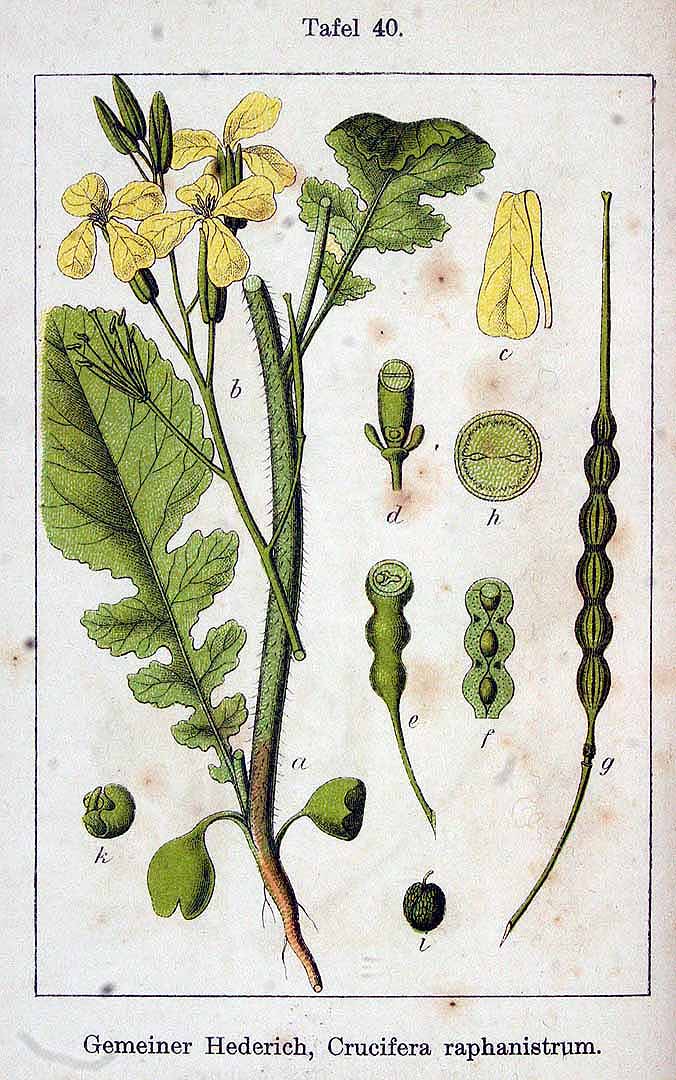
Par Sturm, J., Krause, E.H.L., Lutz, K.G., Flora von Deutschland in Abbildungen nach der Natur, Zweite auflage (1900-1907) Deutschl. Fl., ed. 2 vol. 6 (1902) t. 40, via plantillustrations
✖

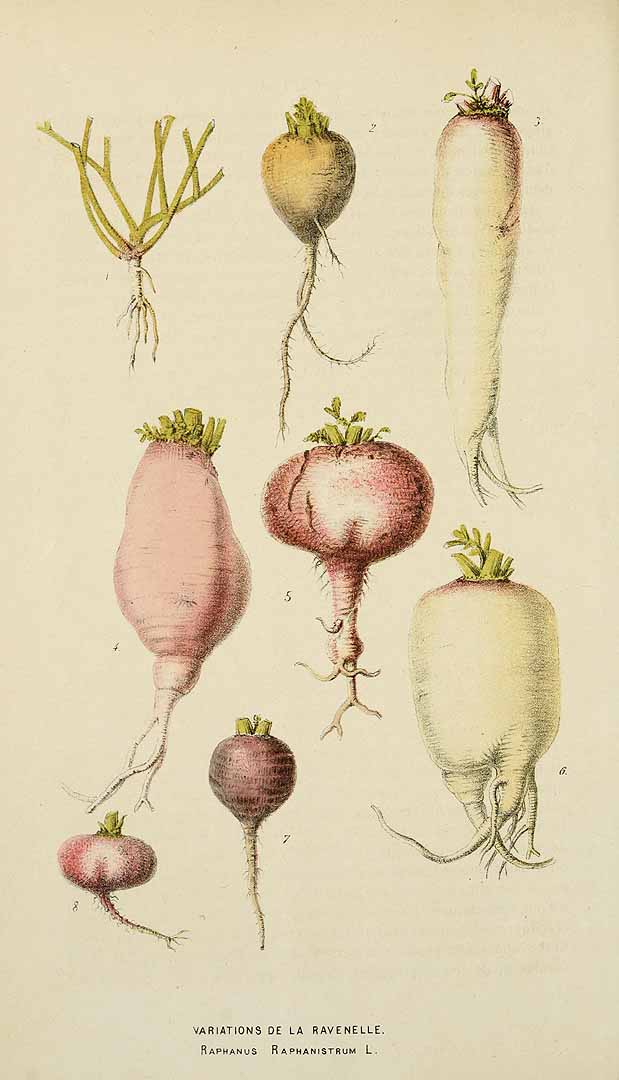
Par Belgique horticole, journal des jardins et des vergers (1851-1885) Belgique Hort. vol. 19 (1869) t. 12 p. 151 , via plantillustrations
✖
Autres infos
dont infos de 0FPI ("FOOD PLANTS INTERNATIONAL", en anglais) :
Distribution :
C'est une plante tempérée. Il pousse près des sites humides. Il peut pousser dans les endroits tropicaux et tempérés. En Argentine, il passe du niveau de la mer à 1 100 m d'altitude. Herbier de Tasmanie. Au Sichuan{{{0(+x) (traduction automatique).
Original : It is a temperate plant. It grows near damp sites. It can grow in tropical and temperate places. In Argentina it grows from sea level to 1,100 m above sea level. Tasmania Herbarium. In Sichuan{{{0(+x).
Localisation :
Afrique, Argentine, Australie, Asie, Bahamas, Balkans, Bosnie, Brésil, Grande-Bretagne, Chili, Chine, Cuba, République tchèque, République dominicaine, Afrique de l'Est, Éthiopie, Europe *, Grèce, Haïti, Hawaï, Irlande, Italie, Méditerranée, Mexique, Mongolie, Nouvelle-Zélande, Afrique du Nord, Amérique du Nord, Pacifique, Pakistan, Paraguay, Pologne, Portugal, Slovénie, Afrique du Sud, Afrique australe, Espagne, Taïwan, Tasmanie, Turquie, Uruguay, USA, Antilles, Zimbabwe{{{0(+x) (traduction automatique).
Original : Africa, Argentina, Australia, Asia, Bahamas, Balkans, Bosnia, Brazil, Britain, Chile, China, Cuba, Czech Republic, Dominican Republic, East Africa, Ethiopia, Europe*, Greece, Haiti, Hawaii, Ireland, Italy, Mediterranean, Mexico, Mongolia, New Zealand, North Africa, North America, Pacific, Pakistan, Paraguay, Poland, Portugal, Slovenia, South Africa, Southern Africa, Spain, Taiwan, Tasmania, Turkey, Uruguay, USA, West Indies, Zimbabwe{{{0(+x).
Rusticité (résistance face au froid/gel, climat)
Zones de rusticité :
Liens, sources et/ou références
Liens :
/ ;Sources et/ou références :
bibliographie (liste des sources et/ou références de l'encyclopédie)
dont classification : IPNI ("International Plant Names Index", en anglais) ; TPL ("The Plant List", en anglais) ; Kew (POWO - "Plant Of the World Online", "Royal Botanical Garden", en anglais) ; Tela Botanica ;
dont livres et bases de données : 5PFAF ("Plants For A Future", en anglais) ; 1Plantes sauvages comestibles (livre pages 155 et 156, par S.G. Fleischhauer, J. Guthmann et R. Spiegelberger) ; 1Plantes sauvages comestibles (de S.G. Fleischhauer, J. Guthmann et R. Spiegelberger, éditions Ulmer, 2012) / détails du livre ; 77Semences de Kokopelli (de Dominique Guillet, 6ème édition, 2007) / détails du livre
Warning: Undefined variable $prex in /home/waso5761/public_html/inc/fiches.php on line 2607
dont bibliographie/références de 0FPI ("FOOD PLANTS INTERNATIONAL", en anglais) :
Ashagre, M., et al, 2016, Ethnobotanical study of wild edible plants in Burji District, Segan Area Zone of Southern Nations, Nationalities and Peoples Region (SNNPR), Ethiopia. Journal of Ethnobiology and Ethnomedicine (2016) 12:32 ; Banga, O., 1979, Radish, in Simmonds N.W.,(ed), Crop Plant Evolution. Longmans. London. p 60 ; Biscotti, N. & Pieroni, A., 2015, The hidden Mediterranean diet: wild vegetables traditionally gathered and consumed in the Gargano area, Apulia, SE Italy. Acta Societatis Botanicorum Poloniae 84 (3): 327-338 ; Biscotti, N. et al, 2018, The traditional food use of wild vegetables in Apulia (Italy) in the light of Italian ethnobotanical literature. Italian Botanist 5:1-24 ; Blamey, M and Grey-Wilson, C., 2005, Wild flowers of the Mediterranean. A & C Black London. p 69 ; Bodkin, F., 1991, Encyclopedia Botanica. Cornstalk publishing, p 870 ; Cerne, M., 1992, Wild Plants from Slovenia used as Vegetables. Acta Horticulturae 318 ; Cordero, S. E., Abello, L. A., & Galvez, F. L., 2017, Plantas silvestres comestibles y medicinales de Chile y otras partes del mundo. CORMA p 228 (As Raphanus sativus) ; Curtis, W.M., 1956, The Students Flora of Tasmania Vol 1 p 48 ; Dashorst, G.R.M., and Jessop, J.P., 1998, Plants of the Adelaide Plains & Hills. Botanic Gardens of Adelaide and State Herbarium. p 68 ; Dogan, Y., 2012, Traditionally used wild edible greens in the Aegean Region of Turkey. Acta Societatis Botanicorum Poloniae 81(4): 329-342 ; Dogan, Y. et al, 2013, Wild Edible Plants sold in the Local Markets of Izmir, Turkey. Pak. J. Bot. 45(S1): 177-184 ; Dogan, Y., et al, 2015, Of the importance of a leaf: the ethnobotany of sarma in Turkey and the Balkans. Journal of Ethnobiology and Ethnomedicine, 11:56 ; Ertug, F., 2004, Wild Edible Plants of the Bodrum Area. (Mugla, Turkey). Turk. J. Bot. 28 (2004): 161-174 ; Ertug, F, Yenen Bitkiler. Resimli Türkiye Florası -I- Flora of Turkey - Ethnobotany supplement ; Facciola, S., 1998, Cornucopia 2: a Source Book of Edible Plants. Kampong Publications, p 58 ; Flora of Australia, Volume 8, Lecythidales to Batales, Australian Government Publishing Service, Canberra (1982) p 247 ; Flora of China @ efloras.org Volume 8 ; Fox, F. W. & Young, M. E. N., 1982, Food from the Veld. Delta Books. p 136 ; Hadjichambis, A. C., et al, 2007, Wild and semi-domesticated food plant consumption in seven circum-Mediterranean areas. International Journal of Food Sciences and Nutrition. 2007, 1-32. ; Hammer, K. & Spahillari, M., 1999, Crops of European origin. in Report of a networking group on minor crops. IPGRI p 44 ; Harris, S., Buchanan, A., Connolly, A., 2001, One Hundred Islands: The Flora of the Outer Furneaux. Tas Govt. p 214 ; Hedrick, U.P., 1919, (Ed.), Sturtevant's edible plants of the world. p 549 ; Hussey, B.M.J., Keighery, G.J., Cousens, R.D., Dodd, J., Lloyd, S.G., 1997, Western Weeds. A guide to the weeds of Western Australia. Plant Protection Society of Western Australia. p 120 ; Hyde-Wyatt, B.H. & Morris D.I., 1975, Tasmanian Weed Handbook. Dept of Ag Tasmania. p 43 ; Irving, M., 2009, The Forager Handbook, A Guide to the Edible Plants of Britain. Ebury Press p 95 ; Kermath, B. M., et al, 2014, Food Plants in the Americas: A survey of the domesticated, cultivated and wild plants used for Human food in North, Central and South America and the Caribbean. On line draft. p 739 ; Kizilarslan, C. & Ozhatay, N., 2012, An ethnobotanical study of the useful and edible plants of İzmit. Marmara Pharmaceutical Journal 16: 134-140, 2012. ; Lamp, C & Collet F., 1989, Field Guide to Weeds in Australia. Inkata Press. p 233 ; Lazarides, M. & Hince, B., 1993, Handbook of Economic Plants of Australia, CSIRO. p 203 ; Lentini, F. and Venza, F., 2007, Wild food plants of popular use in Sicily. J Ethnobiol Ethnomedicine. 3: 15 ; Low, T., 1991, Wild Herbs of Australia and New Zealand. Angus & Robertson. p 54 (Drawing) ; Low, T., 1992, Bush Tucker. Australiaâ's Wild Food Harvest. Angus & Robertson. p 146 ; Åukasz Åuczaj and Wojciech M SzymaÅ„ski, 2007, Wild vascular plants gathered for consumption in the Polish countryside: a review. J Ethnobiol Ethnomedicine. 3: 17 ; Malezas Comestibles del Cono Sur, INTA, 2009, Buernos Aires ; Motti, R. et al, 2009, Traditional Plant Use in the Phlegraean Fields Regional Park (Campania, Southern Italy). Human Ecology 37:775-782 ; Paczkowska, G. & Chapman, A.R., 2000, The Western Australian Flora. A Descriptive Catalogue. Western Australian Herbarium. p 188 ; Pieroni, A., 1999, Gathered wild food plants in the Upper Valley of the Serchio River (Garfagnana), Central Italy. Economic Botany 53(3) pp 327-341 ; Plants for a Future database, The Field, Penpol, Lostwithiel, Cornwall, PL22 0NG, UK. http://www.scs.leeds.ac.uk/pfaf/ ; Plants of Haiti Smithsonian Institute http://botany.si.edu ; Polat, R., et al, 2015, Survey of wild food plants for human consumption in Elazig (Turkey). Indian Journal of Traditional Knowledge. Vol. 1(1): 69-75 ; Redzic, S. J., 2006, Wild Edible Plants and their Traditional Use in the Human Nutrition in Bosnia-Herzegovina. Ecology of Food and Nutrition, 45:189-232 ; Redzic, S., 2010, Use of Wild and Semi-Wild Edible Plants in Nutrition and Survival of People in 1430 Days of Siege of Sarajevo during the War in Bosnia and Herzegovina (1992–1995). Coll. Antropol 34 (2010) 2:551-570 ; Signorini, M. A., et al, 2009, Plants and traditional knowledge: An ethnobotanical investigation on Monte Ortobene (Nuoro, Sardinia). Journal or Ethnobiology and Ethnomedicine, 5:6 ; Simkova, K. et al, 2014, Ethnobotanical review of wild edible plants used in the Czech Republic. Journal of Applied Botany and Food Quality 88, 49-67 ; Sp. pl. 2:669. 1753 ; Tasmanian Herbarium Vascular Plants list p 18 ; Tardio, J., et al, Ethnobotanical review of wild edible plants in Spain. Botanical J. Linnean Soc. 152 (2006), 27-71 ; Urgamal, M., Oyuntsetseg, B., Nyambayar, D. & Dulamsuren, Ch. 2014. Conspectus of the vascular plants of Mongolia. (Editors: Sanchir, Ch. & Jamsran, Ts.). Ulaanbaatar, Mongolia. “Admon“ Press. 334pp. (p. 79-90). ; van Wyk, B., 2000, A Photographic Guide to Wild Flowers of South Africa. Struik Nature. p 35 ; Vieyra-Odilon, L and Vibrans, H., 2001, Weeds as Crops: The Value of Maize Field Weeds in the Valley of Toluca, Mexico. Economic Botany 55(3):426-443 ; Wehmeyer, A. S, 1986, Edible Wild Plants of Southern Africa. Data on the Nutrient Contents of over 300 species ; Zhou Taiyan, Lu Lianli, Yang Guang; Ihsan A. Al-Shehbaz, BRASSICACEAE (CRUCIFERAE), Flora of China.
Recherche de/pour :
- "Raphanus raphanistrum" sur Google (pages et
images) ;
GRIN ("Germplasm Resources Information Network", en anglais) ;
TROPICOS (en anglais) ;
Pl@ntNet ;
Pl@ntUse ;
"Useful Tropical Plants" (en anglais) ou
"Useful Temperate Plants" (en anglais) ;
- "Ravenelle" sur Google (pages, images et recettes) ;
- "Raphanus raphanistrum" sur Google (pages et
images) ;
GRIN ("Germplasm Resources Information Network", en anglais) ;
TROPICOS (en anglais) ;
Pl@ntNet ;
Pl@ntUse ;
"Useful Tropical Plants" (en anglais) ou
"Useful Temperate Plants" (en anglais) ;
Espèces du même genre (Raphanus)
4 taxons
Espèces de la même famille (Brassicaceae)
375 taxons
- Alliaire officinale
- Alysse des murailles
- Arabette des dames
- Arabette hérissée
- Arabette sagittée
- Barbarée
- Barbarée intermédiaire
- Barbarée raide
- Bourse-à-pasteur rougeâtre
- Brassicelle
- Brise-pierres
- Brocoli sauvage
- Bunias d'orient
- Calépine
- Caméline
- Capselle bourse-à-pasteur
- Caquilier
- Cardamine
- Cardamine à bulbilles
- Cardamine à feuilles de Réséda
- Cardamine à larges feuilles
- Cardamine à petites fleurs
- Cardamine à trois folioles
- Cardamine amère
- Cardamine des bois
- Cardamine des prés
- Cardamine hirsute
- Carrichtère
- Chorispore délicat
- Chou
- Chou allongé
- Chou des champs
- Chou nuage blanc
- Chou sauvage de Grèce
- Cochléaire d'Angleterre
- Cochléaire du Danemark
- Cochléaire officinale
- Colza
- Conringie d'Orient
- Corbeille d'or
- Corbeille-d'argent
- Corne de cerf
- Corne-de-cerf commune
- Coronope didyme
- Crambé
- Crambe de tartarie
- Crambe maritime
- Cresson à petites feuilles
- Cresson alénois
- Cresson de fontaine
- Aethionema cordifolium Boiss.
- Alliaria petiolata (M. Bieb.) Cavara & Grande (Alliaire officinale)
- Alyssum constellatum Boiss.
- Alyssum desertorum Stapf
- Alyssum homalocarpum
- Alyssum murale Waldst. & Kit. (Alysse des murailles)
- Anastatica hierochuntica L.
- Arabidella eremigena
- Arabidopsis lyrata
- Arabidopsis thaliana (L.) Heynh. (Arabette des dames)
- Arabis alpina Krock. ex Steud. (Corbeille-d'argent)
- Arabis caucasica Willd. (Corbeille-d'argent)
- Arabis hirsuta (L.) Scop. (Arabette hérissée)
- Arabis lyrata L.
- Arabis pendula L.
- Arabis sagittata (Arabette sagittée)
- Arabis serrata Franch. & Sav.
- Arabis tibetica Hook.f. & Thomson
- Armoracia macrocarpa
- Armoracia rusticana G.Gaertn., B.Mey. & Scherb. (Raifort)
- Armoracia sisymbrioides
- Aurinia saxatilis (L.) Desv. (Corbeille d'or)
- Aurinia saxatilis (L.) Desv. (Corbeille d'or)
- Barbarea australis Jord.
- Barbarea bosniaca Murb.
- Barbarea intermedia Boreau (Barbarée intermédiaire)
- Barbarea orthoceras Ledeb.
- Barbarea plantaginea DC.
- Barbarea stricta J.Fellm. (Barbarée raide)
- Barbarea verna (Mill.) Asch. (Cresson des jardins)
- Barbarea vulgaris W. T. Aiton (Barbarée)
- Berteroella maximowiczii
- Blennodia canescens R.Br.
- Brassica campestris L. (Navette sauvage)
- Brassica carinata A. Braun (Moutarde d'éthiopie)
- Brassica cerifolia
- Brassica cretica Lam. (Chou sauvage de Grèce)
- Brassica deflexa Boiss.
- Brassica elongata Ehrh. (Chou allongé)
- Brassica fruticulosa Cirillo (Moutarde de Cosson)
- Brassica glauca
- Brassica integrifolia
- Brassica juncea (L.) Czern. (Moutarde chinoise)
- Brassica kaber
- Brassica napus L. (Colza)
- Brassica nigra (L.) K.Koch (Moutarde noire)
- Brassica oleracea L. (Chou)
- Brassica rapa L. (Navet)
- Brassica rapa 2
- Brassica ruvo L.H.Bailey (Rapini)
- ...
Par Sturm, J., Krause, E.H.L., Lutz, K.G., Flora von Deutschland in Abbildungen nach der Natur, Zweite auflage (1900-1907) Deutschl. Fl., ed. 2 vol. 6 (1902) t. 40, via plantillustrations


 - page de recherche - reconnaissance (identification) de plantes ;
 - page des archives avec de nombreux documents sur différents thèmes complémentaires comme la botanique, les légumes,
les champignons, la cuisine, le bien-être ainsi que différents MOOC mais également des liens vers les archives de l'association ;
- page des archives avec de nombreux documents sur différents thèmes complémentaires comme la botanique, les légumes,
les champignons, la cuisine, le bien-être ainsi que différents MOOC mais également des liens vers les archives de l'association ;

 pour poser des question à l'IA (Terra) ou discuter avec elle/lui, et ce
 ou
ou
 permettant de passer du format standard à l'AMP (et vice-versa), lequel est simplifié et donc plus rapide.
 pour les racines,
 pour le tronc (et/ou l'écorce, la sève...), et enfin
 pour les champignons,
puis les notes alimentaires et médicinales (de 1 à 5 étoiles), la rusticité (résistance au froid/gel)
et pour finir un résumé.
pour les champignons,
puis les notes alimentaires et médicinales (de 1 à 5 étoiles), la rusticité (résistance au froid/gel)
et pour finir un résumé. menant ici 🙂
 ,
,
 ,
,
 ,
,


 ,
,







 (en bas à gauche).
