Pouteria bullata
Pas d'illustration
pour le moment 😕

Un arbre. Il perd plusieurs de ses feuilles au cours de l'année. Il atteint 10-16 m de haut. Le tronc a des rainures le long de celui-ci. Les jeunes branches ont une couvertu ... (traduction automatique)
→suite


Affich., herbiers & co.
Pouteria bullata

Un arbre. Il perd plusieurs de ses feuilles au cours de l'année. Il atteint 10-16 m de haut. Le tronc a des rainures le long de celui-ci. Les jeunes branches ont une couverture brune. Les feuilles sont de... (traduction automatique) →suite
Pas d'illustration
pour le moment 😕
Pas d'illustration
pour le moment 😕
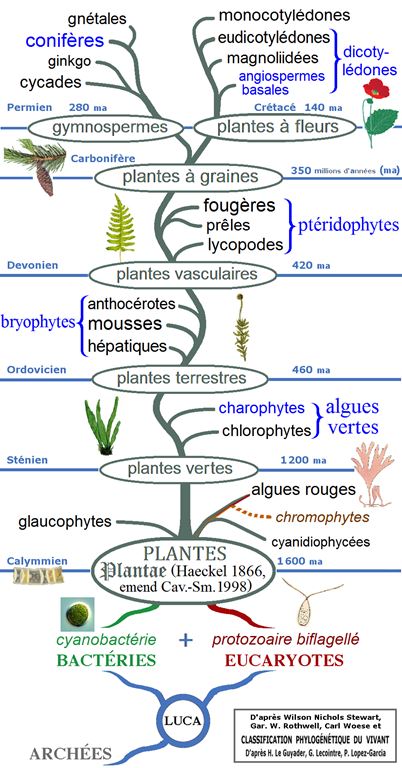
Classification
- Classique : en haut de l'écran, sous le coeur.
- Phylogénétique :
- Clade 4 : Angiospermes ;
- Clade 3 : Dicotylédones_vraies ;
- Clade 2 : Astéridées ;
- Ordre APN : Ericales ;
- Famille APN : Sapotaceae ;
À droite, cet arbre phylogénétique des plantes montre les principaux clades et groupes traditionnels (monophylétiques en noir et paraphylétiques en bleu).
Dénominations
- Nom botanique : Pouteria bullata (S. Moore) Baehni
- Synonymes : Lucuma bullata S. Moore, Pouteria costata Dubard [Invalid], Pouteria pellita Baehni, Lucuma rubicunda Pierre
- Noms anglais et locaux : Bullate pouteria
Description et culture
Tableau récapitulatif
Parties comes-tibles Note comest. (1-5) Note medic. (1-5) (Zones de) Rusticité Besoins en 
Besoins en  (1-3)
(1-3)Périodes de semis et récoltes Graines au gramme Durée de viabilité Profon-deur semis Espace-ment plants Espace-ment lignes Durée germi-native Durée avant récolte J F M A M J
J A S O N D
J F M A M J
J A S O N D
- dont infos de 0FPI ("FOOD PLANTS INTERNATIONAL", en anglais) :
Description :
Un arbre. Il perd plusieurs de ses feuilles au cours de l'année. Il atteint 10-16 m de haut. Le tronc a des rainures le long de celui-ci. Les jeunes branches ont une couverture brune. Les feuilles sont de papier. Ils sont près des extrémités des branches. Les feuilles mesurent entre 18 et 28 cm de long. Il y a des poils sur la surface inférieure. Les fleurs sont en groupes de 3 à 5 sur des branches nues. Les fruits sont ovales et jaunes. Ils mesurent 6 cm de long. Il y a 1 graine{{{0(+x) (traduction automatique).
Original : A tree. It loses many of its leaves during the year. It grows 10-16 m tall. The trunk has grooves along it. The young branches have a brown covering. The leaves are papery. They are near the ends of branches. The leaves are 18-28 cm long. There are hairs on the under surface. The flowers are in groups of 3-5 on bare branches. The fruit are oval and yellow. They are 6 cm long. There is 1 seed{{{0(+x).
Production :
Les plantes poussent lentement{{{0(+x) (traduction automatique).
Original : Plants grow slowly{{{0(+x).
Culture :
Les plantes sont cultivées à partir de graines. Les graines sont récoltées à partir de fruits mûrs qui ont été stockés en tas pour leur permettre de se décomposer en partie avant d'être lavés à l'eau courante. Les graines doivent être plantées fraîches. Ils doivent être à l'ombre claire. Les semis émergent en 60 à 70 jours{{{0(+x) (traduction automatique).
Original : Plants are grown from seed. The seeds are collected from ripe fruit that have been stored in piles to allow them to partly decompose than washed out in running water. Seeds need to be planted fresh. They should be in light shade. Seedlings emerge in 60-70 days{{{0(+x).
 Consommation (rapports de comestibilité, parties utilisables et usages alimentaires correspondants)
Consommation (rapports de comestibilité, parties utilisables et usages alimentaires correspondants)Parties comestibles :
fruit{{{0(+x) (traduction automatique). Original : Fruit{{{0(+x).Détails :
Les fruits très mûrs sont consommés frais{{{0(+x) (traduction automatique).
Original : The very ripe fruit are eaten fresh{{{0(+x).
Partie testée :
/ Risques et précautions à prendre
Risques et précautions à prendrenéant, inconnus ou indéterminés.
Autres infos
dont infos de 0FPI ("FOOD PLANTS INTERNATIONAL", en anglais) :
Distribution :
Une plante tropicale. Il pousse dans la forêt semi-décidue au Brésil{{{0(+x) (traduction automatique).
Original : A tropical plant. It grows in semi-deciduous forest in Brazil{{{0(+x).
Localisation :
Brésil *, Amérique du Sud{{{0(+x) (traduction automatique).
Original : Brazil*, South America{{{0(+x).
Notes :
Il existe environ 150-320 espèces de Pouteria. Ils poussent sous les tropiques{{{0(+x) (traduction automatique).
Original : There are about 150-320 Pouteria species. They grow in the tropics{{{0(+x).
Liens, sources et/ou références
Liens :
/ ;Sources et/ou références :
bibliographie (liste des sources et/ou références de l'encyclopédie)
dont livres et bases de données : 0FPI ("FOOD PLANTS INTERNATIONAL", en anglais) ;
dont bibliographie/références de 0FPI ("FOOD PLANTS INTERNATIONAL", en anglais) :
Grandtner, M. M. & Chevrette, J., 2013, Dictionary of Trees, Volume 2: South America: Nomenclature, Taxonomy and Ecology. Academic Press p 523 ; Kermath, B. M., et al, 2014, Food Plants in the Americas: A survey of the domesticated, cultivated and wild plants used for Human food in North, Central and South America and the Caribbean. On line draft. p 685 ; Lorenzi, H., Bacher, L., Lacerda, M. & Sartori, S., 2006, Brazilian Fruits & Cultivated Exotics. Sao Paulo, Instituto Plantarum de Estuados da Flora Ltda. p 298 ; Lorenzi, H., 2009, Brazilian Trees. A Guide to the Identification and Cultivation of Brazilian Native Trees. Instituto Plantarum de Estuados da Flora Ltda. Vol. 3 p 338 ; Pennington, T.D., 1990, Sapotaceae in Flora Neotropica Monograph 52. New York Botanical Gardens. p 443
Recherche de/pour :
- "Pouteria bullata" sur Google (pages et
images) ;
IPNI ("International Plant Names Index", en anglais) ;
TPL ("The Plant List", en anglais) ;
GRIN ("Germplasm Resources Information Network", en anglais) ;
TROPICOS (en anglais) ;
Tela Botanica ;
Pl@ntNet ;
Pl@ntUse ;
"Plants For A Future" (en anglais) ;
"Useful Tropical Plants" (en anglais) ou
"Useful Temperate Plants" (en anglais) ;
- "Pouteria bullata" sur Google (pages et
images) ;
IPNI ("International Plant Names Index", en anglais) ;
TPL ("The Plant List", en anglais) ;
GRIN ("Germplasm Resources Information Network", en anglais) ;
TROPICOS (en anglais) ;
Tela Botanica ;
Pl@ntNet ;
Pl@ntUse ;
"Plants For A Future" (en anglais) ;
"Useful Tropical Plants" (en anglais) ou
"Useful Temperate Plants" (en anglais) ;
Espèces du même genre (Pouteria)
92 taxons
- Pouteria adolfi-friedericii
- Pouteria alnifolia
- Pouteria altissima
- Pouteria amygdalicarpa
- Pouteria anomala
- Pouteria arguacoensium
- Pouteria australis
- Pouteria baehniana Monach.
- Pouteria beaurepairei
- Pouteria bilocularis
- Pouteria bracteata T.D.Penn.
- Pouteria brevipetiolata T.D.Penn.
- Pouteria butyrocarpa
- Pouteria caimito (Ruiz & Pav.) Radlk. (Abiu)
- Pouteria campechiana (Kunth) Baehni (Canistel)
- Pouteria capacifolia Pilz
- Pouteria cayennensis
- Pouteria chiricana
- Pouteria cladantha Sandwith
- Pouteria coelomatica Rizzini
- Pouteria collina
- Pouteria cordiformis T.D.Penn.
- Pouteria coriacea
- Pouteria cuspidata
- Pouteria dictyoneura
- Pouteria dominigensis
- Pouteria durlandii
- Pouteria egregia Sandwith
- Pouteria elegans
- Pouteria engleri Eyma
- Pouteria filipes Eyma
- Pouteria fossicola Cronquist
- Pouteria franciscana Baehni
- Pouteria gardneri
- Pouteria gardneriana
- Pouteria glauca T.D.Penn.
- Pouteria glomerata
- Pouteria gomphiifolia
- Pouteria gongrijpii
- Pouteria grandiflora
- Pouteria guianensis Griseb.
- Pouteria hispida Eyma
- Pouteria jariensis Pires & T.D.Penn.
- Pouteria juruana K.Krause
- Pouteria krukovii
- Pouteria laevigata
- Pouteria lecythidicarpa P.E.Snchez & Poveda
- Pouteria longifolia
- Pouteria lucuma (Ruiz & Pav.) Kuntze (Lucuma)
- Pouteria lucumifolia
- ...
Espèces de la même famille (Sapotaceae)
367 taxons
- Abiu
- Arganier
- Armadillo fruit
- Beurre d'Orère
- Caïmitier
- Caïmitier à fruit blanc
- Caïmitier africain
- Canistel
- Cerisier espagnol
- Fruit miracle
- Jacan
- Karité
- Lamut
- Lucuma
- Lucuma sauvage
- Makoré
- Mimusope coriace
- Munga
- Omuma
- Pomme noire
- Sapotier
- Sapotier vert
- Sapotillier
- Sapotillier kecik
- Satinleaf
- Argania spinosa (L.) Skeels (Arganier)
- Autranella congolensis
- Baillonella toxisperma Pierre (Beurre d'Orère)
- Beccariella brownlessiana
- Beccariella macrocarpa
- Beccariella papyracea
- Bumelia lanuginosa
- Bumelia lycioides
- Bumelia tenax
- Burckella banikiensis
- Burckella fijiensis
- Burckella macropoda
- Burckella majus
- Burckella obovata
- Burckella richii
- Burckella sorei P.Royen
- Burckella sp megahilum
- Burckella thurstonii
- Chromolucuma rubiflora
- Chrysophyllum africanum A.DC. (Caïmitier africain)
- Chrysophyllum albidum G.Don (Caïmitier à fruit blanc)
- Chrysophyllum amazonicum T.D.Penn.
- Chrysophyllum arenarium Allemo
- Chrysophyllum argenteum Jacq.
- Chrysophyllum bangweolense R.E.Fr. & Pellegr.
- Chrysophyllum boivinianum
- Chrysophyllum bombycinum T.D.Penn.
- Chrysophyllum brenesii Cronquist
- Chrysophyllum cainito L. (Caïmitier)
- Chrysophyllum cuneifolium
- Chrysophyllum eximium Ducke
- Chrysophyllum flexuosum Mart.
- Chrysophyllum giganteum A.Chev.
- Chrysophyllum gonocarpum
- Chrysophyllum gorungosanum Engl.
- Chrysophyllum imperiale
- Chrysophyllum inornatum Mart.
- Chrysophyllum lacourtianum De Wild.
- Chrysophyllum lucentifolium Cronquist
- Chrysophyllum macoucou Aubl.
- Chrysophyllum manaosense
- Chrysophyllum marginatum
- Chrysophyllum mexicanum Brandegee
- Chrysophyllum michino H. B. & Kunth
- Chrysophyllum obovatum Sabine & G.Don
- Chrysophyllum oliviforme L. (Satinleaf)
- Chrysophyllum ovale Rusby
- Chrysophyllum paranaense T.D.Penn.
- Chrysophyllum perpulchrum Mildbr. ex Hutch. & Dalziel
- Chrysophyllum pomiferum
- ...







 donne accès au menu
  - encyclopédies des plantes alimentaires ;
 - page de recherche - reconnaissance (identification) de plantes ;
 - page du calendrier lunaire et son générateur (au format PDF et JPG) ;
 - tableau récapitulatif ;
 - générateur de potées (soupes), avec estimation des apports nutrionnels et du coût;
 - générateur de codes QR ;
 - page des archives avec de nombreux documents sur différents thèmes complémentaires comme la botanique, les légumes,
les champignons, la cuisine, le bien-être ainsi que différents MOOC mais également des liens vers les archives de l'association ;
- page des archives avec de nombreux documents sur différents thèmes complémentaires comme la botanique, les légumes,
les champignons, la cuisine, le bien-être ainsi que différents MOOC mais également des liens vers les archives de l'association ;

 ou
ou
 permettant de passer du format standard à l'AMP (et vice-versa), lequel est simplifié et donc plus rapide.
 pour le fruit (et/ou les graines, la pulpe, etc...),
 pour les fleurs (et/ou pétales, calice...),
 pour les feuilles (et/ou la tige, les pousses...),
 pour les racines,
 pour le tronc (et/ou l'écorce, la sève...), et enfin
 pour les champignons,
puis les notes alimentaires et médicinales (de 1 à 5 étoiles), la rusticité (résistance au froid/gel)
et pour finir un résumé.
pour les champignons,
puis les notes alimentaires et médicinales (de 1 à 5 étoiles), la rusticité (résistance au froid/gel)
et pour finir un résumé. menant ici 🙂
 ,
,  et
et





 ,
,


 Encyclopédie(s)
 Recherche-Reconnaissance
 Tableau récapitulatif
 Codes QR
 Archives
 Calendrier(s) lunaire(s)
  Potées
 Re-naturation/naturalisation
 Affichettes, herbiers &
co.
Affichettes, herbiers &
co. menu
menu galerie