Holarrhena pubescens


Un petit arbre ou un grand arbuste. Il perd ses feuilles. Il atteint 10 m de haut. L'écorce est rugueuse et gris pâle et craquelée. Il se décolle en flocons irréguliers. ... (traduction automatique)
→suite


Affich., herbiers & co.
Holarrhena pubescens
Un petit arbre ou un grand arbuste. Il perd ses feuilles. Il atteint 10 m de haut. L'écorce est rugueuse et gris pâle et craquelée. Il se décolle en flocons irréguliers. Les feuilles sont fines et opp... (traduction automatique) →suite

Pas d'illustration
pour le moment 😕
Classification
- Classique : en haut de l'écran, sous le coeur.
- Phylogénétique :
- Clade 4 : Angiospermes ;
- Clade 3 : Dicotylédones_vraies ;
- Clade 2 : Astéridées ;
- Clade 1 : Lamiidées ;
- Ordre APN : Gentianales ;
- Famille APN : Apocynaceae ;
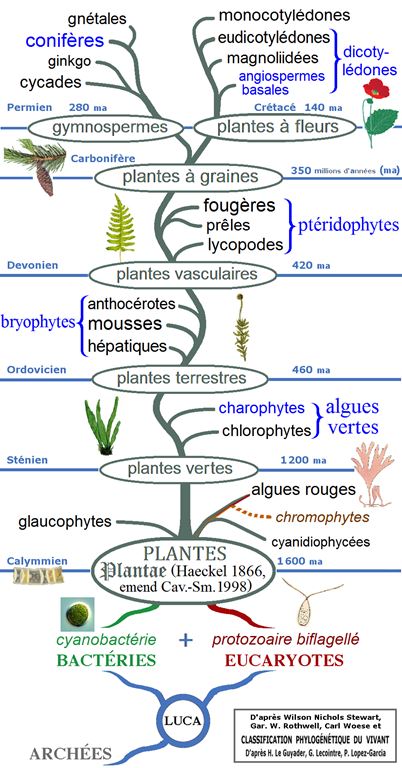
À droite, cet arbre phylogénétique des plantes montre les principaux clades et groupes traditionnels (monophylétiques en noir et paraphylétiques en bleu).
Dénominations
- Nom botanique : Holarrhena pubescens Wall. ex G.Don
- Synonymes : Chonemorpha antidysenterica (Roth) G. Don, Chonemorpha pubescens (Wall.) G. Don, Echites adglutinatus Burm.f, Holarrhena antidysenterica (Roth) Wall. ex A. DC, Nerium antidystericum (Roth.) A. DC, et d'autres
- Noms anglais et locaux : Easter tree, Ivory tree, Conessi bark
Description et culture
Tableau récapitulatif
Parties comes-tibles Note comest. (1-5) Note medic. (1-5) (Zones de) Rusticité Besoins en 
Besoins en  (1-3)
(1-3)Périodes de semis et récoltes Graines au gramme Durée de viabilité Profon-deur semis Espace-ment plants Espace-ment lignes Durée germi-native Durée avant récolte J F M A M J
J A S O N D
J F M A M J
J A S O N D
- dont infos de 0FPI ("FOOD PLANTS INTERNATIONAL", en anglais) :
Description :
Un petit arbre ou un grand arbuste. Il perd ses feuilles. Il atteint 10 m de haut. L'écorce est rugueuse et gris pâle et craquelée. Il se décolle en flocons irréguliers. Les feuilles sont fines et opposées. Ils sont vert pâle et largement ovales. Ils sont en forme de coin à la base. Les fleurs sont blanches ou crème. Ils mesurent 3-4 cm de diamètre. Ils sont en grappes lâches. Ils sont au bout de brindilles. Le fruit est une paire de follicules courbes et élancés. Ils mesurent 20 à 48 cm de long et 6 à 8 mm d'épaisseur. Il s'ouvre pour révéler de nombreuses graines{{{0(+x) (traduction automatique).
Original : A small tree or tall shrub. It loses its leaves. It grows 10 m tall. The bark is rough and pale grey and cracked. It peels off in irregular flakes. The leaves are thin and opposite. They are pale green and broadly oval. They are wedge shaped at the base. The flowers are white or cream. They are 3-4 cm across. They are in loose clusters. They are at the ends of twigs. The fruit are a pair of follicles that are curved and slender. They are 20-48 cm long and 6-8 mm thick. It opens to reveal many seeds{{{0(+x).
 Consommation (rapports de comestibilité, parties utilisables et usages alimentaires correspondants)
Consommation (rapports de comestibilité, parties utilisables et usages alimentaires correspondants)Parties comestibles :
fleurs, graines, fruits, feuilles{{{0(+x) (traduction automatique). Original : Flowers, Seeds, Fruit, Leaves{{{0(+x).Détails :
Les fleurs sont cuites et consommées comme légume. Les jeunes fruits sont consommés comme légume. ATTENTION: Il y a un alcaloïde toxique dans les graines{{{0(+x) (traduction automatique).
Original : The flowers are cooked and eaten as a vegetable. The young fruit are eaten as a vegetable. CAUTION: There is a poisonous alkaloid in the seeds{{{0(+x).
Partie testée :
/ Risques et précautions à prendre
Risques et précautions à prendrecf. consommation
Autres infos
dont infos de 0FPI ("FOOD PLANTS INTERNATIONAL", en anglais) :
Statut :
Les fleurs sont vendues sur les marchés locaux{{{0(+x) (traduction automatique).
Original : Flowers are sold in local markets{{{0(+x).
Distribution :
C'est une plante subtropicale. Il est originaire d'Inde. Il pousse jusqu'à 1 100 m d'altitude dans l'Himalaya. Au Yunnan{{{0(+x) (traduction automatique).
Original : It is a subtropical plant. It is native to India. It grows up to 1,100 m altitude in the Himalayas. In Yunnan{{{0(+x).
Localisation :
Africa, Asia, Bangladesh, Cambodia, China, Himalayas, India, Indochina, Laos, Myanmar, Nepal, Northeastern India, SE Asia, Sikkim, Taiwan, Thailand, Vietnam{{{0(+x) (traduction automatique).
Original : Africa, Asia, Bangladesh, Cambodia, China, Himalayas, India, Indochina, Laos, Myanmar, Nepal, Northeastern India, SE Asia, Sikkim, Taiwan, Thailand, Vietnam{{{0(+x).
Notes :
L'écorce et les graines sont utilisées pour contrôler la dysenterie{{{0(+x) (traduction automatique).
Original : The bark and seeds are used to control dysentery{{{0(+x).
Liens, sources et/ou références
Liens :
/ ;Sources et/ou références :
bibliographie (liste des sources et/ou références de l'encyclopédie)
dont classification : IPNI ("International Plant Names Index", en anglais) ; Kew (POWO - "Plant Of the World Online", "Royal Botanical Garden", en anglais) ;
dont livres et bases de données : 0FPI ("FOOD PLANTS INTERNATIONAL", en anglais) ;
Warning: Undefined variable $prex in /home/waso5761/public_html/inc/fiches.php on line 2607
dont bibliographie/références de 0FPI ("FOOD PLANTS INTERNATIONAL", en anglais) :
Ambasta, S.P. (Ed.), 2000, The Useful Plants of India. CSIR India. p 270 (As Holarrhena antidysenterica) ; Burkill, I.H., 1966, A Dictionary of the Economic Products of the Malay Peninsula. Ministry of Agriculture and Cooperatives, Kuala Lumpur, Malaysia. Vol 1 (A-H) p 1199 (As Holarrhena antidysenterica) ; Chandrakumar, P., et al, 2015, Ethnobotanical studies of wild edible plants of Gond, Halba and Kawar tribes of Salekasa Taluka, Gondia District, Maharashtra State, India. International Research Journal of Pharmacy 6(8) ; Dangol, D. R. et al, 2017, Wild Edible Plants in Nepal. Proceedings of 2nd National Workshop on CUAOGR, 2017. ; Dobriyal, M. J. R. & Dobriyal, R., 2014, Non Wood Forest Produce an Option for Ethnic Food and Nutritional Security in India. Int. J. of Usuf. Mngt. 15(1):17-37 (As Holarrhena antidysenterica) ; Jadhav, R., et al, 2015, Forest Foods of Northern Western Ghats: Mode of Consumption, Nutrition and Availability. Asian Agri-History Vol. 19, No. 4: 293-317 ; Joshi, N., et al, 2007, Traditional neglected vegetables of Nepal: Their sustainable utilization for meeting human needs. Tropentag 2007. Conference on International Agricultural Research for Development. ; Joshi, N. & Siwakoti, M., 2012, Wild Vegetables Used by Local Community of Makawanpur District and Their Contribution to Food Security and Income Generation. Nepal Journal of Science and Technology Vol. 13, No. 1 (2012) 59-66 ; Kumar, S. A., Manus, D. & Mallika, M., 2018, Impact of non-timber forest products on Forest and in Livelihood Economy of the People of Adjoining Areas of Jalpaiguri Forest Division, West Bengal, India. Int. J. of Life Sciences, 2018; 6 (2):365-385 ; Marandi, R. R. & Britto, S. J., 2015, Medicinal Properties of Edible Weeds of Crop Fields and Wild plants Eaten by Oraon Tribals of Latehar District, Jharkhand. International Journal of Life Science and Pharma Research. Vo. 5. (2) April 2015 (As Holarrhena antidysenterica) ; Panda, T., 2014, Traditional knowledge on wild edible plants as livelihood food in Odisha, India. Journal of Biology and Earth Sciences 2014; 4 (2): B144-B159 (As Holarrhena antidysenterica) ; Prafulla, S., 2017, Wild Food Diversity of Nawegaon-Nagzira Tiger Reserve in Gondia-Bhandara district of Maharashtra, India. Int. J. of Life Sciences, 2017, Vol. 5 (4): 620-626 ; Prodr. 8:413. 1844 (As Holarrhena antidysenterica) ; Rahangdale, D.R. & Rahangdale, S.S., 2014, Potential Wild Edible Plant Resources from Maharashtra Future Prospects for their Conservation and Improvement. Life Science Leaflets. http://lifesciencesleaflets.ning.com ; Reddy, B. M., 2012, Wild edible plants of Chandrapur district, Maharashtra, India. Indian Journal of Natural Products and Resources. 3(1) pp 110-117 ; Savita, et al, 2006, Studies on wild edible plants of ethnic people in east Sikkim. Asian J. of Bio Sci. (2006) Vol. 1 No. 2 : 117-125 (As Holarrhena antidysenterica) ; Sarma, H., et al, 2010, Updated Estimates of Wild Edible and Threatened Plants of Assam: A Meta-analysis. International Journal of Botany 6(4): 414-423 (As Holarrhena antidysenterica) ; Sharma, B.D., & Lakshminarasimhan, P., 1986, Ethnobotanical Studies on the Tribals of Nasik District (Maharashtra). J. Econ. Tax. Bot. Vol. 8 No. 2 pp 439-446 (As Holarrhena antidysenterica) ; Swaminathan, M.S., and Kochnar, S.L., 2007, An Atlas of Major Flowering Trees in India. Macmillan. p 200 (As Holarrhena antidysenterica) ; Tewari, D.N., 1994, Important Plants of India. International Book Distributors, India. p 64 (As Holarrhena antidysenterica)
Recherche de/pour :
- "Holarrhena pubescens" sur Google (pages et
images) ;
TPL ("The Plant List", en anglais) ;
GRIN ("Germplasm Resources Information Network", en anglais) ;
TROPICOS (en anglais) ;
Tela Botanica ;
Pl@ntNet ;
Pl@ntUse ;
"Plants For A Future" (en anglais) ;
"Useful Tropical Plants" (en anglais) ou
"Useful Temperate Plants" (en anglais) ;
- "Holarrhena pubescens" sur Google (pages et
images) ;
TPL ("The Plant List", en anglais) ;
GRIN ("Germplasm Resources Information Network", en anglais) ;
TROPICOS (en anglais) ;
Tela Botanica ;
Pl@ntNet ;
Pl@ntUse ;
"Plants For A Future" (en anglais) ;
"Useful Tropical Plants" (en anglais) ou
"Useful Temperate Plants" (en anglais) ;
Espèces de la même famille (Apocynaceae)
688 taxons
- Araujia
- Asclépiade de Curaçao
- Beaumontie à grandes fleurs
- Cascabèle thévétie
- Céropégie de Wood
- Chicle muyo
- Dompte-venin
- Drégée volubile
- Frangipanier blanc
- Frangipanier rouge
- Gingembre blanc
- Gonphocarpe
- Grande pervenche
- Gymnema sylvestre
- Herbe aux perruches
- Karonda
- Mada
- Num num
- Pearl
- Périploque
- Pervenche de Madagascar
- Petite pervenche
- Prunier du natal
- Sarpagandha de l'Inde
- Sorva
- Tabernémontane divariqué
- Tsicta
- Acokanthera oppositifolia (Lam.) Codd
- Acokanthera rotundata (Codd) Kupicha
- Acokanthera schimperi (A.DC.) Schweinf.
- Aganonerion polymorphum Pierre ex Spire
- Alafia lucida Stapf
- Alafia sp
- Alstonia angustiloba Miq.
- Alstonia costata Wall. ex Miq.
- Alstonia macrophylla Wall. ex G.Don
- Alstonia pacifica
- Alstonia scholaris
- Alstonia spatulata Blume
- Alyxia lucida Wall.
- Alyxia stellata
- Amalocalyx microlobus Pierre ex Spire
- Ambelania acida Aubl.
- Ambelania occidentalis Zarucchi
- Amphineuron marginatum
- Ancylobothrys amoena Hua
- Ancylobothrys capensis
- Ancylobothrys petersiana
- Ancylobothrys pyriformis Pierre
- Ancylobothrys scandens
- Ancylobothrys tayloris
- Angolluma laticorona
- Anodendron paniculatum A.DC.
- Apocynum cannabinum L.
- Apocynum venetum A.DC.
- Araujia angustifolia
- Araujia odorata
- Araujia plumosa Schltr.
- Araujia sericifera Brot. (Araujia)
- Asclepias adscendens
- Asclepias affinis De Wild.
- Asclepias albens
- Asclepias asperula
- Asclepias aurea
- Asclepias brevicuspis
- Asclepias buchwaldii
- Asclepias californica Greene
- Asclepias compressidens
- Asclepias crassinervis N.E.Br.
- Asclepias crispa P.J.Bergius
- Asclepias cucullata
- Asclepias cultriformis Harv. ex Schltr.
- Asclepias curassavica Griseb. (Asclépiade de Curaçao)
- Asclepias decumbens L.
- Asclepias densiflora N.E.Br.
- Asclepias dissona N.E.Br.
- Asclepias eminens
- ...







 donne accès au menu
  - encyclopédies des plantes alimentaires ;
 - page de recherche - reconnaissance (identification) de plantes ;
 - page du calendrier lunaire et son générateur (au format PDF et JPG) ;
 - tableau récapitulatif ;
 - générateur de potées (soupes), avec estimation des apports nutrionnels et du coût;
 - générateur de codes QR ;
 - page des archives avec de nombreux documents sur différents thèmes complémentaires comme la botanique, les légumes,
les champignons, la cuisine, le bien-être ainsi que différents MOOC mais également des liens vers les archives de l'association ;
- page des archives avec de nombreux documents sur différents thèmes complémentaires comme la botanique, les légumes,
les champignons, la cuisine, le bien-être ainsi que différents MOOC mais également des liens vers les archives de l'association ;

 ou
ou
 permettant de passer du format standard à l'AMP (et vice-versa), lequel est simplifié et donc plus rapide.
 pour le fruit (et/ou les graines, la pulpe, etc...),
 pour les fleurs (et/ou pétales, calice...),
 pour les feuilles (et/ou la tige, les pousses...),
 pour les racines,
 pour le tronc (et/ou l'écorce, la sève...), et enfin
 pour les champignons,
puis les notes alimentaires et médicinales (de 1 à 5 étoiles), la rusticité (résistance au froid/gel)
et pour finir un résumé.
pour les champignons,
puis les notes alimentaires et médicinales (de 1 à 5 étoiles), la rusticité (résistance au froid/gel)
et pour finir un résumé. menant ici 🙂
 ,
,  et
et





 ,
,


 Encyclopédie(s)
 Recherche-Reconnaissance
 Tableau récapitulatif
 Codes QR
 Archives
 Calendrier(s) lunaire(s)
  Potées
 Re-naturation/naturalisation
 Affichettes, herbiers &
co.
Affichettes, herbiers &
co. menu
menu galerie