Astroloma pinifolium
 |
***
-
*
|
***
-
*
Un petit arbuste raide. Elle peut être dressée ou étendue. Il atteint 20-60 cm de haut et s'étend sur 50 cm - 1,5 m de large. Les feuilles mesurent 12-25 mm de long et 1-2 ... (traduction automatique)
→suite


Affich., herbiers & co.
Astroloma pinifolium
Un petit arbuste raide. Elle peut être dressée ou étendue. Il atteint 20-60 cm de haut et s'étend sur 50 cm - 1,5 m de large. Les feuilles mesurent 12-25 mm de long et 1-2 mm de large. Les feuilles son... (traduction automatique) →suite
Note alimentaire  médicinale


Classification
- Classique : en haut de l'écran, sous le coeur.
- Phylogénétique :
- Clade 4 : Angiospermes ;
- Clade 3 : Dicotylédones_vraies ;
- Clade 2 : Astéridées ;
- Ordre APN : Ericales ;
- Famille APN : Ericaceae ;
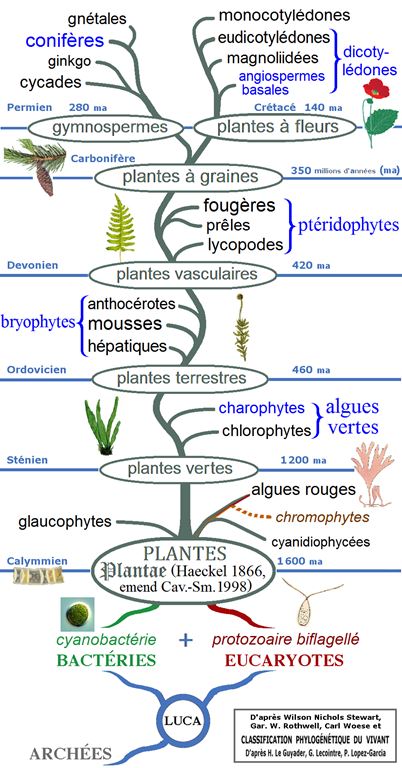
À droite, cet arbre phylogénétique des plantes montre les principaux clades et groupes traditionnels (monophylétiques en noir et paraphylétiques en bleu).
Dénominations
- Nom botanique : Astroloma pinifolium (R. Br.) Benth.
- Noms anglais et locaux : Cranberry, Pine Heath, Pine-leaved Groundberry
Description et culture
Tableau récapitulatif
Parties comes-tibles Note comest. (1-5) Note medic. (1-5) (Zones de) Rusticité Besoins en 
Besoins en  (1-3)
(1-3)Périodes de semis et récoltes Graines au gramme Durée de viabilité Profon-deur semis Espace-ment plants Espace-ment lignes Durée germi-native Durée avant récolte Zones de rusticité : 7, 8, 9, 10 J F M A M J
J A S O N D
J F M A M J
J A S O N D
Types de feuillage :
Persistant
- dont infos de 0FPI ("FOOD PLANTS INTERNATIONAL", en anglais) :
Description :
Un petit arbuste raide. Elle peut être dressée ou étendue. Il atteint 20-60 cm de haut et s'étend sur 50 cm - 1,5 m de large. Les feuilles mesurent 12-25 mm de long et 1-2 mm de large. Les feuilles sont serrées ensemble et comme des aiguilles. Ils ont des pointes acérées. Les parties les plus anciennes de la plante n'ont souvent pas de feuilles. Les bords des feuilles sont bouclés. Les fleurs se développent sur de courtes tiges à la base de la croissance des saisons précédentes. Les fleurs sont jaunes avec des pointes vertes et forment de longs tubes comme des cloches. Ils mesurent 15 à 18 mm de long. Ils sont serrés à la gorge. Les pointes des pétales se recourbent. Le fruit est rond. Il est vert. Il a une couche charnue sur une pierre dure{{{0(+x) (traduction automatique).
Original : A small stiff shrub. It can be erect or spreading. It grows to 20-60 cm tall and spread 50 cm - 1.5 m wide. The leaves are 12-25 mm long and 1-2 mm wide. The leaves are crowded together and like needles. They have sharp points. Older parts of the plant often do not have leaves. The edges of the leaves are curled. The flowers develop on short stalks at the base of the previous seasons growth. The flowers are yellow with green tips and form long tubes like bells. They are 15-18 mm long. They are constricted at the throat. The tips of the petals curve back. The fruit is round. It is green. It has a fleshy layer over a hard stone{{{0(+x).
Production :
Les plantes fleurissent de septembre à mars{{{0(+x) (traduction automatique).
Original : Plants flower from September to March{{{0(+x).
Culture :
Les plantes peuvent être cultivées à partir de graines. Les graines germent lentement. Il peut également être cultivé à partir de boutures{{{0(+x) (traduction automatique).
Original : Plants can be grown from seed. Seed are slow to germinate. It can also be grown from cuttings{{{0(+x).
Consommation (rapports de comestibilité, parties utilisables et usages alimentaires correspondants)
Consommation (rapports de comestibilité, parties utilisables et usages alimentaires correspondants)Parties comestibles :
fruit{{{0(+x) (traduction automatique). Original : Fruit{{{0(+x).Partie testée :
fruit{{{0(+x) (traduction automatique). Original : Fruit{{{0(+x) Risques et précautions à prendre
Risques et précautions à prendrenéant, inconnus ou indéterminés.
Galerie(s)

Par Edwards, S.T., Botanical Register (1815-1828) Bot. Reg. vol. 3 (1817), via plantillustrations
✖

Par Natural History Museum, London Nat. Hist. Mus., London, via plantillustrations
✖

![Illustration Astroloma pinifolium, Par Loddiges, C.L., botanical cabinet [C. Loddiges] (1817-1833) Bot. Cab. vol. 3 (1818), via plantillustrations](inc/images/illustrations/astroloma_pinifolium3.jpg)
Par Loddiges, C.L., botanical cabinet [C. Loddiges] (1817-1833) Bot. Cab. vol. 3 (1818), via plantillustrations
✖
Autres infos
dont infos de 0FPI ("FOOD PLANTS INTERNATIONAL", en anglais) :
Distribution :
Une plante tempérée. Il pousse dans les landes côtières. Il peut également pousser dans les régions subtropicales et semi-arides. Il peut tolérer de fortes gelées. Il a besoin de sols humides bien drainés ou de sols secs. Il a besoin du plein soleil. Jardins botaniques de Hobart. Herbier de Tasmanie{{{0(+x) (traduction automatique).
Original : A temperate plant. It grows in coastal heaths. It can also grow in subtropical and semiarid regions. It can tolerate heavy frosts. It needs moist well drained soils or dry soils. It needs full sunlight. Hobart Botanical Gardens. Tasmania Herbarium{{{0(+x).
Localisation :
Australie *, Tasmanie *{{{0(+x) (traduction automatique).
Original : Australia*, Tasmania*{{{0(+x).
Notes :
Il existe environ 20 espèces d'astrolomes{{{0(+x) (traduction automatique).
Original : There are about 20 Astroloma species{{{0(+x).
Rusticité (résistance face au froid/gel, climat)
Zones de rusticité : 7, 8, 9, 10
Liens, sources et/ou références
Liens :
/ ;Sources et/ou références :
bibliographie (liste des sources et/ou références de l'encyclopédie)
dont livres et bases de données : 5PFAF ("Plants For A Future", en anglais) ; 0FPI ("FOOD PLANTS INTERNATIONAL", en anglais) ;
dont bibliographie/références de 0FPI ("FOOD PLANTS INTERNATIONAL", en anglais) :
Bircher, A. G. & Bircher, W. H., 2000, Encyclopedia of Fruit Trees and Edible Flowering Plants in Egypt and the Subtropics. AUC Press. p 47 ; Bodkin, F., 1991, Encyclopedia Botanica. Cornstalk publishing, p 115 ; Cameron, M., (Ed.) 1981, A Guide to Flowers & Plants of Tasmania. Reed p 80 ; Cherikoff V. & Isaacs, J., The Bush Food Handbook. How to gather, grow, process and cook Australian Wild Foods. Ti Tree Press, Australia p 194 ; Collier, P., 1993, Woodland Wild flowers of Tasmania. Plant Identikit. Society for growing Australian Plants Tasmania Region. Hobart. p 32 ; Curtis, W.M., 1963, The Students Flora of Tasmania Vol 2 p 424 ; Elliot, W.R., & Jones, D.L., 1982, Encyclopedia of Australian Plants suitable for cultivation. Vol 2. Lothian. p 250 ; Fl. austral. 4:159. 1869 ; Gilfedder, L et al, 2003, The Nature of the Midlands. Midlands Bushweb. PO Box 156 Longford, Tasmania. p 88 ; Greig, D., 1996, Flowering Natives for Home Gardens. Angus & Robertson. p 58 ; Grieg, D., 2002, A photographic guide to Wildflowers of South-eastern Australia. New Holland. p 31 ; Hibbert, M., 2002, The Aussie Plant Finder 2002, Florilegium. p 35 ; Howells, C & Gulline, H., 2003, Coastal Plants of Tasmania. Plant Identikit. Australian Plant Society, Tasmania. p 27 ; Lord, E.E., & Willis, J.H., 1999, Shrubs and Trees for Australian gardens. Lothian. p 149 ; Minchin, R.F., Tasmanian Wildflowers. A Field Guide. Volume one. Regal Publications, Launceston p 94 ; Molyneux, B & Forrester, S., 1997, The Austraflora A-Z of Australian Plants. Reed. p 46 ; Plants for a Future database, The Field, Penpol, Lostwithiel, Cornwall, PL22 0NG, UK. http://www.scs.leeds.ac.uk/pfaf/ ; Tasmanian Herbarium Vascular Plants list p 25 ; Whiting, J. et al, 2004, Tasmania's Natural Flora. Tasmania's Natural Flora Editorial Committee PO Box 194, Ulverstone, Tasmania, Australia 7315 p 115
Recherche de/pour :
- "Astroloma pinifolium" sur Google (pages et
images) ;
IPNI ("International Plant Names Index", en anglais) ;
TPL ("The Plant List", en anglais) ;
GRIN ("Germplasm Resources Information Network", en anglais) ;
TROPICOS (en anglais) ;
Tela Botanica ;
Pl@ntNet ;
Pl@ntUse ;
"Useful Tropical Plants" (en anglais) ou
"Useful Temperate Plants" (en anglais) ;
- "Astroloma pinifolium" sur Google (pages et
images) ;
IPNI ("International Plant Names Index", en anglais) ;
TPL ("The Plant List", en anglais) ;
GRIN ("Germplasm Resources Information Network", en anglais) ;
TROPICOS (en anglais) ;
Tela Botanica ;
Pl@ntNet ;
Pl@ntUse ;
"Useful Tropical Plants" (en anglais) ou
"Useful Temperate Plants" (en anglais) ;
Espèces du même genre (Astroloma)
7 taxons
Espèces de la même famille (Ericaceae)
399 taxons
- Agératum bleu
- Airelle à feuilles étroites
- Airelle à feuilles membraneuses
- Airelle à gros fruits
- Airelle à petites feuilles
- Airelle ovale
- Airelle rouge
- Andromède
- Arbousier
- Arbousier américain
- Arbousier de Chypre
- Arbousier hybride
- Bleuet/myrtille noire du sud des etats-unis (tp* d
- Bruyère à quatre angles
- Bruyère cendrée
- Bruyère commune
- Bruyère des Açores
- Bruyère en arbre
- Busserole
- Busserole des alpes
- Camarine noire
- Canneberge
- Canneberge à petits fruits
- Chimaphile
- Chimaphile ombellée
- Corème blanche
- Gaulthérie couchée
- Gaulthérie shallon
- Laurier-rose des Alpes
- Lédon des marais
- Myrtillier
- Myrtillier 'sunshine blue dwarf'
- Myrtillier d'Amérique
- Myrtillier des marais ou marécages
- Myrtillier du New Jersey (tp* de "New Jersey blueber
- Myrtillier en cascasde
- Myrtillier/bleuet d'elliott (tp* de "Elliott's blue
- Myrtillier/bleuet de darrow (tp* de "Darrow's blueb
- Myrtillier/bleuet du canada
- Ohelo berry
- Petite Pyrole
- Pirole maritime
- Pirole unilatérale
- Pyrole uniflore
- Rhododendron de Kaempfer
- Rhododendron de la mer Noire
- Rhododendron de Sims
- Rhododendron du Japon
- Rhododendron écarlate
- Rhododendron faux-argousier
- Acrothamnus hookeri
- Acrothamnus montanus
- Acrotriche aggregata R.Br.
- Acrotriche depressa R.Br.
- Acrotriche divaricata R.Br.
- Acrotriche prostrata F.Muell.
- Acrotriche rigida B.R.Paterson
- Acrotriche serrulata R.Br.
- Agapetes saligna
- Agapetes serpens
- Agapetes variegata
- Ageratum conyzoides Sieber ex Steud. (Agératum bleu)
- Andromeda glaucophylla Link
- Andromeda polifolia L. (Andromède)
- Anthopterus wardii Ball
- Arbutus andrachne L. (Arbousier de Chypre)
- Arbutus arizonica
- Arbutus canariensis Veill. ex Duhamel (Arbousier)
- Arbutus glandulosa M.Martens & Galeotti
- Arbutus menziesii Pursh (Arbousier américain)
- Arbutus texana Buckley
- Arbutus unedo L. (Arbousier)
- Arbutus x andrachnoides (Arbousier hybride)
- Arbutus xalapensis Andrews ex Hook.
- Arctostaphylos alpina (L.) Spreng. (Busserole des alpes)
- Arctostaphylos caucasica Lipsch.
- Arctostaphylos columbiana Piper
- Arctostaphylos glauca S.Watson
- Arctostaphylos hookeri G.Don
- Arctostaphylos manzanita Parry
- Arctostaphylos nevadensis A.Gray
- Arctostaphylos obispoensis Eastw.
- Arctostaphylos parryana Lemmon
- Arctostaphylos patula Greene
- Arctostaphylos pringlei Parry
- Arctostaphylos pungens A.Gray
- Arctostaphylos rubra
- Arctostaphylos stanfordiana Parry
- Arctostaphylos tomentosa (Pursh) Lindl.
- Arctostaphylos tomentosum
- Arctostaphylos uva-ursi (L.) Spreng. (Busserole)
- Arctostaphylos viscida Parry
- Arctous alpina
- Arctous rubra
- Astroloma ciliatum
- Astroloma conostephioides
- Astroloma humifusum
- Astroloma microcalyx Sond.
- Astroloma pallidum R.Br.
- Astroloma serratifolium
- ...







 donne accès au menu
  - encyclopédies des plantes alimentaires ;
 - page de recherche - reconnaissance (identification) de plantes ;
 - page du calendrier lunaire et son générateur (au format PDF et JPG) ;
 - tableau récapitulatif ;
 - générateur de potées (soupes), avec estimation des apports nutrionnels et du coût;
 - générateur de codes QR ;
 - page des archives avec de nombreux documents sur différents thèmes complémentaires comme la botanique, les légumes,
les champignons, la cuisine, le bien-être ainsi que différents MOOC mais également des liens vers les archives de l'association ;
- page des archives avec de nombreux documents sur différents thèmes complémentaires comme la botanique, les légumes,
les champignons, la cuisine, le bien-être ainsi que différents MOOC mais également des liens vers les archives de l'association ;

 ou
ou
 permettant de passer du format standard à l'AMP (et vice-versa), lequel est simplifié et donc plus rapide.
 pour le fruit (et/ou les graines, la pulpe, etc...),
 pour les fleurs (et/ou pétales, calice...),
 pour les feuilles (et/ou la tige, les pousses...),
 pour les racines,
 pour le tronc (et/ou l'écorce, la sève...), et enfin
 pour les champignons,
puis les notes alimentaires et médicinales (de 1 à 5 étoiles), la rusticité (résistance au froid/gel)
et pour finir un résumé.
pour les champignons,
puis les notes alimentaires et médicinales (de 1 à 5 étoiles), la rusticité (résistance au froid/gel)
et pour finir un résumé. menant ici 🙂
 ,
,  et
et





 ,
,


 Encyclopédie(s)
 Recherche-Reconnaissance
 Tableau récapitulatif
 Codes QR
 Archives
 Calendrier(s) lunaire(s)
  Potées
 Re-naturation/naturalisation
 Affichettes, herbiers &
co.
Affichettes, herbiers &
co. menu
menu galerie







 (en bas à gauche).
