
 Encyclopédie(s)
 Recherche-Reconnaissance
 Tableau récapitulatif
 Codes QR
 Archives
 Calendrier(s) lunaire(s)
  Potées
 Re-naturation/naturalisation
 Affichettes, herbiers &
co.
Affichettes, herbiers &
co. menu
menu galerie


Poivre du sichuan
(Zanthoxylum simulans)


 |
***
-
**
|
***
-
**
-15°C
Un arbre à feuilles caduques. Il atteint 6 m de haut. C'est une forme large et étalée. L'écorce est grise avec des processus en forme de cône dessus. Les feuilles ont des ... (traduction automatique)
→suite


Affich., herbiers & co.
Poivre du sichuan
Un arbre à feuilles caduques. Il atteint 6 m de haut. C'est une forme large et étalée. L'écorce est grise avec des processus en forme de cône dessus. Les feuilles ont des folioles le long de la tige. ... (traduction automatique) →suite
Note alimentaire  médicinale

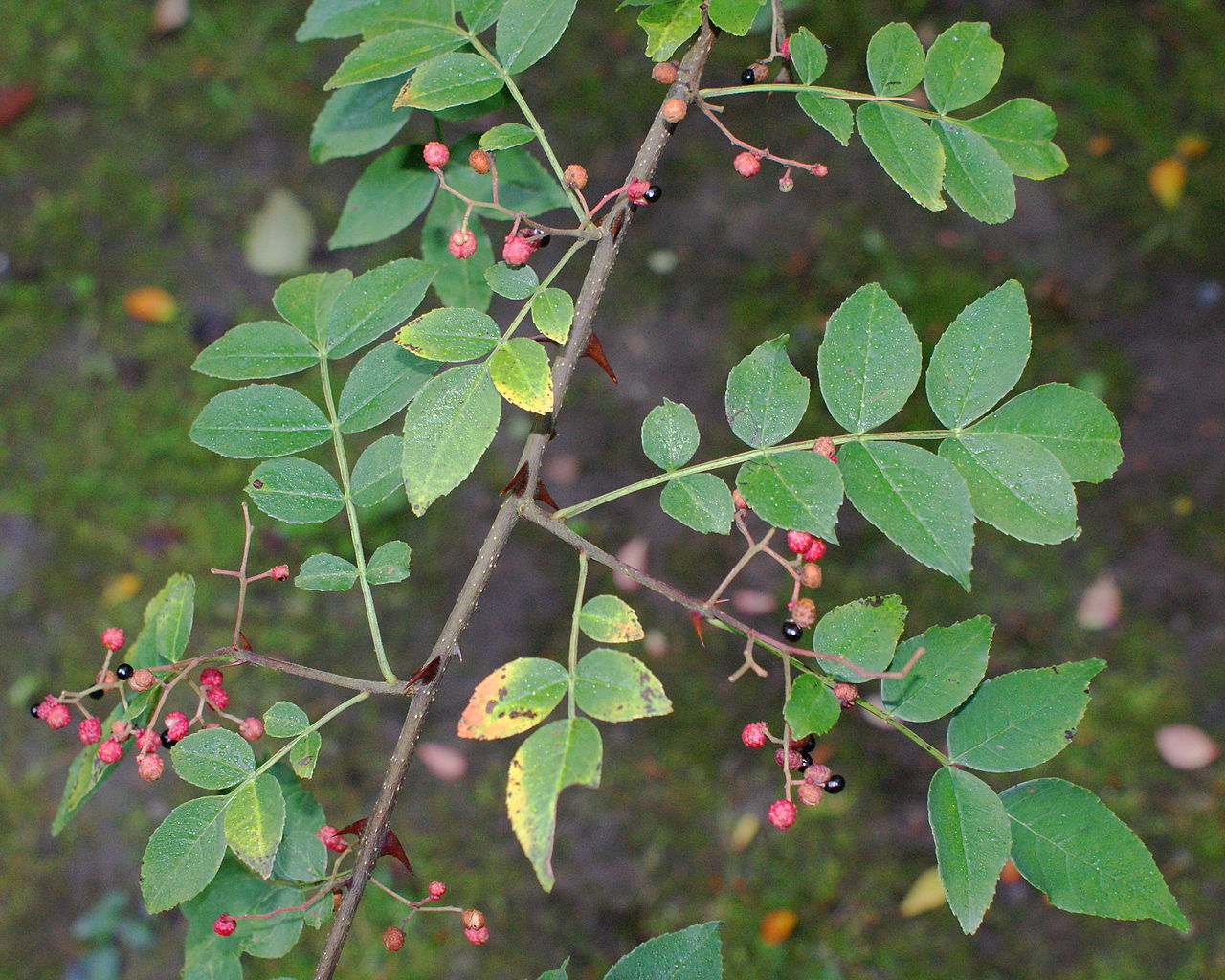
Zanthoxylum simulans
Classification
- Classique : en haut de l'écran, sous le coeur.
- Phylogénétique :
- Clade 4 : Angiospermes ;
- Clade 3 : Dicotylédones_vraies ;
- Clade 2 : Rosidées ;
- Clade 1 : Malvidées ;
- Ordre APN : Sapindales ;
- Famille APN : Rutaceae ;
À droite, cet arbre phylogénétique des plantes montre les principaux clades et groupes traditionnels (monophylétiques en noir et paraphylétiques en bleu).

Dénominations
- Nom botanique : Zanthoxylum simulans Hance (1866)
- Synonymes français : clavalier à feuilles de frêne, poivrier chinois, poivre de montagne, clavalier
- Synonymes : Probably now Zanthoxylum bungeanum
- Noms anglais et locaux : Chinese-pepper (Chinese pepper), Sichuan-pepper, Szechuan-pepper (Szechwan pepper), flat-spine prickly ash, prickly ash, hua-chiao, Sichuan peppercorn, ye hua jiao (cn transcrit), täuschende Stachelesche (de), kinesiskt pepparträd (sv)
Description et culture
Tableau récapitulatif
Parties comes-tibles Note comest. (1-5) Note medic. (1-5) (Zones de) Rusticité Besoins en 
Besoins en  (1-3)
(1-3)Périodes de semis et récoltes Graines au gramme Durée de viabilité Profon-deur semis Espace-ment plants Espace-ment lignes Durée germi-native Durée avant récolte -15°C J F M A M J
J A S O N D
J F M A M J
J A S O N D55
Types de feuillage :
Caduque
Nombre de graines au gramme :
55
- dont infos de 0FPI ("FOOD PLANTS INTERNATIONAL", en anglais) :
Description :
Un arbre à feuilles caduques. Il atteint 6 m de haut. C'est une forme large et étalée. L'écorce est grise avec des processus en forme de cône dessus. Les feuilles ont des folioles le long de la tige. Les feuilles mesurent 20 cm de long et il y a environ 11 folioles. Ils sont ovales et vert brillant. Il peut y avoir des piquants sur la surface supérieure. La tige a des piquants. Les fleurs sont petites et vertes. Ils se produisent en grappes de 5 cm de diamètre. Les fruits sont petits et ronds. Ils sont verruqueux et ont un fort arôme. Ils mesurent 5 mm de diamètre. Ils sont verts et mûrissent au rouge. En séchant, ils s'ouvrent pour révéler des graines noires brillantes.
Probablement maintenant Zanthoxylum bungeanum{{{0(+x) (traduction automatique).
Original : A deciduous tree. It grows 6 m high. It is a broad spreading shape. The bark is grey with cone shaped processes over it. The leaves have leaflets along the stalk. The leaves are 20 cm long and there are about 11 leaflets. They are oval and glossy green. There can be some prickles on the upper surface. The stalk has prickles. The flowers are small and green. They occur in clusters 5 cm across. The fruit are small and round. They are warty and have a strong aroma. They are 5 mm across. They are green and ripen to red. On drying they split open to reveal shiny black seeds. Probably now Zanthoxylum bungeanum{{{0(+x).
Consommation (rapports de comestibilité, parties utilisables et usages alimentaires correspondants)
Consommation (rapports de comestibilité, parties utilisables et usages alimentaires correspondants)Partie(s) comestible(s){{{0(+x) : fruit, graines, écorce, aromatisant, feuilles{{{0(+x).
Utilisation(s)/usage(s){{{0(+x) culinaire(s) :
-le fruit est séché et grillé et utilisé comme condiment soit entier, soit broyé en poudre ; il est utilisé pour l'assaisonnement de l'huile d'arachide et pour les plats sautés{{{0(+x) ;
-feuilles cuites (ex. : comme potherbe) ? (qp*).
Partie testée :
/ Risques et précautions à prendre
Risques et précautions à prendrenéant, inconnus ou indéterminés.
Autres infos
Synonyme de Zanthoxylum bungeanum Maxim. 1871, selon TPL{{{(rp*).
Distribution :
C'est une plante tempérée. Il est originaire de Chine. Il pousse dans les bois de montagne et les fourrés. Il convient aux zones de rusticité 5-8{{{0(+x) (traduction automatique).
Original : It is a temperate plant. It is native to China. It grows in mountain woods and thickets. It suits hardiness zones 5-8{{{0(+x).
Localisation :
Asie, Australie, Chine, Japon, Slovénie, Taiwan{{{0(+x) (traduction automatique).
Original : Asia, Australia, China, Japan, Slovenia, Taiwan{{{0(+x).
Notes :
Il existe environ 200 espèces de Zanthoxylum{{{0(+x) (traduction automatique).
Original : There are about 200 Zanthoxylum species{{{0(+x).
Rusticité (résistance face au froid/gel, climat)
-15°C
Liens, sources et/ou références
Liens :
Wikipedia ;Sources et/ou références :
bibliographie (liste des sources et/ou références de l'encyclopédie)
dont classification : IPNI ("International Plant Names Index", en anglais) ; TPL ("The Plant List", en anglais) ; GRIN ("Germplasm Resources Information Network", en anglais) ; Kew (POWO - "Plant Of the World Online", "Royal Botanical Garden", en anglais) ;
dont livres et bases de données : 5PFAF ("Plants For A Future", en anglais) ; 0FPI ("FOOD PLANTS INTERNATIONAL", en anglais) ;
dont bibliographie/références de 0FPI ("FOOD PLANTS INTERNATIONAL", en anglais) :
Ann. Sci. Nat. Bot. ser. 5, 5:208. 1866 ; Brickell, C. (Ed.), 1999, The Royal Horticultural Society A-Z Encyclopedia of Garden Plants. Convent Garden Books. p 1068 ; Coombes, A.J., 2000, Trees. Dorling Kindersley Handbooks. p 285 ; Cundall, P., (ed.), 2004, Gardening Australia: flora: the gardener's bible. ABC Books. p 1495 ; Facciola, S., 1998, Cornucopia 2: a Source Book of Edible Plants. Kampong Publications, p 221 ; Hu, Shiu-ying, 2005, Food Plants of China. The Chinese University Press. p 504 ; Martin, F. W., et al, 1987, Perennial Edible Fruits of the Tropics. USDA Handbook 642 p 78 ; Solomon, C., 2001, Encyclopedia of Asian Food. New Holland. p 371
Recherche de/pour :
- "Zanthoxylum simulans" sur Google (pages et
images) ;
TROPICOS (en anglais) ;
Tela Botanica ;
Pl@ntNet ;
Pl@ntUse ;
"Useful Tropical Plants" (en anglais) ou
"Useful Temperate Plants" (en anglais) ;
- "Poivre du sichuan" sur Google (pages, images et recettes) ;
- "Zanthoxylum simulans" sur Google (pages et
images) ;
TROPICOS (en anglais) ;
Tela Botanica ;
Pl@ntNet ;
Pl@ntUse ;
"Useful Tropical Plants" (en anglais) ou
"Useful Temperate Plants" (en anglais) ;
Espèces du même genre (Zanthoxylum)
41 taxons
- Andaliman
- Clavalier américain ou d'amérique,
- Clavalier de corée ou coréen
- Clavalier de l'inde
- Fagarier hétérophylle
- Poivrier de sichuan
- Zanthoxylum acanthopodium DC. (Andaliman)
- Zanthoxylum ailanthoides Siebold & Zucc.
- Zanthoxylum alatum Roxb.
- Zanthoxylum americanum Mill. (Clavalier américain ou d'amérique,)
- Zanthoxylum armatum DC.
- Zanthoxylum avicennae (Lam.) DC.
- Zanthoxylum beecheyanum K.Koch
- Zanthoxylum budrunga
- Zanthoxylum bungeanum Maxim.
- Zanthoxylum chalybeum Engl.
- Zanthoxylum clava-herculis L.
- Zanthoxylum coreanum Nakai (Clavalier de corée ou coréen)
- Zanthoxylum deremense
- Zanthoxylum fagara
- Zanthoxylum flavum Vahl
- Zanthoxylum gilletii
- Zanthoxylum hamiltonianum Wall. ex Hook.f.
- Zanthoxylum heitzii
- Zanthoxylum heterophyllum (Fagarier hétérophylle)
- Zanthoxylum holtzianum
- Zanthoxylum khasianum Hook.f.
- Zanthoxylum lemairei
- Zanthoxylum leprieurii Guill. & Perr.
- Zanthoxylum limonella
- Zanthoxylum martinicense
- Zanthoxylum myriacanthum Wall. ex Hook.f.
- Zanthoxylum nitidum (Roxb.) DC.
- Zanthoxylum okinawense
- Zanthoxylum ovalifolium Wight
- Zanthoxylum oxyphyllum Edgew.
- Zanthoxylum paracanthum
- Zanthoxylum piperitum (L.) DC. (Poivrier de sichuan)
- Zanthoxylum planispinum Siebold & Zucc.
- Zanthoxylum rhetsa (Roxb.) DC. (Clavalier de l'inde)
- Zanthoxylum rhoifolium Lam.
- Zanthoxylum schinifolium Siebold & Zucc.
- Zanthoxylum sp
- Zanthoxylum usambarense
- Zanthoxylum usitatum Diels
- Zanthoxylum zanthoxyloides
Espèces de la même famille (Rutaceae)
321 taxons
- Andaliman
- Bael
- Bergamotier
- Bigaradier
- Buis de chine
- Calamondin
- Caloupilé
- Cédrat
- Citrange
- Citrangequat
- Citron caviar
- Citron doux
- Citron ponderosa
- Citron rouge
- Citron verruqueux,
- Citronnier
- Citronnier meyer
- Clavalier américain ou d'amérique,
- Clavalier de corée ou coréen
- Clavalier de l'inde
- Clémentinier
- Clémentinier et mandarinier
- Combava
- Dictame blanc
- Diosmée hirsute
- Fagarier hétérophylle
- Haplophylle tuberculé
- Kawista batu
- Kugli
- Kumquat
- Kumquat de Malaisie
- Kumquat Fukushu
- Kumquat meiwa
- Kumquat rond
- Kumquat sauvage
- Lime du désert
- Lime mont blanc
- Limequat
- Limette de palestine
- Limettier
- Limettier de Tahiti
- Mandarine shekwasha
- Mandariner satsuma
- Mandarinier
- Mandarinier changsha
- Mandarinier chinotto
- Mandarinier king
- Matasano
- Omuboro
- Oranger
- Acronychia aberrans T.G.Hartley
- Acronychia acidula F.Muell.
- Acronychia acrynychioides
- Acronychia bauerlenii
- Acronychia chooreechillum
- Acronychia crassipetala T.G.Hartley
- Acronychia imperforata F.Muell.
- Acronychia laevis J.R.Forst. & G.Forst.
- Acronychia oblongifolia
- Acronychia odorata
- Acronychia oligoplebia
- Acronychia parviflora C.T.White
- Acronychia pedunculata
- Acronychia pubescens
- Acronychia suberosa C.T.White
- Acronychia vestita F.Muell.
- Acronychia wilcoxiana
- Adenandra formosana
- Adenandra fragrans Eckl. & Zeyh.
- Adenandra ryukyuensis
- Aegle marmelos (L.) Corrêa (Bael)
- Afraegle paniculata (Schumach. & Thonn.) Engl.
- Agathosma betulina
- Agathosma crenulata
- Agathosma hispida
- Agathosma ovata
- Amyris elemifera J.Koenig ex Blume
- Amyris pinnata Kunth
- Angostura trifoliata
- Atalantia buxifolia
- Atalantia ceylanica
- Atalantia citroides Pierre ex Guillaumin
- Atalantia malabarica
- Atalantia monophylla DC.
- Atalantia racemosa Wight ex Hook.
- Balsamocitrus daweii
- Bergera koenigii L. (Caloupilé)
- Boronia bipinnata Lindl.
- Boronia megastigma Nees ex Bartl.
- Calodendrum capense
- Casimiroa edulis La Llave (Sapotier blanc)
- Casimiroa pringlei
- Casimiroa pubescens Ramrez
- Casimiroa sapota Oerst.
- Casimiroa tetrameria Millsp. (Matasano)
- Casimiroa watsonii Engl.
- Chloroxylon swietenia DC.
- Citremocitrus x sp
- Citrofortunella floridana x
- Citrofortunella microcarpa x (Bunge) Wijnands (Calamondin)
- ...





 - page de recherche - reconnaissance (identification) de plantes ;
 - page des archives avec de nombreux documents sur différents thèmes complémentaires comme la botanique, les légumes,
les champignons, la cuisine, le bien-être ainsi que différents MOOC mais également des liens vers les archives de l'association ;
- page des archives avec de nombreux documents sur différents thèmes complémentaires comme la botanique, les légumes,
les champignons, la cuisine, le bien-être ainsi que différents MOOC mais également des liens vers les archives de l'association ;

 pour poser des question à l'IA (Terra) ou discuter avec elle/lui, et ce
 ou
ou
 permettant de passer du format standard à l'AMP (et vice-versa), lequel est simplifié et donc plus rapide.
 pour les fleurs (et/ou pétales, calice...),
 pour les racines,
 pour les champignons,
puis les notes alimentaires et médicinales (de 1 à 5 étoiles), la rusticité (résistance au froid/gel)
et pour finir un résumé.
pour les champignons,
puis les notes alimentaires et médicinales (de 1 à 5 étoiles), la rusticité (résistance au froid/gel)
et pour finir un résumé. menant ici 🙂
 et
et

 ,
,
 ,
,
 ,
,





 ,
,







