Bouea oppositifolia
Pas d'illustration
pour le moment 😕

Un petit arbre. Il atteint une hauteur de 8 à 10 m. Il peut atteindre une hauteur de 20 à 40 m et avoir un tronc de 30 cm de diamètre. L'écorce est gris foncé et peut prà ... (traduction automatique)
→suite


Affich., herbiers & co.
Bouea oppositifolia

Un petit arbre. Il atteint une hauteur de 8 à 10 m. Il peut atteindre une hauteur de 20 à 40 m et avoir un tronc de 30 cm de diamètre. L'écorce est gris foncé et peut présenter des fissures peu profo... (traduction automatique) →suite
Pas d'illustration
pour le moment 😕
Pas d'illustration
pour le moment 😕
Classification
- Classique : en haut de l'écran, sous le coeur.
- Phylogénétique :
- Clade 4 : Angiospermes ;
- Clade 3 : Dicotylédones_vraies ;
- Clade 2 : Rosidées ;
- Clade 1 : Malvidées ;
- Ordre APN : Sapindales ;
- Famille APN : Anacardiaceae ;
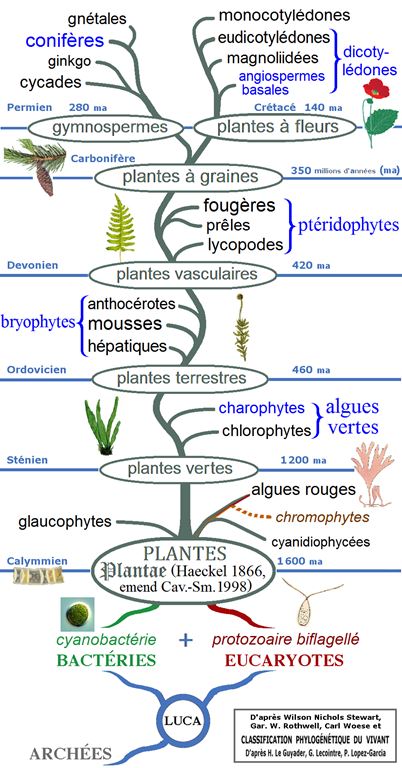
À droite, cet arbre phylogénétique des plantes montre les principaux clades et groupes traditionnels (monophylétiques en noir et paraphylétiques en bleu).
Dénominations
- Nom botanique : Bouea oppositifolia (Roxb.) Meisn.
- Synonymes : Bouea angustifolia Blume, Bouea brandisiana Kurz, Bouea burmanica Hook.f. non Griffith, Bouea burmanica var. kurzii Lecomte, Bouea burmanica var. microphylla (Griff.) Engl, Bouea burmanica var. roxburghii Lecomte, Bouea diversifolia Miq, Bouea gandaria Blume, Bouea microphylla Griffith, Bouea myrsinoides Bl, Cambessedea oppositifolia (Roxb.) Wight & Arn ex Voigt, Haplospondias brandisiana (Kurz) Kosterm, Manga acida Noronha, Mangifera oppositifolia Roxb, Matania laotica Gagnep
- Noms anglais et locaux : Plum mango
Description et culture
Tableau récapitulatif
Parties comes-tibles Note comest. (1-5) Note medic. (1-5) (Zones de) Rusticité Besoins en 
Besoins en  (1-3)
(1-3)Périodes de semis et récoltes Graines au gramme Durée de viabilité Profon-deur semis Espace-ment plants Espace-ment lignes Durée germi-native Durée avant récolte J F M A M J
J A S O N D
J F M A M J
J A S O N D
- dont infos de 0FPI ("FOOD PLANTS INTERNATIONAL", en anglais) :
Description :
Un petit arbre. Il atteint une hauteur de 8 à 10 m. Il peut atteindre une hauteur de 20 à 40 m et avoir un tronc de 30 cm de diamètre. L'écorce est gris foncé et peut présenter des fissures peu profondes. Les feuilles sont opposées. Ils sont simples, en forme d'épée et rugueux. Les fleurs sont dans un arrangement floral lâche. Les fleurs ont 3-5 pétales. Le fruit a une graine à l'intérieur d'une pierre violette. Les fleurs et les fruits sont aux extrémités des brindilles. Le fruit mûr est jaune orangé. C'est comme une petite mangue. Ils mesurent 2,5 cm de long. La chair est jaune{{{0(+x) (traduction automatique).
Original : A small tree. It grows 8-10 m tall. It can grow 20-40 m high and have a trunk 30 cm across. The bark is dark grey and can have shallow cracks. The leaves are opposite. They are simple, sword shaped and rough. The flowers are in a loose flower arrangement. The flowers have 3-5 petals. The fruit has one seed inside a violet stone. The flowers and fruit are at the ends of twigs. The ripe fruit are orange yellow. It is like a small mango. They are 2.5 cm long. The flesh is yellow{{{0(+x).
Production :
La fructification est saisonnière{{{0(+x) (traduction automatique).
Original : Fruiting is seasonal{{{0(+x).
Culture :
Les plantes sont cultivées à partir de graines{{{0(+x) (traduction automatique).
Original : Plants are grown from seeds{{{0(+x).
 Consommation (rapports de comestibilité, parties utilisables et usages alimentaires correspondants)
Consommation (rapports de comestibilité, parties utilisables et usages alimentaires correspondants)Parties comestibles :
feuilles, fruits{{{0(+x) (traduction automatique). Original : Leaves, Fruit{{{0(+x).Détails :
Les jeunes fruits peuvent être consommés crus ou sucrés. Ceux-ci sont également utilisés en cuisine. Certains sont marinés. Les fruits mûrs sont sucrés. La moitié des fruits mûrs sont transformés en conserves{{{0(+x) (traduction automatique).
Original : The young fruit can be eaten raw or sweetened. These are also used in cooking. Some are pickled. Ripe fruit are sweet. Half ripe fruit are made into preserves{{{0(+x).
Partie testée :
feuilles{{{0(+x) (traduction automatique). Original : Leaves{{{0(+x) Risques et précautions à prendre
Risques et précautions à prendrenéant, inconnus ou indéterminés.
Autres infos
dont infos de 0FPI ("FOOD PLANTS INTERNATIONAL", en anglais) :
Statut :
C'est un fruit cultivé{{{0(+x) (traduction automatique).
Original : It is a cultivated fruit{{{0(+x).
Distribution :
Une plante tropicale. Il pousse dans les forêts tropicales pluviales des basses terres jusqu'à 600 m d'altitude. Il pousse dans les climats de mousson. Au Yunnan{{{0(+x) (traduction automatique).
Original : A tropical plant. It grows in lowland tropical rainforests up to 600 m above sea level. It grows in monsoonal climates. In Yunnan{{{0(+x).
Localisation :
Asie, îles Andaman, Brunei, Cambodge, Chine, Inde, Indochine, Indonésie, Laos, Malaisie, Myanmar, Pacifique, Philippines, Asie du Sud-Est, Thaïlande, Vietnam{{{0(+x) (traduction automatique).
Original : Asia, Andaman Islands, Brunei, Cambodia, China, India, Indochina, Indonesia, Laos, Malaysia, Myanmar, Pacific, Philippines, SE Asia, Thailand, Vietnam{{{0(+x).
Liens, sources et/ou références
Liens :
/ ;Sources et/ou références :
bibliographie (liste des sources et/ou références de l'encyclopédie)
dont classification : IPNI ("International Plant Names Index", en anglais) ; Kew (POWO - "Plant Of the World Online", "Royal Botanical Garden", en anglais) ;
dont livres et bases de données : 0FPI ("FOOD PLANTS INTERNATIONAL", en anglais) ;
dont bibliographie/références de 0FPI ("FOOD PLANTS INTERNATIONAL", en anglais) :
Ambasta, S.P. (Ed.), 2000, The Useful Plants of India. CSIR India. p 79 ; Arora, R. K., 2014, Diversity in Underutilized Plant Species - An Asia-Pacific Perspective. Bioversity International. p 60 ; Bircher, A. G. & Bircher, W. H., 2000, Encyclopedia of Fruit Trees and Edible Flowering Plants in Egypt and the Subtropics. AUC Press. p 62 ; Burkill, I.H., 1966, A Dictionary of the Economic Products of the Malay Peninsula. Ministry of Agriculture and Cooperatives, Kuala Lumpur, Malaysia. Vol 1 (A-H) p 358 (As Bouea burmanica) ; Chayamarit, K., 1994, Preliminary Checklist of the Family Anacardiaceae in Thailand. Thai For. Bull. 22:1-25 ; Coronel, R.E., 1982, Fruit Collections in the Philippines. IBPGR Newsletter p 9 (As Bouea burmanica) ; Ding Hou, 1978, Anacardiaceae, in Flora Malesiana Ser 1 Vol 8(3) p 468 ; Dobriyal, M. J. R. & Dobriyal, R., 2014, Non Wood Forest Produce an Option for Ethnic Food and Nutritional Security in India. Int. J. of Usuf. Mngt. 15(1):17-37 ; Hanum, F. I., 1999, Plant Diversity and Conservation Value of Ayer Hitam Forest, Selangor, Peninsula Malaysia. Pertanika J. Trop. Agric. Sci. 22(2):73-83 ; Hedrick, U.P., 1919, (Ed.), Sturtevant's edible plants of the world. p 111 (As Bouea burmanica) ; Jacquat, C., 1990, Plants from the Markets of Thailand. D.K. Book House p 80 ; Kebler, P. J. A., & Kidiyasa, 1994, Trees of the Balikpapan-Samarinda area of East Kalimantan, Indonesia. The Tropenbos Foundation, Wageningen, The Netherlands. p 37 ; Macmillan, H.F. (Revised Barlow, H.S., et al) 1991, Tropical Planting and Gardening. Sixth edition. Malayan Nature Society. Kuala Lumpur. p 296 ; Martin, F.W. & Ruberte, R.M., 1979, Edible Leaves of the Tropics. Antillian College Press, Mayaguez, Puerto Rico. p 174 ; Martin, F. W., et al, 1987, Perennial Edible Fruits of the Tropics. USDA Handbook 642 p 13 ; Martin, M.A., 1971, Introduction L'Ethnobotanique du Cambodge. Centre National de la Recherche Scientifique. Paris. (As Bouea burmanica) ; Milow, P., et al, 2013, Malaysian species of plants with edible fruits or seeds and their evaluation. International Journal of Fruit Science. 14:1, 1-27 ; Morton, J. F., 1987, Fruits of Warm Climates. Wipf & Stock Publishers p 238 ; Nakahara, K. et al, 2002, Antimutagenicity of Some Edible Thai Plants, and a Biocative Carbazole Alkaloid, Mahanine, Isolated from Micromelum minutum. Journal of Agricultural and Food Chemistry. 50: 4796-4892 ; Phon, P., 2000, Plants used in Cambodia. © Pauline Dy Phon, Phnom Penh, Cambodia. p 99 ; Pl. vasc. gen. comm. 55. 1837 ; PROSEA (Plant Resources of South East Asia) handbook, Volume 2, 1991, Edible fruits and nut. p 105 ; Saw, L.G., LaFrankie, J. V. Kochummen, K. M., Yap S. K., 1991, Fruit Trees in a Malaysian Rain Forest. Economic Botany, Vol. 45, No. 1, pp. 120-136 ; Slik, F., www.asianplant.net ; Soepadmo, E. and Wong, K. M. and Saw, L. G., 1996, Tree Flora of Sabah and Sarawak. Forestry Malaysia. Volume Two. p 7 ; Sukarya, D. G., (Ed.) 2013, 3,500 Plant Species of the Botanic Gardens of Indonesia. LIPI p 160 ; USDA, ARS, National Genetic Resources Program. Germplasm Resources Information Network - (GRIN). [Online Database] National Germplasm Resources Laboratory, Beltsville, Maryland. Available: www.ars-grin.gov/cgi-bin/npgs/html/econ.pl (10 April 2000) ; Wong, K. C., Collection and Evaluation of Under-Utilized Tropical and Subtropical Fruit Tree Genetic Resources in Malaysia. JIRCAS International Symposium Series No. 3: 27-38 (As Bouea microphylla) ; Zawiah, N. & Othaman, H., 2012, 99 Spesies Buah di FRIM. Institut Penyelidikan Perhutanan Malaysia. p 72
Recherche de/pour :
- "Bouea oppositifolia" sur Google (pages et
images) ;
TPL ("The Plant List", en anglais) ;
GRIN ("Germplasm Resources Information Network", en anglais) ;
TROPICOS (en anglais) ;
Tela Botanica ;
Pl@ntNet ;
Pl@ntUse ;
"Plants For A Future" (en anglais) ;
"Useful Tropical Plants" (en anglais) ou
"Useful Temperate Plants" (en anglais) ;
- "Bouea oppositifolia" sur Google (pages et
images) ;
TPL ("The Plant List", en anglais) ;
GRIN ("Germplasm Resources Information Network", en anglais) ;
TROPICOS (en anglais) ;
Tela Botanica ;
Pl@ntNet ;
Pl@ntUse ;
"Plants For A Future" (en anglais) ;
"Useful Tropical Plants" (en anglais) ou
"Useful Temperate Plants" (en anglais) ;
Espèces de la même famille (Anacardiaceae)
322 taxons
- Anacardier
- Anacardier de l'Inde
- Anacardier géant
- Anacardier sauvage
- Baies à limonade (tp* de "lemonade berry")
- Binjai
- Faux-poivrier
- Faux-poivrier odorant
- Huigen
- Kemang
- Khinjuk
- Laitue d'eau
- Lapsi
- Manguier
- Manguier kalimantan
- Manguier parfumé
- Manguier pari
- Maprang
- Marula
- Noix de singes (tp* de "Monkey nut")
- Pistachier
- Pistachier de lAtlas
- Pistachier lentisque
- Pistachier térébinthe
- Pomme cythère
- Prune cafre
- Prunier espagnol
- Prunier mombin
- Raisin d'afrique
- Sambal
- Sumac
- Sumac à long pied
- Sumac à sucre (tp* de "sugar sumac")
- Sumac de virginie
- Sumac Fustet
- Sumac glabre
- Sumac hybride
- Umbu
- Allospondias sp.
- Amphipterygium adstringens (Schltdl.) Schiede ex Standl.
- Anacardium amapaense J.D.Mitch.
- Anacardium corymbosum Barb.Rodr.
- Anacardium excelsum (Bertero ex Kunth) Skeels (Anacardier sauvage)
- Anacardium fruticosum J.Mitch. & S.A.Mori
- Anacardium giganteum Hancock ex Engl. (Anacardier géant)
- Anacardium humile A.St.-Hil. (Noix de singes (tp* de "Monkey nut"))
- Anacardium macrocarpa Engler
- Anacardium microcarpum Ducke
- Anacardium microsepalum Loes.
- Anacardium nanum A.St.-Hil.
- Anacardium negrense Pires et Froes.
- Anacardium occidentale L. (Anacardier)
- Anacardium othonianum Rizzini
- Anacardium parvifolium Ducke
- Anacardium pumilum Walp.
- Anacardium spruceanum Benth. ex Engl.
- Antrocaryon amazonicum (Ducke) B.L.Burtt & A.W.Hill
- Antrocaryon klaineanum Pierre
- Antrocaryon micraster A.Chev. & Guillaumin
- Antrocaryon nannanii De Wild.
- Bouea macrophylla Griff. (Maprang)
- Buchanania arborescens F.Muell.
- Buchanania axillaris (Desr.) Ramamoorthy
- Buchanania cochinchinensis (Lour.) M.R.Almeida
- Buchanania lanceolata Wight
- Buchanania lancifolia Roxb.
- Buchanania nitida Engl.
- Buchanania obovata Engl.
- Buchanania reticulata Elmer
- Buchanania sessilifolia
- Buchanania siamensis Miq.
- Buchanania splendens Miq.
- Campnosperma oxyrachis
- Campnosperma panamense Standl.
- Choerospondias axillaris (Roxb.) B. L. Burtt & A. W. Hill (Lapsi)
- Comocladia mollissima Kunth
- Comocladia pinnatifolia L.
- Cotinus coggygria Scop. (Sumac Fustet)
- Cyrtocarpa edulis (Brandegee) Standl.
- Cyrtocarpa procera Kunth
- Dracontomelon costatum Blume
- Dracontomelon dao (Blanco) Merr. & Rolfe
- Dracontomelon duperreanum Pierre
- Dracontomelon lenticulatum H.P.Wilk.
- Dracontomelon macrocarpum H.L.Li
- Dracontomelon vitiense Engl.
- Euroschinus falcatus Hook.f.
- Fegimanra africana (Oliv.) Pierre
- ...







 donne accès au menu
  - encyclopédies des plantes alimentaires ;
 - page de recherche - reconnaissance (identification) de plantes ;
 - page du calendrier lunaire et son générateur (au format PDF et JPG) ;
 - tableau récapitulatif ;
 - générateur de potées (soupes), avec estimation des apports nutrionnels et du coût;
 - générateur de codes QR ;
 - page des archives avec de nombreux documents sur différents thèmes complémentaires comme la botanique, les légumes,
les champignons, la cuisine, le bien-être ainsi que différents MOOC mais également des liens vers les archives de l'association ;
- page des archives avec de nombreux documents sur différents thèmes complémentaires comme la botanique, les légumes,
les champignons, la cuisine, le bien-être ainsi que différents MOOC mais également des liens vers les archives de l'association ;

 ou
ou
 permettant de passer du format standard à l'AMP (et vice-versa), lequel est simplifié et donc plus rapide.
 pour le fruit (et/ou les graines, la pulpe, etc...),
 pour les fleurs (et/ou pétales, calice...),
 pour les feuilles (et/ou la tige, les pousses...),
 pour les racines,
 pour le tronc (et/ou l'écorce, la sève...), et enfin
 pour les champignons,
puis les notes alimentaires et médicinales (de 1 à 5 étoiles), la rusticité (résistance au froid/gel)
et pour finir un résumé.
pour les champignons,
puis les notes alimentaires et médicinales (de 1 à 5 étoiles), la rusticité (résistance au froid/gel)
et pour finir un résumé. menant ici 🙂
 ,
,  et
et





 ,
,


 Encyclopédie(s)
 Recherche-Reconnaissance
 Tableau récapitulatif
 Codes QR
 Archives
 Calendrier(s) lunaire(s)
  Potées
 Re-naturation/naturalisation
 Affichettes, herbiers &
co.
Affichettes, herbiers &
co. menu
menu galerie