Rambai
(Baccaurea motleyana)

 |
***
|
***
Un arbre atteignant 20 m de haut. Le tronc mesure 40 cm de diamètre. L'arbre est densément feuillu. Les feuilles sont simples. Ils sont brillants. Le dessous des feuilles es ... (traduction automatique)
→suite


Affich., herbiers & co.
Rambai
Note alimentaire 

Un arbre atteignant 20 m de haut. Le tronc mesure 40 cm de diamètre. L'arbre est densément feuillu. Les feuilles sont simples. Ils sont brillants. Le dessous des feuilles est velouté. Les feuilles sont ... (traduction automatique) →suite
Pas d'autre illustration
pour le moment 😕
Baccaurea motleyana
Classification
- Classique : en haut de l'écran, sous le coeur.
- Phylogénétique :
- Clade 4 : Angiospermes ;
- Clade 3 : Dicotylédones_vraies ;
- Clade 2 : Rosidées ;
- Clade 1 : Fabidées ;
- Ordre APN : Malpighiales ;
- Famille APN : Phyllanthaceae ;
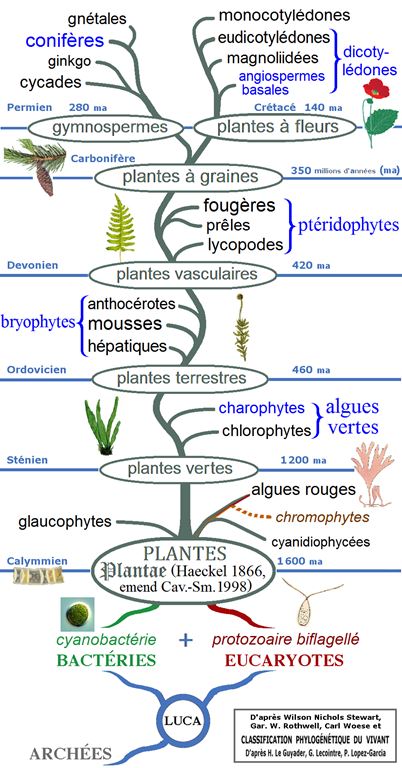
À droite, cet arbre phylogénétique des plantes montre les principaux clades et groupes traditionnels (monophylétiques en noir et paraphylétiques en bleu).
Dénominations
- Nom botanique : Baccaurea motleyana Müll.Arg. (1866)
- Synonymes français : rambi, rambai commun (tp* de "common rambai"), | mafai farang{{{69
- Synonymes : Baccaurea pubescens Pax & K.Hoffm. 1866 ;
Dont basionyme : Pierardia motleyana Müll.Arg. 1864 ; - Noms anglais et locaux : rambai, common rambai, Motley's rambai, rambi (phi), menteng (ms), negeri (ms), rambai (ms), rambeh (ms)
Description et culture
Tableau récapitulatif
Parties comes-tibles Note comest. (1-5) Note medic. (1-5) (Zones de) Rusticité Besoins en 
Besoins en  (1-3)
(1-3)Périodes de semis et récoltes Graines au gramme Durée de viabilité Profon-deur semis Espace-ment plants Espace-ment lignes Durée germi-native Durée avant récolte J F M A M J
J A S O N D
J F M A M J
J A S O N D
- dont infos de 0FPI ("FOOD PLANTS INTERNATIONAL", en anglais) :
Description :
Un arbre atteignant 20 m de haut. Le tronc mesure 40 cm de diamètre. L'arbre est densément feuillu. Les feuilles sont simples. Ils sont brillants. Le dessous des feuilles est velouté. Les feuilles sont en forme d'épée et mesurent 20 à 35 cm de long sur 8 à 17 cm de large. Les tiges des feuilles mesurent 3 à 10 cm de long. Les arbres sont séparés mâles et femelles. Les fleurs pendent des branches. Les fleurs mâles sont petites et vert jaunâtre pâle. Ils n'ont pas de pétales. Ils ont un doux parfum. Les fleurs femelles sont plus grandes. Les fruits sont accrochés aux ficelles des brindilles. Chaque fruit mesure environ 2 à 4 cm de diamètre. Ils ont une peau fine et lisse. La pulpe est blanche et laisse passer la lumière. Il contient plusieurs graines. Les graines sont assez grosses. Ils sont plats et bruns{{{0(+x) (traduction automatique).
Original : A tree up to 20 m tall. The trunk is 40 cm across. The tree is densely leafy. The leaves are simple. They are glossy. The underside of the leaves is velvety. The leaves are sword shaped and 20-35 cm long by 8-17 cm wide. The leaf stalks are 3-10 cm long. Trees are separately male and female. Flowers hang from the branches. Male flowers are small and pale yellowish-green. They do not have petals. They have a sweet scent. The female flowers are larger. The fruit hang on strings from the twigs. Each fruit is about 2-4 cm across. They have a smooth thin skin. The pulp is white and let's light through. It contains several seeds. The seeds are fairly large. They are flat and brown{{{0(+x).
Production :
Les arbres fruitent 3 ans après la plantation{{{0(+x) (traduction automatique).
Original : Trees fruit 3 years after planting{{{0(+x).
Culture :
Les plantes sont cultivées à partir de graines. Ils peuvent également être cultivés par stratification à l'air et greffage{{{0(+x) (traduction automatique).
Original : Plants are grown from seed. They can also be grown by air-layering and grafting{{{0(+x).
 Consommation (rapports de comestibilité, parties utilisables et usages alimentaires correspondants)
Consommation (rapports de comestibilité, parties utilisables et usages alimentaires correspondants)Fruit (fruits2(+),27(+x),65(+x),69 (chair(dp*) {arillodes65(+x) et péricarpes(dp*)} crue27(+x),65(+x) ou cuite27(+x)) [nourriture/aliment : fruit potentiel{{{2(+) ; et base boissons/breuvages{{{(dp*) fermenté(e)s : vin{{{65(+x)] ; et jus65(+x) [base(dp*) boissons/breuvages{{{65(+x)]) comestible.
Détails :
Le rambai est principalement cultivé pour son fruit. L' arillode, douce à légèrement acide, est consommée crue ou en confitures et conserves. Le jus de n'importe quelle variété peut être utilisé pour faire des boissons en le sucrant et diluant selon les goûts et en le servant avec de la glace. Le fruit peut être fermenté et transformé en un vin{{{65(+x).
Partie testée :
fruit{{{0(+x) (traduction automatique). Original : Fruit{{{0(+x)| Taux d'humidité (%) | Énergie (kj) | Énergie (kcal) | Protéines (g) |
|---|---|---|---|
| 79 | 272 | 65 | 1.7 |
| Pro- vitamines A (µg) |
Vitamines C (mg) | Fer (mg) | Zinc (mg) |
| 0 | 0 | 0.8 | 0 |
 Risques et précautions à prendre
Risques et précautions à prendrenéant, inconnus ou indéterminés.
Petite histoire-géo
Aire d'origine : Asie tropicale{{{2(+x). :: Plus de détails et d'infos (dont zone(s) de culture) : voir GRIN ("2").
Autres infos
dont infos de 0FPI ("FOOD PLANTS INTERNATIONAL", en anglais) :
Statut :
C'est un arbre cultivé{{{0(+x) (traduction automatique).
Original : It is a cultivated tree{{{0(+x).
Distribution :
Une plante tropicale. Il convient aux tropiques des plaines chaudes et humides. Il a besoin d'une position chaude sans gel. Il pousse de 15 à 500 m d'altitude. Au Yunnan{{{0(+x) (traduction automatique).
Original : A tropical plant. It suits the hot humid lowland tropics. It needs a warm frost free position. It grows from 15 to 500 m altitude. In Yunnan{{{0(+x).
Localisation :
Asie, Australie, Brunei, Chine, Indochine, Indonésie, Malaisie, Pacifique, Philippines, Asie du Sud-Est, Sri Lanka, Thaïlande, Vietnam{{{0(+x) (traduction automatique).
Original : Asia, Australia, Brunei, China, Indochina, Indonesia, Malaysia, Pacific, Philippines, SE Asia, Sri Lanka, Thailand, Vietnam{{{0(+x).
Notes :
Il existe environ 80 espèces de Baccaurea{{{0(+x) (traduction automatique).
Original : There are about 80 Baccaurea species{{{0(+x).
Liens, sources et/ou références
Liens :
/ ;Sources et/ou références :
bibliographie (liste des sources et/ou références de l'encyclopédie)
dont classification : IPNI ("International Plant Names Index", en anglais) ; TPL ("The Plant List", en anglais) ; 2GRIN ("Germplasm Resources Information Network", en anglais) ; 69Xycol ; Kew (POWO - "Plant Of the World Online", "Royal Botanical Garden", en anglais) ;
dont livres et bases de données : 5PFAF ("Plants For A Future", en anglais) ; 27Dictionnaire des plantes comestibles (livre, page 44, par Louis Bubenicek), 65"Edible Medicinal and Non-Medicinal Plants" (livre en anglais, volume 4, page 239 à 242, par T.K. Lim) ;
dont bibliographie/références de 0FPI ("FOOD PLANTS INTERNATIONAL", en anglais) :
Arora, R. K., 2014, Diversity in Underutilized Plant Species - An Asia-Pacific Perspective. Bioversity International. p 60 ; Bircher, A. G. & Bircher, W. H., 2000, Encyclopedia of Fruit Trees and Edible Flowering Plants in Egypt and the Subtropics. AUC Press. p 51 ; Burkill, I.H., 1966, A Dictionary of the Economic Products of the Malay Peninsula. Ministry of Agriculture and Cooperatives, Kuala Lumpur, Malaysia. Vol 1 (A-H) p 282 ; Chai, P. P. K. (Ed), et al, 2000, A checklist of Flora, Fauna, Food and Medicinal Plants. Lanjak Entimau Wildlife Sanctuary, Sarawak. Forestry Malaysia & ITTO. p 167 ; Chin, H.F., & Yong, H.S., 1996, Malaysian Fruits in Colour. Tropical press, Kuala Lumpur p 32 ; Coronel, R.E., 1982, Fruit Collections in the Philippines. IBPGR Newsletter p 9 ; Darley, J.J., 1993, Know and Enjoy Tropical Fruit. P & S Publishers. p 42 ; A. L. P. P. de Candolle, Prodr. 15(2):461. 1866 ; Engel, D.H., & Phummai, S., 2000, A Field Guide to Tropical Plants of Asia. Timber Press. p 94 ; Facciola, S., 1998, Cornucopia 2: a Source Book of Edible Plants. Kampong Publications, p 100 ; Flora of China Vol. 11, p 217 www.eFloras.org ; Food Composition Tables for use in East Asia FAO http://www.fao.org/infoods/directory No. 990 ; Fu, Yongneng, et al, 2003, Relocating Plants from Swidden Fallows to Gardens in Southwestern China. Economic Botany, 57(3): 389-402 ; Giesen, W., 2013, Paludiculture: sustainable alternatives on degraded peat land in Indonesia (revised draft) ; Hanum, F. I., 1999, Plant Diversity and Conservation Value of Ayer Hitam Forest, Selangor, Peninsula Malaysia. Pertanika J. Trop. Agric. Sci. 22(2):73-83 ; Kiple, K.F. & Ornelas, K.C., (eds), 2000, The Cambridge World History of Food. CUP p 1842 ; Lembaga Biologi Nasional, 1977, Buah-Buahan, Balai Pustaka, Jakarta. p 106 ; Macmillan, H.F. (Revised Barlow, H.S., et al) 1991, Tropical Planting and Gardening. Sixth edition. Malayan Nature Society. Kuala Lumpur. p 294 ; Martin, F. W., et al, 1987, Perennial Edible Fruits of the Tropics. USDA Handbook 642 p 27 ; McMakin, P.D., 2000, Flowering Plants of Thailand. A Field Guide. White Lotus. p 105 ; Milow, P., et al, 2013, Malaysian species of plants with edible fruits or seeds and their evaluation. International Journal of Fruit Science. 14:1, 1-27 ; Morton, J. F., 1987, Fruits of Warm Climates. Wipf & Stock Publishers p 211 ; PROSEA (Plant Resources of South East Asia) handbook, Volume 2, 1991, Edible fruits and nut. p 98 ; PROSEA handbook Volume 9 Plants yielding non-seed carbohydrates. p 187 ; Purseglove, J.W., 1968, Tropical Crops Dicotyledons, Longmans. p 139 ; Rajapaksha, U., 1998, Traditional Food Plants in Sri Lanka. HARTI, Sri Lanka. p 208 ; Siong, K. H., 2003, Indigenous Fruits of Sarawak. ITTO & Sarawak Forest Department. p 61 ; Slik, F., www.asianplant.net ; Sukarya, D. G., (Ed.) 2013, 3,500 Plant Species of the Botanic Gardens of Indonesia. LIPI p 145 ; Tankard, G., 1990, Tropical fruit. An Australian Guide to Growing and using exotic fruit. Viking p 114 ; TodaFruta.com.br ; USDA, ARS, National Genetic Resources Program. Germplasm Resources Information Network - (GRIN). [Online Database] National Germplasm Resources Laboratory, Beltsville, Maryland. Available: www.ars-grin.gov/cgi-bin/npgs/html/econ.pl (10 April 2000) ; www.nationalherbarium.nl/thaueuph/ Flora of Thailand. ; Zawiah, N. & Othaman, H., 2012, 99 Spesies Buah di FRIM. Institut Penyelidikan Perhutanan Malaysia. p 50
Recherche de/pour :
- "Baccaurea motleyana" sur Google (pages et
images) ;
TROPICOS (en anglais) ;
Tela Botanica ;
Pl@ntNet ;
Pl@ntUse ;
"Useful Tropical Plants" (en anglais) ou
"Useful Temperate Plants" (en anglais) ;
- "Rambai" sur Google (pages, images et recettes) ;
- "Baccaurea motleyana" sur Google (pages et
images) ;
TROPICOS (en anglais) ;
Tela Botanica ;
Pl@ntNet ;
Pl@ntUse ;
"Useful Tropical Plants" (en anglais) ou
"Useful Temperate Plants" (en anglais) ;
Espèces du même genre (Baccaurea)
43 taxons
- Buah
- Engkumi
- Lampaong
- Lang khae{{{69
- Raisin birmane
- Tampoi carambole (tp* de "tampoi belimbing")
- Tempoi
- Baccaurea angulata Merr (Tampoi carambole (tp* de "tampoi belimbing"))
- Baccaurea annamensis Gagnep.
- Baccaurea bracteata Mll.Arg.
- Baccaurea brevipes Hook.f.
- Baccaurea carinata Haegens
- Baccaurea costulata (Miq.) Mll.Arg.
- Baccaurea courtallensis (Wight) Mll.Arg.
- Baccaurea deflexa Mll.Arg.
- Baccaurea dolichobotrys Merr.
- Baccaurea dulcis (Jack) Müll.Arg. (Buah)
- Baccaurea edulis Merr.
- Baccaurea griffithii Hook.f.
- Baccaurea javanica (Blume) Müll. Arg.
- Baccaurea lanceolata (Miq.) Mull. Arg. (Lampaong)
- Baccaurea macrocarpa (Miq.) Müll.Arg. (Tempoi)
- Baccaurea macrophylla (Müll.Arg.) Müll.Arg. (Lang khae{{{69)
- Baccaurea maingayi Hook.f.
- Baccaurea malayana (Jack) King ex Hook.f.
- Baccaurea microcarpa (Airy Shaw) Haegens
- Baccaurea minor Hook.f.
- Baccaurea mollis Haegens
- Baccaurea multiflora Burck ex J.J.Sm.
- Baccaurea nanihua Merr.
- Baccaurea nesophila Airy Shaw
- Baccaurea odoratissima Elmer
- Baccaurea papuana F.M.Bailey
- Baccaurea parviflora (Mll.Arg.) Mll.Arg.
- Baccaurea philippinensis
- Baccaurea polyneura Hook.f.
- Baccaurea pubera (Miq.) Mll.Arg.
- Baccaurea purpurea Haegens
- Baccaurea pyriformis Gage
- Baccaurea racemosa (Reinw.) Muell. Arg. (Engkumi)
- Baccaurea ramiflora Lour. (Raisin birmane)
- Baccaurea reticulata Hook.f.
- Baccaurea sarawakensis Pax & K.Hoffm.
- Baccaurea simaloerensis Haegens
- Baccaurea sumatrana (Miq.) Mll.Arg.
- Baccaurea sylvestris Lour.
- Baccaurea tetrandra
- Baccaurea trigonocarpa Merr.
- Baccaurea velutina (Ridl.) Ridl.
Espèces de la même famille (Euphorbiaceae)
598 taxons
- Acalyphe d'Inde
- Acalyphe géante
- Acalyphe hérissée
- Acalyphe lancéolée
- Andrachne faux-téléphium
- Antidesme de Madagascar
- Bancoulier
- Bignay
- Buah
- Buisson de Noël
- Cerise de la rivière herbert (dp*)
- Chaya
- Chrozophore
- Dentelaire du Cap
- Engkumi
- Épurge
- Euphorbe
- Euphorbe à feuilles de thym
- Euphorbe âcre
- Euphorbe couchée
- Euphorbe de Heyne
- Euphorbe de Nice
- Euphorbe de Robb
- Euphorbe dentée
- Euphorbe des garrigues
- Euphorbe des jardiniers
- Euphorbe des moissons
- Euphorbe des sables
- Euphorbe faux Cyprès
- Euphorbe fluette de Merino
- Euphorbe prostrée
- Euphorbe réveille-matin
- Girembellier
- Hévéa du Brésil
- Inchi
- Katuk
- Lampaong
- Lang khae{{{69
- Malaka
- Manioc
- Médecinier béni
- Médicinier à feuilles de cotonnier
- Médicinier multifide
- Mercuriale des montagnes
- Mercuriale tomenteuse
- Noyer africain (tp* de "african nut tree")
- Pédilanthe tithymaloïde
- Phyllanthe amer
- Phyllanthe de Madras
- Phyllanthe niruri
- Acalypha amentacea Roxb.
- Acalypha australis L.
- Acalypha bipartita Muell. Arg.
- Acalypha boehmeroides
- Acalypha cardiophylla Merr.
- Acalypha caturus Blume
- Acalypha ciliata Forssk.
- Acalypha fruticosa Forssk.
- Acalypha glabrata Thunb.
- Acalypha glandulifolia Buchinger & Meisn. ex C.Krauss
- Acalypha grandis Benth. (Acalyphe géante)
- Acalypha hispida Burm.f. (Acalyphe hérissée)
- Acalypha indica (L.) Vell. (Acalyphe d'Inde)
- Acalypha lanceolata Willd. (Acalyphe lancéolée)
- Acalypha malabarica Mll.Arg.
- Acalypha matsudai Hayata
- Acalypha nemora
- Acalypha nemorosa
- Acalypha nemorum F.Muell. ex Müll.Arg.
- Acalypha ornata Hochst. ex A Rich.
- Acalypha paniculata Miq.
- Acalypha peduncularis Pax
- Acalypha plicata Griseb.
- Acalypha racemosa Wall. ex F.W.Andrews
- Acalypha rivularis Seem.
- Acalypha segetalis Mull. Arg.
- Acalypha siamensis Oliver ex Gage
- Acalypha spiciflorum
- Acalypha stricta Poepp.
- Acalypha suirenbiensis Yamam.
- Acalypha volkensii Pax
- Acalypha wilkesiana Mull. Arg.
- Actephila excelsa (Dalzell) Mll.Arg.
- Adelia barbinervis Cham. & Schltdl.
- Alchornea cordifolia (Schumach. & Thonn.) Müll.Arg. (Buisson de Noël)
- Alchornea floribunda Mll.Arg.
- Alchornea scandens
- Alchornea triplinervia
- Aleurites cordatus
- Aleurites fordii Hemsl.
- Aleurites moluccanus (L.) Willd. (Bancoulier)
- Aleurites rockinghamensis
- Andrachne telephioides L. (Andrachne faux-téléphium)
- Antidesma acidum Retz.
- Antidesma alexiteria Gaertn.
- Antidesma Bunius (L.) Spreng. (Bignay)
- Antidesma celebicum Miq.
- Antidesma coriaceum Tul.
- Antidesma dallachyanum Baill. (Cerise de la rivière herbert (dp*))
- Antidesma edule Merr.
- ...







 donne accès au menu
  - encyclopédies des plantes alimentaires ;
 - page de recherche - reconnaissance (identification) de plantes ;
 - page du calendrier lunaire et son générateur (au format PDF et JPG) ;
 - tableau récapitulatif ;
 - générateur de potées (soupes), avec estimation des apports nutrionnels et du coût;
 - générateur de codes QR ;
 - page des archives avec de nombreux documents sur différents thèmes complémentaires comme la botanique, les légumes,
les champignons, la cuisine, le bien-être ainsi que différents MOOC mais également des liens vers les archives de l'association ;
- page des archives avec de nombreux documents sur différents thèmes complémentaires comme la botanique, les légumes,
les champignons, la cuisine, le bien-être ainsi que différents MOOC mais également des liens vers les archives de l'association ;

 ou
ou
 permettant de passer du format standard à l'AMP (et vice-versa), lequel est simplifié et donc plus rapide.
 pour le fruit (et/ou les graines, la pulpe, etc...),
 pour les fleurs (et/ou pétales, calice...),
 pour les feuilles (et/ou la tige, les pousses...),
 pour les racines,
 pour le tronc (et/ou l'écorce, la sève...), et enfin
 pour les champignons,
puis les notes alimentaires et médicinales (de 1 à 5 étoiles), la rusticité (résistance au froid/gel)
et pour finir un résumé.
pour les champignons,
puis les notes alimentaires et médicinales (de 1 à 5 étoiles), la rusticité (résistance au froid/gel)
et pour finir un résumé. menant ici 🙂
 ,
,  et
et





 ,
,


 Encyclopédie(s)
 Recherche-Reconnaissance
 Tableau récapitulatif
 Codes QR
 Archives
 Calendrier(s) lunaire(s)
  Potées
 Re-naturation/naturalisation
 Affichettes, herbiers &
co.
Affichettes, herbiers &
co. menu
menu galerie