Panicum maximum
Pas d'illustration
pour le moment 😕
 |
*
-
**
|
*
-
**
Une herbe. qui ne cesse de croître d'année en année. Il forme des touffes. Il a de courtes tiges souterraines ou des rhizomes. Il peut mesurer 2 à 3 m de haut. Les limbes ... (traduction automatique)
→suite


Affich., herbiers & co.
Panicum maximum
Note alimentaire 
Note médicinale 
Note autre usage 

Une herbe. qui ne cesse de croître d'année en année. Il forme des touffes. Il a de courtes tiges souterraines ou des rhizomes. Il peut mesurer 2 à 3 m de haut. Les limbes des feuilles mesurent 15 à 30... (traduction automatique) →suite
Pas d'illustration
pour le moment 😕
Pas d'illustration
pour le moment 😕
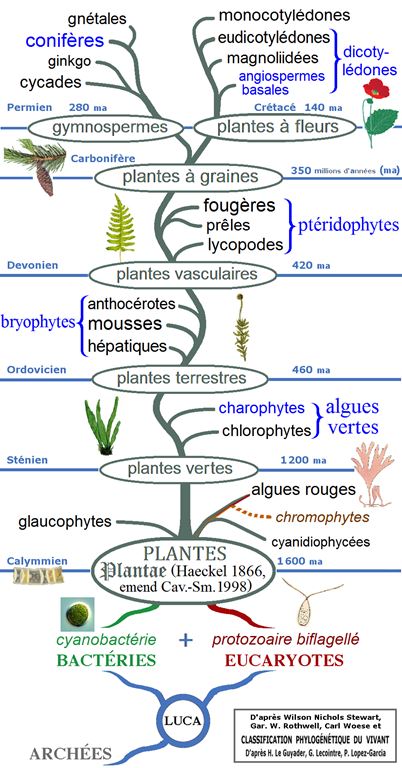
Classification
- Classique : en haut de l'écran, sous le coeur.
- Phylogénétique :
- Clade 4 : Angiospermes ;
- Clade 3 : Monocotylédones ;
- Clade 2 : Commelinidées ;
- Ordre APN : Poales ;
- Famille APN : Poaceae ;
À droite, cet arbre phylogénétique des plantes montre les principaux clades et groupes traditionnels (monophylétiques en noir et paraphylétiques en bleu).
Dénominations
- Nom botanique : Panicum maximum Jacq.
- Synonymes : Megathyrsus maximus (Jacq.) B. K. Simon & Jacobs, Panicum eburneum Trin, Panicum heynii Roth, Panicum jumentorum Pers, Panicum laeve Lam, Panicum praelongum Steud, Panicum scaberrimum Lag, Panicum teff Desv, Panicum tephrosanthum Schinz, Panicum trichocondylum Steud, Urochloa maxima (Jacq.) R. D. Webster
- Noms anglais et locaux : Guinea grass. Green panic grass
Description et culture
Tableau récapitulatif
Parties comes-tibles Note comest. (1-5) Note medic. (1-5) (Zones de) Rusticité Besoins en 
Besoins en  (1-3)
(1-3)Périodes de semis et récoltes Graines au gramme Durée de viabilité Profon-deur semis Espace-ment plants Espace-ment lignes Durée germi-native Durée avant récolte J F M A M J
J A S O N D
J F M A M J
J A S O N D
- dont infos de 0FPI ("FOOD PLANTS INTERNATIONAL", en anglais) :
Description :
Une herbe. qui ne cesse de croître d'année en année. Il forme des touffes. Il a de courtes tiges souterraines ou des rhizomes. Il peut mesurer 2 à 3 m de haut. Les limbes des feuilles mesurent 15 à 30 cm de long. La partie florale de la tête fleurie a des branches latérales en anneau. La tête fleurie est ouverte et ramifiée. Il a une tige verticale centrale. Les longues branches latérales minces poussent à partir de cela. Les fleurs sont petites et ovales et mesurent 2-3 mm de long. Ils sont sur de petites tiges ondulées{{{0(+x) (traduction automatique).
Original : A grass. which keeps growing from year to year. It forms tufts. It has short underground stems or rhizomes. It can be 2-3 m tall. The leaf blades are 15-30 cm long. The flower part of the flowering head has side branches in a ring. The flowering head is open and branched. It has a central upright stem. The long thin side branches grow out from this. The flowers are small and oval and 2-3 mm long. They are on small wavy stalks{{{0(+x).
 Consommation (rapports de comestibilité, parties utilisables et usages alimentaires correspondants)
Consommation (rapports de comestibilité, parties utilisables et usages alimentaires correspondants)Parties comestibles :
graines, céréales, céréales{{{0(+x) (traduction automatique). Original : Seeds, Grains, Cereal{{{0(+x).Détails :
Les grains sont torréfiés, séchés à fond, puis pilés. Ils sont ensuite bouillis et consommés salés ou non salés, et / ou avec une saveur{{{0(+x) (traduction automatique).
Original : The grains are roasted, dried thoroughly, and then pounded. They are then boiled and eaten salted or unsalted, and/or with a relish{{{0(+x).
Partie testée :
/ Risques et précautions à prendre
Risques et précautions à prendrenéant, inconnus ou indéterminés.
Autres infos
dont infos de 0FPI ("FOOD PLANTS INTERNATIONAL", en anglais) :
Distribution :
Une plante tropicale. Il poussera sur une gamme de sols mais poussera mieux sur des sols fertiles. C'est souvent sur les plaines fluviales alluviales. Il peut tolérer l'ombre. Il pousse entre 20 et 2100 m d'altitude. Il pousse dans les zones chaudes et arides. Il pousse dans les zones avec une pluviométrie annuelle comprise entre 300 et 1 500 mm. Il peut pousser dans des endroits arides{{{0(+x) (traduction automatique).
Original : A tropical plant. It will grow on a range of soils but grows best on fertile soils. It is often on alluvial river flats. It can tolerate shade. It grows between 20-2,100 m above sea level. It grows in hot arid areas. It grows in areas with an annual rainfall between 300-1,500 mm. It can grow in arid places{{{0(+x).
Localisation :
Afrique *, Angola, Argentine, Asie, Australie, Botswana, Brésil, Burkina Faso, Cameroun, Afrique centrale, Amérique centrale, Chine, RD Congo, Afrique de l'Est, Île de Pâques, Eswatini, Ghana, Guadeloupe, Guyane, Guyanes, Guinée, Guinée, Guinée © e, Guinée-Bissau, Guyane, Hawaï, Inde, Indochine, Indonésie, Iran, Japon, Kenya, Laos, Lesotho, Petites Antilles, Madagascar, Malawi, Malaisie, Méditerranée, Mozambique, Namibie, Nigéria, Île Norfolk, Pacifique, Pakistan , Papouasie-Nouvelle-Guinée, PNG, Philippines, Porto Rico, Asie du Sud-Est, Sénégal, Sierra Leone, Slovénie, Afrique du Sud, Amérique du Sud, Afrique australe, Sri Lanka, Saint-Kitts-et-Nevis, Suriname, Swaziland, Taiwan, Tanzanie, Tonga, Ouganda, Uruguay, USA, Venezuela, Afrique de l'Ouest, Antilles, Zambie, Zimbabwe{{{0(+x) (traduction automatique).
Original : Africa*, Angola, Argentina, Asia, Australia, Botswana, Brazil, Burkina Faso, Cameroon, Central Africa, Central America, China, Congo DR, East Africa, Easter Island, Eswatini, Ghana, Guadeloupe, Guiana, Guianas, Guinea, Guinée, Guinea-Bissau, Guyana, Hawaii, India, Indochina, Indonesia, Iran, Japan, Kenya, Laos, Lesotho, Lesser Antilles, Madagascar, Malawi, Malaysia, Mediterranean, Mozambique, Namibia, Nigeria, Norfolk Island, Pacific, Pakistan, Papua New Guinea, PNG, Philippines, Puerto Rico, SE Asia, Senegal, Sierra Leone, Slovenia, South Africa, South America, Southern Africa, Sri Lanka, St. Kitts and Nevis, Suriname, Swaziland, Taiwan, Tanzania, Tonga, Uganda, Uruguay, USA, Venezuela, West Africa, West Indies, Zambia, Zimbabwe{{{0(+x).
Notes :
Il existe environ 500 espèces de Panicum. C'est une bonne herbe fourragère{{{0(+x) (traduction automatique).
Original : There are about 500 Panicum species. It is a good fodder grass{{{0(+x).
Liens, sources et/ou références
Liens :
/ ;Sources et/ou références :
bibliographie (liste des sources et/ou références de l'encyclopédie)
dont classification : IPNI ("International Plant Names Index", en anglais) ; Kew (POWO - "Plant Of the World Online", "Royal Botanical Garden", en anglais) ; Tela Botanica ;
dont livres et bases de données : 5PFAF ("Plants For A Future", en anglais) ; 0FPI ("FOOD PLANTS INTERNATIONAL", en anglais) ;
dont bibliographie/références de 0FPI ("FOOD PLANTS INTERNATIONAL", en anglais) :
Ambasta, S.P. (Ed.), 2000, The Useful Plants of India. CSIR India. p 426 ; Burkill, H. M., 1985, The useful plants of west tropical Africa, Vol. 2. Kew. ; Burkill, I.H., 1966, A Dictionary of the Economic Products of the Malay Peninsula. Ministry of Agriculture and Cooperatives, Kuala Lumpur, Malaysia. Vol 2 (I-Z) p 1684 ; Collectanea 1:76. 1787 ("1786"); Icon. pl. rar. 1:2, t. 13. 1787? ("1781-1786") ; CROSS-UPCOTT, ; Flora of Australia Volume 49, Oceanic Islands 1, Australian Government Publishing Service, Canberra. (1994) p 481 ; Fowler, D. G., 2007, Zambian Plants: Their Vernacular Names and Uses. Kew. p 71 ; Grivetti, L. E., 1980, Agricultural development: present and potential role of edible wild plants. Part 2: Sub-Saharan Africa, Report to the Department of State Agency for International Development. p 73 ; http://www.botanic-gardens-ljubljana.com/en/plants ; Hussey, B.M.J., Keighery, G.J., Cousens, R.D., Dodd, J., Lloyd, S.G., 1997, Western Weeds. A guide to the weeds of Western Australia. Plant Protection Society of Western Australia. p 60 ; Lazarides, M. & Hince, B., 1993, Handbook of Economic Plants of Australia, CSIRO. p 180 ; Long, C., 2005, Swaziland's Flora - siSwati names and Uses http://www.sntc.org.sz/flora/ ; Malezas Comestibles del Cono Sur, INTA, 2009, Buernos Aires ; Peters, C. R., O'Brien, E. M., and Drummond, R.B., 1992, Edible Wild plants of Sub-saharan Africa. Kew. p 25 ; Pickering, H., & Roe, E., 2009, Wild Flowers of the Victoria Falls Area. Helen Pickering, London. p 96 ; Purseglove, J.W., 1972, Tropical Crops. Monocotyledons. Longmans p 199 ; Royal Botanic Gardens, Kew (1999). Survey of Economic Plants for Arid and Semi-Arid Lands (SEPASAL) database. Published on the Internet; http://www.rbgkew.org.uk/ceb/sepasal/internet [Accessed 3rd June 2011] ; Scudder, 1962, ; Swaziland's Flora Database http://www.sntc.org.sz/flora ; TAIRA, ; Terashima, H., et al, 1992, Ethnobotany of the Lega in the Tropical Rainforest of Eastern Zaire (Congo): Part Two, Zone de Walikale, African Study Monographs, Suppl. 19:1-60 ; Tredgold, M.H., 1986, Food Plants of Zimbabwe. Mambo Press. p 26 ; Vernon, R., 1983, Field Guide to Important Arable Weeds of Zambia. Dept of Agriculture, Chilanga, Zambia. p 120 ; von Katja Rembold, 2011, Conservation status of the vascular plants in East African rain forests. Dissertation Universitat Koblenz-Landau p 176 ; Williams, C.N., Chew, W.Y., and Rajaratnam, J.A., 1989, Tree and Field Crops of the Wetter Regions of the Tropics. Longman, p 246 ; Yuncker, T.G., 1959, Plants of Tonga, Bernice P. Bishop Museum, Hawaii, Bulletin 220. p 60 ; Zizka, G., 1991, Flowering Plants of Easter Island. Palmarum Hortus Francofurtensis
Recherche de/pour :
- "Panicum maximum" sur Google (pages et
images) ;
TPL ("The Plant List", en anglais) ;
GRIN ("Germplasm Resources Information Network", en anglais) ;
TROPICOS (en anglais) ;
Pl@ntNet ;
Pl@ntUse ;
"Useful Tropical Plants" (en anglais) ou
"Useful Temperate Plants" (en anglais) ;
- "Panicum maximum" sur Google (pages et
images) ;
TPL ("The Plant List", en anglais) ;
GRIN ("Germplasm Resources Information Network", en anglais) ;
TROPICOS (en anglais) ;
Pl@ntNet ;
Pl@ntUse ;
"Useful Tropical Plants" (en anglais) ou
"Useful Temperate Plants" (en anglais) ;
Espèces du même genre (Panicum)
46 taxons
- Millet bulbeux
- Millet commun
- Millet décomposé
- Millet délavé
- Millet mexicain
- Millet novemnerve
- Millet poivré
- Panic capillaire
- Panic dressé
- Panic presque blanchâtre
- Panic rampant
- Panicum amarum Elliott
- Panicum anabaptistum Steud.
- Panicum antidotale Retz.
- Panicum atrosanguineum Hochst. ex A.Rich.
- Panicum bergii Arechav.
- Panicum bisulcatum Thunb.
- Panicum bulbosum Kunth (Millet bulbeux)
- Panicum capillare L. (Panic capillaire)
- Panicum chamaeraphicides
- Panicum coloratum Thouars ex Spreng.
- Panicum curviflorum Hornem.
- Panicum cymbiforme Hughes
- Panicum decompositum R.Br. (Millet décomposé)
- Panicum distichum Lam.
- Panicum effusum R.Br.
- Panicum fluviicola Steud.
- Panicum hemitomon Schult.
- Panicum heterostachyum Hack.
- Panicum hippothrix K.Schum. ex Engl.
- Panicum hirticaule J.Presl (Millet mexicain)
- Panicum infestum Andersson
- Panicum kalaharense Mez
- Panicum kotschyanum Hochst. ex Steud.
- Panicum laetum Kunth
- Panicum laevinode Lindl. (Millet poivré)
- Panicum miliaceum L. (Millet commun)
- Panicum mindanaense Merr.
- Panicum novemnerve Stapf (Millet novemnerve)
- Panicum obtusum Kunth
- Panicum paludosum Roxb.
- Panicum pansum Rendle
- Panicum pilosum Sw.
- Panicum prolutum F.Muell. (Millet délavé)
- Panicum psilopodium Trin.
- Panicum repens L. (Panic rampant)
- Panicum sonorum Beal
- Panicum sp.
- Panicum subalbidum Kunth (Panic presque blanchâtre)
- Panicum sumatrense Roth
- Panicum tactum
- Panicum turgidum Forssk.
- Panicum urvilleanum Kunth
- Panicum virgatum Roxb. ex Steud. (Panic dressé)
- Panicum walense Mez
- Panicum whitei J.M.Black
Espèces de la même famille (Poaceae)
881 taxons
- Agrostide blanche
- Alpiste
- Alpiste à épi court
- Alpiste de Rotgès
- Alpiste mineur
- Amidonnier
- Amidonnier sauvage
- Amourette commune
- Aristide
- Aristide de l'Ascension
- Aristide sétacée
- Avoine
- Avoine à fourrage
- Avoine à gruau
- Avoine barbue
- Avoine d'Espagne
- Avoine d'Orient
- Avoine de Ludovic
- Avoine élevée
- Avoine odorante
- Bambou
- Bambou à rayures jaunes
- Bambou asper
- Bambou bhaluka
- Bambou carré
- Bambou chocolat
- Bambou commun
- Bambou de Veitch
- Bambou doré
- Bambou fastuosa (p*)
- Bambou flexueux
- Bambou géant
- Bambou glauca
- Bambou hamiltonii
- Bambou makinoi (p*)
- Bambou marbré
- Bambou médicinal
- Bambou membranaceus
- Bambou moso
- Bambou noir
- Bambou nuda
- Bambou pagode
- Bambou sasa palmata
- Bambou soufré à tige verte
- Bambou violacé
- Bambou viridiglaucescens
- Bambou yunnanicus
- Bardanette
- Bardanette rameuse
- Blé de Khorasan
- Achnatherum hymenoides (Roem. & Schult.) Ricker ex Piper
- Acidosasa chinensis C.D.Chu & C.S.Chao ex Keng f.
- Acidosasa edulis (T.H.Wen) T.H.Wen
- Acidosasa purpurea (Hsueh & T.P.Yi) Keng f.
- Acroceras amplectens Stapf
- Aegilops geniculata Fig. & De Not. (Égilope genouillé)
- Aegilops speltoides Tausch. (Égilope faux épeautre)
- Aegilops triuncialis L. (Égilope à 3 arêtes)
- Aeluropus lagopoides (Élurope)
- Agrostis perennans
- Agrostis stolonifera L. (Agrostide blanche)
- Agrotriticum x sp
- Aira caespitosa Muhl.
- Alopecurus aequalis Sobol. (Vulpin fauve)
- Alopecurus pratensis Bourg. ex Lange (Vulpin des prés de Linné)
- Ammophila arenaria (L.) Link (Oyat)
- Amphipogon caricinus F.Muell.
- Andropogon canaliculatus Schumach.
- Andropogon gayanus Kunth
- Andropogon gerardii
- Andropogon pinguipes Stapf
- Andropogon pseudapricus Stapf
- Andropogon sorghum
- Andropogon tectorum Schumach. & Thonn.
- Anthephora nigritana Stapf & C.E.Hubb.
- Anthephora pubescens Nees
- Anthoxanthum odoratum L. (Flouve odorante)
- Aristida acuta S.T.Blake
- Aristida adscensionis L. (Aristide de l'Ascension)
- Aristida congesta Roem. & Schult. (Aristide)
- Aristida inaequiglumis Domin
- Aristida publifolia
- Aristida pungens Desf.
- Aristida setacea Steud. (Aristide sétacée)
- Aristida stipoides R.Br.
- Arrhenatherum elatius (Avoine élevée)
- Arundinaria faberi Rendle
- Arundinaria gigantea
- Arundinaria hookeriana Munro
- Arundinaria niitakayamensis Hayata
- Arundinaria spp
- Arundinella setosa Trin.
- Arundo donax L. (Roseau)
- Astrebla lappacea
- Astrebla pectinata
- Astrebla squarrosa C.E.Hubb.
- Avena abyssinica Hochst.
- Avena barbata Pott ex Link (Avoine barbue)
- Avena brevis Roth (Avoine à fourrage)
- Avena byzantina K.Koch
- ...







 donne accès au menu
  - encyclopédies des plantes alimentaires ;
 - page de recherche - reconnaissance (identification) de plantes ;
 - page du calendrier lunaire et son générateur (au format PDF et JPG) ;
 - tableau récapitulatif ;
 - générateur de potées (soupes), avec estimation des apports nutrionnels et du coût;
 - générateur de codes QR ;
 - page des archives avec de nombreux documents sur différents thèmes complémentaires comme la botanique, les légumes,
les champignons, la cuisine, le bien-être ainsi que différents MOOC mais également des liens vers les archives de l'association ;
- page des archives avec de nombreux documents sur différents thèmes complémentaires comme la botanique, les légumes,
les champignons, la cuisine, le bien-être ainsi que différents MOOC mais également des liens vers les archives de l'association ;

 ou
ou
 permettant de passer du format standard à l'AMP (et vice-versa), lequel est simplifié et donc plus rapide.
 pour le fruit (et/ou les graines, la pulpe, etc...),
 pour les fleurs (et/ou pétales, calice...),
 pour les feuilles (et/ou la tige, les pousses...),
 pour les racines,
 pour le tronc (et/ou l'écorce, la sève...), et enfin
 pour les champignons,
puis les notes alimentaires et médicinales (de 1 à 5 étoiles), la rusticité (résistance au froid/gel)
et pour finir un résumé.
pour les champignons,
puis les notes alimentaires et médicinales (de 1 à 5 étoiles), la rusticité (résistance au froid/gel)
et pour finir un résumé. menant ici 🙂
 ,
,  et
et





 ,
,


 Encyclopédie(s)
 Recherche-Reconnaissance
 Tableau récapitulatif
 Codes QR
 Archives
 Calendrier(s) lunaire(s)
  Potées
 Re-naturation/naturalisation
 Affichettes, herbiers &
co.
Affichettes, herbiers &
co. menu
menu galerie







