Plantain des sables
(Plantago arenaria)
 |
*
-
***
|
*
-
***
Une herbe courte. C'est une plante annuelle et poilue. Les tiges sont très ramifiées. Les feuilles sont étroites et opposées ou en anneaux. Ils mesurent 20 à 70 mm de lon ... (traduction automatique)
→suite


Affich., herbiers & co.
Plantain des sables
Une herbe courte. C'est une plante annuelle et poilue. Les tiges sont très ramifiées. Les feuilles sont étroites et opposées ou en anneaux. Ils mesurent 20 à 70 mm de long sur 1 à 3 mm de large. Ils ... (traduction automatique) →suite
Note alimentaire  médicinale

Pas d'illustration
pour le moment 😕
Plantago arenaria
Classification
- Classique : en haut de l'écran, sous le coeur.
- Phylogénétique :
- Clade 4 : Angiospermes ;
- Clade 3 : Dicotylédones_vraies ;
- Clade 2 : Astéridées ;
- Clade 1 : Lamiidées ;
- Ordre APN : Lamiales ;
- Famille APN : Plantaginaceae ;
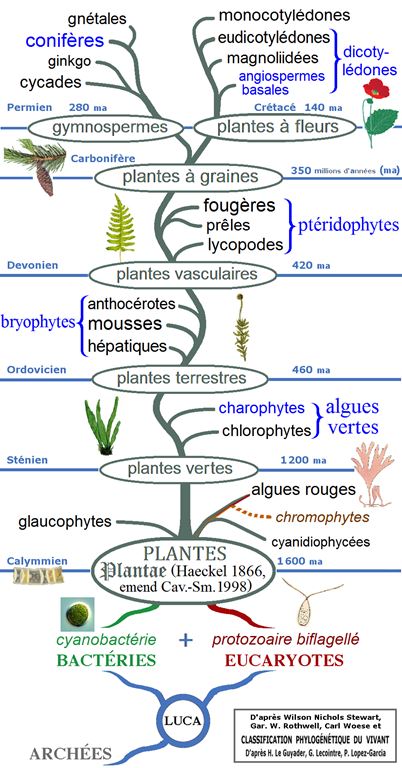
À droite, cet arbre phylogénétique des plantes montre les principaux clades et groupes traditionnels (monophylétiques en noir et paraphylétiques en bleu).
Dénominations
- Nom botanique : Plantago arenaria Waldst. & Kit.
- Synonymes français : plantain scabre, herbe aux puces
- Synonymes : Plantago ramosa, Plantago psyllium, Plantago indica
- Noms anglais et locaux : French Psyllium
Description et culture
Tableau récapitulatif
Parties comes-tibles Note comest. (1-5) Note medic. (1-5) (Zones de) Rusticité Besoins en 
Besoins en  (1-3)
(1-3)Périodes de semis et récoltes Graines au gramme Durée de viabilité Profon-deur semis Espace-ment plants Espace-ment lignes Durée germi-native Durée avant récolte Zones de rusticité : J F M A M J
J A S O N D
J F M A M J
J A S O N D
- dont infos de 0FPI ("FOOD PLANTS INTERNATIONAL", en anglais) :
Description :
Une herbe courte. C'est une plante annuelle et poilue. Les tiges sont très ramifiées. Les feuilles sont étroites et opposées ou en anneaux. Ils mesurent 20 à 70 mm de long sur 1 à 3 mm de large. Ils ne sont pas charnus et n'ont pas de dents. Les fleurs sont blanc brunâtre et mesurent 4 mm de long. Ils sont en grappes arrondies. Les anthères sont jaune pâle{{{0(+x) (traduction automatique).
Original : A short herb. It is an annual plant and is hairy. The stems are much branched. The leaves are narrow and opposite or in rings. They are 20-70 mm long by 1-3 mm wide. They are not fleshy and do not have teeth. The flowers are brownish-white and 4 mm long. They are in rounded clusters. The anthers are pale yellow{{{0(+x).
Consommation (rapports de comestibilité, parties utilisables et usages alimentaires correspondants)
Consommation (rapports de comestibilité, parties utilisables et usages alimentaires correspondants)Parties comestibles :
feuilles{{{0(+x) (traduction automatique). Original : Leaves{{{0(+x).Partie testée :
/ Risques et précautions à prendre
Risques et précautions à prendrenéant, inconnus ou indéterminés.
Autres infos
dont infos de 0FPI ("FOOD PLANTS INTERNATIONAL", en anglais) :
Distribution :
C'est une plante tempérée. Il pousse dans des endroits secs, généralement sur des sols sableux. En Chine, il pousse entre 100 et 3 500 m au-dessus du niveau de la mer. En Argentine, il passe du niveau de la mer à 500 m au-dessus du niveau de la mer. Au Sichuan{{{0(+x) (traduction automatique).
Original : It is a temperate plant. It grows in dry places usually on sandy soils. In China it grows between 100-3,500 m above sea level. In Argentina it grows from sea level to 500 m above sea level. In Sichuan{{{0(+x).
Localisation :
Argentine, Asie, Australie, Grande-Bretagne, Chine, Europe, France, Grèce, Inde, Irak, Italie, Japon, Kazakhstan, Kirghizistan, Lituanie, Méditerranée, Amérique du Nord, Pakistan, Portugal, Russie, Sibérie, Slovénie, Amérique du Sud, Espagne, Tadjikistan, Tibet, Turquie{{{0(+x) (traduction automatique).
Original : Argentina, Asia, Australia, Britain, China, Europe, France, Greece, India, Iraq, Italy, Japan, Kazakhstan, Kyrgyzstan, Lithuania, Mediterranean, North America, Pakistan, Portugal, Russia, Siberia, Slovenia, South America, Spain, Tajikistan, Tibet, Turkey{{{0(+x).
Notes :
Les plaignants ou Plantaginaceae se trouvent principalement dans les régions tempérées. Il existe environ 165 espèces de Plantago{{{0(+x) (traduction automatique).
Original : The plaintains or Plantaginaceae are mostly in temperate regions. There are about 165 Plantago species{{{0(+x).
Rusticité (résistance face au froid/gel, climat)
Zones de rusticité :
Liens, sources et/ou références
Liens :
Wikipedia ;Sources et/ou références :
bibliographie (liste des sources et/ou références de l'encyclopédie)
dont classification : IPNI ("International Plant Names Index", en anglais) ; Kew (POWO - "Plant Of the World Online", "Royal Botanical Garden", en anglais) ; Tela Botanica ;
dont livres et bases de données : 5PFAF ("Plants For A Future", en anglais) ; 0FPI ("FOOD PLANTS INTERNATIONAL", en anglais) ;
dont bibliographie/références de 0FPI ("FOOD PLANTS INTERNATIONAL", en anglais) :
Blamey, M and Grey-Wilson, C., 2005, Wild flowers of the Mediterranean. A & C Black London. p 422 ; Descr. icon. pl. Hung. 1:51, t. 51. 1801 ; http://www.botanic-gardens-ljubljana.com/en/plants ; Plants for a Future database, The Field, Penpol, Lostwithiel, Cornwall, PL22 0NG, UK. http://www.scs.leeds.ac.uk/pfaf/
Recherche de/pour :
- "Plantago arenaria" sur Google (pages et
images) ;
TPL ("The Plant List", en anglais) ;
GRIN ("Germplasm Resources Information Network", en anglais) ;
TROPICOS (en anglais) ;
Pl@ntNet ;
Pl@ntUse ;
"Useful Tropical Plants" (en anglais) ou
"Useful Temperate Plants" (en anglais) ;
- "Plantain des sables" sur Google (pages, images et recettes) ;
- "Plantago arenaria" sur Google (pages et
images) ;
TPL ("The Plant List", en anglais) ;
GRIN ("Germplasm Resources Information Network", en anglais) ;
TROPICOS (en anglais) ;
Pl@ntNet ;
Pl@ntUse ;
"Useful Tropical Plants" (en anglais) ou
"Useful Temperate Plants" (en anglais) ;
Espèces du même genre (Plantago)
39 taxons
- Plantain à feuilles dentées
- Plantain à feuilles épaisses
- Plantain amplexicaule
- Plantain asiatique
- Plantain austral
- Plantain blanchissant
- Plantain corne-de-cerf
- Plantain de Patagonie
- Plantain de Rugel
- Plantain des Alpes
- Plantain des Indes
- Plantain lancéolé
- Plantain maritime
- Plantain moyen
- Plantain officinal
- Plantain psyllium
- Plantain queue-de-lièvre
- Plantago affra
- Plantago afra L. (Plantain psyllium)
- Plantago akkensis Coss. & Murb.
- Plantago albicans Roem. & Schult. (Plantain blanchissant)
- Plantago alpina L. (Plantain des Alpes)
- Plantago amplexicaulis Cav. (Plantain amplexicaule)
- Plantago asiatica L. (Plantain asiatique)
- Plantago australis Lam. (Plantain austral)
- Plantago camtschatica Link
- Plantago canescens Schrad. ex Decne.
- Plantago ciliata Boiss.
- Plantago coronopus L. (Plantain corne-de-cerf)
- Plantago crassifolia Roth (Plantain à feuilles épaisses)
- Plantago cunninghamii Decne.
- Plantago debilis R.Br.
- Plantago decipiens Barnoud
- Plantago depressa Willd.
- Plantago hakusanensis Koidz.
- Plantago himalaica Pilg.
- Plantago indica L.
- Plantago insularis Eastw.
- Plantago juncoides Lam.
- Plantago lagopus L. (Plantain queue-de-lièvre)
- Plantago lanceolata L. (Plantain lancéolé)
- Plantago macrocarpa Cham. & Schltdl.
- Plantago major L. (Plantain officinal)
- Plantago maritima W.P.C.Barton (Plantain maritime)
- Plantago media L. (Plantain moyen)
- Plantago oliganthus
- Plantago ovata Phil. (Plantain des Indes)
- Plantago paludosa Turcz. ex Ledeb.
- Plantago patagonica Bertero ex Steud. (Plantain de Patagonie)
- Plantago psyllia St.-Lag.
- Plantago reniformis Beck
- Plantago rugelii Decne. (Plantain de Rugel)
- Plantago serraria L. (Plantain à feuilles dentées)
- Plantago tomentosa Gilib.
- Plantago tubulosa Decne.
Espèces de la même famille (Plantaginaceae)
92 taxons
- Balai doux
- Callitriche de printemps
- Callitriche des eaux stagnantes
- Cymbalaire
- Digitale pourpre
- Grand Muflier
- Linaire
- Linaire à fruits recourbés
- Mouron d'eau
- Pesse
- Plantain à feuilles dentées
- Plantain à feuilles épaisses
- Plantain amplexicaule
- Plantain asiatique
- Plantain austral
- Plantain blanchissant
- Plantain corne-de-cerf
- Plantain de Patagonie
- Plantain de Rugel
- Plantain des Alpes
- Plantain des Indes
- Plantain lancéolé
- Plantain maritime
- Plantain moyen
- Plantain officinal
- Plantain psyllium
- Plantain queue-de-lièvre
- Tête-de-mort
- Véronique à écussons de Linné
- Veronique à feuilles de Serpolet
- Véronique à longues feuilles
- Véronique agreste
- Véronique aquatique
- Véronique brillante
- Véronique de perse
- Véronique des ruisseaux
- Véronique officinale
- Véronique Petit-Chêne
- Antirrhinum majus L. (Grand Muflier)
- Bacopa crenata
- Bacopa sp.
- Callitriche antarctica Engelm. ex Hegelm.
- Callitriche palustris L. (Callitriche de printemps)
- Callitriche stagnalis Scop. (Callitriche des eaux stagnantes)
- Cymbalaria muralis P.Gaertn., B.Mey. & Scherb. (Cymbalaire)
- Digitalis purpurea L. (Digitale pourpre)
- Hemiphragma heterophyllum Wall.
- Hippuris tetraphylla L.f. (Pesse)
- Hippuris vulgaris L. (Pesse)
- Lagotis minor
- Limnophila aromatica (Lam.) Merr.
- Limnophila chinensis
- Limnophila conferta Benth.
- Limnophila erecta Benth.
- Limnophila fragrans
- Limnophila geoffrayi Bonati
- Limnophila heterophylla
- Limnophila indica
- Limnophila micrantha
- Limnophila repens
- Limnophila rugosa
- Linaria cymbalaria
- Linaria hirta (Linaire)
- Linaria reflexa (Linaire à fruits recourbés)
- Linaria vulgaris Mill. (Linaire)
- Misopates orontium (Tête-de-mort)
- Neopicrorhiza scrophulariiflora
- Picrorhiza kurroa Royle ex Benth.
- Picrorhiza scrophulariiflora Pennell
- Plantago affra
- Plantago afra L. (Plantain psyllium)
- Plantago akkensis Coss. & Murb.
- Plantago albicans Roem. & Schult. (Plantain blanchissant)
- Plantago alpina L. (Plantain des Alpes)
- Plantago amplexicaulis Cav. (Plantain amplexicaule)
- Plantago asiatica L. (Plantain asiatique)
- Plantago australis Lam. (Plantain austral)
- Plantago camtschatica Link
- Plantago canescens Schrad. ex Decne.
- Plantago ciliata Boiss.
- Plantago coronopus L. (Plantain corne-de-cerf)
- Plantago crassifolia Roth (Plantain à feuilles épaisses)
- Plantago cunninghamii Decne.
- Plantago debilis R.Br.
- Plantago decipiens Barnoud
- Plantago depressa Willd.
- Plantago hakusanensis Koidz.
- Plantago himalaica Pilg.
- ...







 donne accès au menu
  - encyclopédies des plantes alimentaires ;
 - page de recherche - reconnaissance (identification) de plantes ;
 - page du calendrier lunaire et son générateur (au format PDF et JPG) ;
 - tableau récapitulatif ;
 - générateur de potées (soupes), avec estimation des apports nutrionnels et du coût;
 - générateur de codes QR ;
 - page des archives avec de nombreux documents sur différents thèmes complémentaires comme la botanique, les légumes,
les champignons, la cuisine, le bien-être ainsi que différents MOOC mais également des liens vers les archives de l'association ;
- page des archives avec de nombreux documents sur différents thèmes complémentaires comme la botanique, les légumes,
les champignons, la cuisine, le bien-être ainsi que différents MOOC mais également des liens vers les archives de l'association ;

 ou
ou
 permettant de passer du format standard à l'AMP (et vice-versa), lequel est simplifié et donc plus rapide.
 pour le fruit (et/ou les graines, la pulpe, etc...),
 pour les fleurs (et/ou pétales, calice...),
 pour les feuilles (et/ou la tige, les pousses...),
 pour les racines,
 pour le tronc (et/ou l'écorce, la sève...), et enfin
 pour les champignons,
puis les notes alimentaires et médicinales (de 1 à 5 étoiles), la rusticité (résistance au froid/gel)
et pour finir un résumé.
pour les champignons,
puis les notes alimentaires et médicinales (de 1 à 5 étoiles), la rusticité (résistance au froid/gel)
et pour finir un résumé. menant ici 🙂
 ,
,  et
et





 ,
,


 Encyclopédie(s)
 Recherche-Reconnaissance
 Tableau récapitulatif
 Codes QR
 Archives
 Calendrier(s) lunaire(s)
  Potées
 Re-naturation/naturalisation
 Affichettes, herbiers &
co.
Affichettes, herbiers &
co. menu
menu galerie