Schizophylle commun
(Schizophyllum commune)
Pas d'illustration
pour le moment 😕

Un champignon. Les organes de fructification sont gris et en forme d'éventail. Ils peuvent mesurer 2 à 4 cm de diamètre. Les branchies s'étalent à partir du point où le ... (traduction automatique)
→suite


Affich., herbiers & co.
Schizophylle commun 

Un champignon. Les organes de fructification sont gris et en forme d'éventail. Ils peuvent mesurer 2 à 4 cm de diamètre. Les branchies s'étalent à partir du point où le corps fructifère se fixe aux ... (traduction automatique) →suite
Champignon (cf. MycoDB)
Pas d'illustration
pour le moment 😕
Pas d'illustration
pour le moment 😕
Schizophyllum commune
Classification
- Classique : en haut de l'écran, sous le coeur.
- Phylogénétique : Inconnue
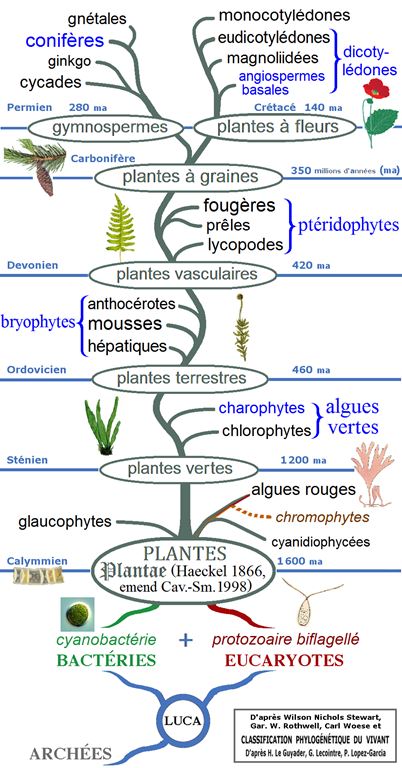
À droite, cet arbre phylogénétique des plantes montre les principaux clades et groupes traditionnels (monophylétiques en noir et paraphylétiques en bleu).
Dénominations
- Nom botanique : Schizophyllum commune Fr.
- Synonymes : Agaricus alneus L, Agaricus multifidus Batsch, Daedalea commune (Fr.) P. Kumm, Merulinus alneus (L.) J. F. Gmel, Schizophyllum alneum Schroter, Schizophyllum alneus (L.) Kuntze, Schizophyllum multifidum (Batsch) Fr
- Noms anglais et locaux : Alder Agaric, Common split gill
Description et culture
Tableau récapitulatif
Parties comes-tibles Note comest. (1-5) Note medic. (1-5) (Zones de) Rusticité Besoins en 
Besoins en  (1-3)
(1-3)Périodes de semis et récoltes Graines au gramme Durée de viabilité Profon-deur semis Espace-ment plants Espace-ment lignes Durée germi-native Durée avant récolte J F M A M J
J A S O N D
J F M A M J
J A S O N D
- dont infos de 0FPI ("FOOD PLANTS INTERNATIONAL", en anglais) :
Description :
Un champignon. Les organes de fructification sont gris et en forme d'éventail. Ils peuvent mesurer 2 à 4 cm de diamètre. Les branchies s'étalent à partir du point où le corps fructifère se fixe aux bûches. Les bords des branchies sont épais et fendus ou comme une rainure{{{0(+x) (traduction automatique).
Original : A mushroom. The fruiting bodies are grey and fan-shaped. They can be 2-4 cm across. The gills spread out from the point where the fruiting body attaches to logs. The edges of the gills are thick and split or like a groove{{{0(+x).
 Consommation (rapports de comestibilité, parties utilisables et usages alimentaires correspondants)
Consommation (rapports de comestibilité, parties utilisables et usages alimentaires correspondants)Parties comestibles :
champignon{{{0(+x) (traduction automatique). Original : Mushroom, Fungus{{{0(+x).Détails :
Le champignon est cuit et mangé. Les champignons séchés peuvent être conservés. Il peut être dur, il est donc bouilli pendant 1 ou 2 heures avec du sel ajouté ou cuit avec de la viande au curry. Il est également cuisiné avec du poisson séché{{{0(+x) (traduction automatique).
Original : The mushroom is cooked and eaten. Dried mushrooms can be preserved. It can be tough so is boiled for 1 or 2 hours with salt added or cooked with meat in curries. It is also cooked with dried fish{{{0(+x).
Partie testée :
champignon{{{0(+x) (traduction automatique). Original : Mushroom{{{0(+x)| Taux d'humidité (%) | Énergie (kj) | Énergie (kcal) | Protéines (g) |
|---|---|---|---|
| / | 0 | 315 | 17.0 |
| Pro- vitamines A (µg) |
Vitamines C (mg) | Fer (mg) | Zinc (mg) |
| 0 | 0 | 0 | 0 |
 Risques et précautions à prendre
Risques et précautions à prendrenéant, inconnus ou indéterminés.
Autres infos
dont infos de 0FPI ("FOOD PLANTS INTERNATIONAL", en anglais) :
Statut :
Les champignons sont vendus sur les marchés{{{0(+x) (traduction automatique).
Original : Mushrooms are sold in markets{{{0(+x).
Distribution :
Une plante tropicale. Il pousse en Afrique tropicale. Ils poussent en groupes sur du bois mort{{{0(+x) (traduction automatique).
Original : A tropical plant. It grows in tropical Africa. They grow in groups on dead wood{{{0(+x).
Localisation :
Afrique, Angola, Asie, Australie, Bénin, Burundi, Cameroun, Afrique centrale, République centrafricaine, RCA, Amérique centrale, Chine, RD Congo, Afrique de l'Est, Égypte, Gabon, Ghana, Guatemala, Himalaya, Hong Kong, Inde, Indochine , Indonésie, Kenya, Laos, Madagascar, Malawi, Malaisie, Mali, Mexique, Mozambique, Népal, Nigéria, Afrique du Nord, Amérique du Nord, Inde du Nord-Est, Pacifique, Pérou, Asie du Sud-Est, Singapour, Afrique du Sud, Afrique australe, Amérique du Sud, Tanzanie, Thaïlande, Tonga, Afrique de l'Ouest, Zambie, Zimbabwe{{{0(+x) (traduction automatique).
Original : Africa, Angola, Asia, Australia, Benin, Burundi, Cameroon, Central Africa, Central African Republic, CAR, Central America, China, Congo DR, East Africa, Egypt, Gabon, Ghana, Guatemala, Himalayas, Hong Kong, India, Indochina, Indonesia, Kenya, Laos, Madagascar, Malawi, Malaysia, Mali, Mexico, Mozambique, Nepal, Nigeria, North Africa, North America, Northeastern India, Pacific, Peru, SE Asia, Singapore, South Africa, Southern Africa, South America, Tanzania, Thailand, Tonga, West Africa, Zambia, Zimbabwe{{{0(+x).
Liens, sources et/ou références
Liens :
/ ;Sources et/ou références :
bibliographie (liste des sources et/ou références de l'encyclopédie)
dont livres et bases de données : 0FPI ("FOOD PLANTS INTERNATIONAL", en anglais) ;
dont bibliographie/références de 0FPI ("FOOD PLANTS INTERNATIONAL", en anglais) :
Abdullah, F. & Rusea, G., 2009, Documentation of inherited knowledge on wild edible fungi from Malaysia. Blumea 54, 35-38 ; Aletor, V. A., 1995, Compositional studies on edible tropical species of mushrooms. Food Chemistry 54 (1995) 265-268 ; Alexopoulos, C.J., 1962, Introductory Mycology. Wiley Toppan. p 516 ; Ambasta S.P. (Ed.), 2000, The Useful Plants of India. CSIR India. p 557 ; Bhaben, T., et al, 2010, Wild edible fungal resources by ethnic tribes of nagaland, India. Indian Journal of Traditional Knowledge. Vol 10(3) p 513 ; Boa, E. R., 2004, Wild edible fungi and their importance to people. FAO Non Wood Forest Products Booklet 17 ; Burkill, I.H., 1966, A Dictionary of the Economic Products of the Malay Peninsula. Ministry of Agriculture and Cooperatives, Kuala Lumpur, Malaysia. Vol 2 (I-Z) p 2011 ; Buyck, B., & Nzigidahera, B., 1995, Ethnomycological Notes from Western Burundi. Belg. Journ. Bot. 128(2): 131-138 ; Christensen, M., et al, 2008, Collection and Use of Wild Edible Fungi in Nepal. Economic Botany, 62(1), 2008, pp. 12–23 ; Cronin, L., 1989, The Concise Australian Flora. Reed. p 301 ; Dashorst, G.R.M., and Jessop, J.P., 1998, Plants of the Adelaide Plains & Hills. Botanic Gardens of Adelaide and State Herbarium. p 26 ; Degreef, J., et al, 2016, Wild edible mushrooms, a valuable resource for food security and rural development in Burundi and Rwanda. Biotechnol. Agron. Soc. Environ. 2016 20(4), 441-452 ; Devi, O.S., P. Komor & D. Das, 2010, A checklist of traditional edible bio-resources from Ima markets of Imphal Valley, Manipur, India. Journal of Threatened Taxa 2(11): 1291-1296 ; efta-online.org, Edible Fungi of Tropical Africa, Jardin botanique Meise ; Fuhrer, B., 2005, A field guide to Australian Fungi. Bloomings Books. p 172 ; Grivetti, L. E., 1980, Agricultural development: present and potential role of edible wild plants. Part 2: Sub-Saharan Africa, Report to the Department of State Agency for International Development. p 34 ; Hall, I. R., et al, 2003, Edible and Poisonous Mushrooms of the World. Timber Press. p 312 ; Herrera, 1934, (As Schizophyllum alneum) ; Gryzenhout, M., 2010, Mushrooms of South Africa. Pocket Guide. Struik. p 69 ; Hall, I. R., et al, 2003, Edible and Poisonous Mushrooms of the World. Timber Press. p 214 ; Hoare, A., 2003, Food use of the Lundayeh SW Sabah. Borneo Research Council. ; Jacquat, C., 1990, Plants from the Markets of Thailand. D.K. Book House p 28 ; Jardin, C., 1970, List of Foods Used In Africa, FAO Nutrition Information Document Series No 2.p 115 ; Kharel, S. & Rajbhandary, S., Ethnomycological Knowledge of Some Wild Edible Mushrooms in Bhardeo, Lalitpur, Nepal. ; Kiple, K.F. & Ornelas, K.C., (eds), 2000, The Cambridge World History of Food. CUP p 318 ; Kiple, K.F. & Ornelas, K.C., (eds), 2000, The Cambridge World History of Food. CUP p 322 (As Schizophyllum alneum) ; Latiff, A. et al, 1996, Distribution of minerals in the pileus and stalk of some selected edible mushrooms. Food Chemistry 56 (2): 115-121 ; Lautenschläger, T., et al, 2018, First large-scale ethnobotanical survey in the province of UÃge, northern Angola. Journal of Ethnobiology and Ethnomedicine (2018) 14:51 ; Lipp, 1991, ; Longvah, T. and Deosthale, Y. G., 1998, Compositional and nutritional studies on edible wild mushroom from northeast India. Food Chemistry 63(3): 331-334 ; Medhi, P. & Borthakur, S. K., 2012, Phytoresources from North Cachur Hills of Assam -3: Edible plants sold at Hflong market. Indian Journal of Natural Products and Resources. 3(1) pp 84-109 ; Medhi, P. & Borthakur, S. K., 2013, Wild edible plants sold by the Zeme Nagas at the makeshift market of Mahur, Dima Hasao district of Assam. Pleione 7(1): 84 - 93. 2013 ; Medhi, P., Sarma, A and Borthakur, S. K., 2014, Wild edible plants from the Dima Hasao district of Assam, India. Pleione 8(1): 133-148 ; Pfoze, N. L., et al, 2012, Assessment of Local Dependency on Selected Wild Edible Plants and fruits from Senapati district, Manipur, Northeast India. Ethnobotany Research & Applications 10:357-367 ; Pfoze, N. L., et al, 2012, Survey and assessment of floral diversity on wild edible plants from Senapati district of Manipur, Northeast India. Journal of Biodiversity and Environmental Sciences. 1(6):50-52 ; Piearce, G.D., 1981, Zambian mushrooms - customs and folklore. British Mycological Society Bulletin 139-42 ; Quininez-Martinez, M., et al, 2014, Knowledge and use of edible mushrooms in two municipalities of the Sierra Tarahumara, Chihuahua, Mexico. Journal of Ethniobiology and Ethnomedicine 10:6 ; Rijal, A., 2011, Surviving on Knowledge: Ethnobotany of Chepang community from mid-hills of Nepal. Ethnobotany Research & Applications 9:181-215 ; Ruan-Soto, F., et al, 2006, Process and dynamics of traditional selling wild edible mushrooms in tropical Mexico. Journal of Ethnobiology and Ethnomedicine 2006, 2:3 ; Ruan-Soto, F. et al, 2009, Use and handling of wild fungi in two communities of the Lacandona Rainforest, Chiapas, Mexico. Revista Mexicana de Micologia. 29, 2009 ; Santiago, F, H., et al, 2016, Traditional knowledge and use of wild mushrooms by Mixtecs or Ñuu savi, the people of the rain, from Southeastern Mexico. Journal of Ethnobiology and Ethnomedicine 12:35 p 8 ; See, L. S., et al, 2008, Utilization of Macrofungi by some Indigenous Communities for Food and Medicine in Peninsular Malaysia. Sustainable Forest Management and Poverty Alleviation: Roles of Traditional Forest-related Knowledge IUFRO World Series Volume 21 ; Singh, P.K., Singh, N.I., and Singh, L.J., 1988, Ethnobotanical Studies on Wild Edible Plants in the Markets of Manipur - 2. J. Econ. Tax. Bot. Vol. 12 No. 1 pp 113-119 ; Thatoi, H. & Singdevsachan, S. K., 2014, Diversity, nutritional composition and medicinal potential of Indian mushrooms: A review. African Journal of Biotechnology 13(4): 523-545 ; Tibuhwa, 2013, Wild Mushroom - an underutilized healthy food resource and income generator: experience from Tanzania rural areas. Journal of Ethnobiology and Ethnomedicine 9:49 ; www.unesco.org/mab/doc/mys/2000/final report_ghana/pdf
Recherche de/pour :
- "Schizophyllum commune" sur Google (pages et
images) ;
IPNI ("International Plant Names Index", en anglais) ;
TPL ("The Plant List", en anglais) ;
GRIN ("Germplasm Resources Information Network", en anglais) ;
TROPICOS (en anglais) ;
Tela Botanica ;
Pl@ntNet ;
Pl@ntUse ;
"Plants For A Future" (en anglais) ;
"Useful Tropical Plants" (en anglais) ou
"Useful Temperate Plants" (en anglais) ;
- "Schizophylle commun" sur Google (pages, images et recettes) ;
- "Schizophyllum commune" sur Google (pages et
images) ;
IPNI ("International Plant Names Index", en anglais) ;
TPL ("The Plant List", en anglais) ;
GRIN ("Germplasm Resources Information Network", en anglais) ;
TROPICOS (en anglais) ;
Tela Botanica ;
Pl@ntNet ;
Pl@ntUse ;
"Plants For A Future" (en anglais) ;
"Useful Tropical Plants" (en anglais) ou
"Useful Temperate Plants" (en anglais) ;
Espèces de la même famille (Agaricaceae)
199 taxons
- Agaric à bulbe abrupt
- Agaric auguste
- Agaric blanc sanguinolent
- Agaric boule-de-neige
- Agaric bulbeux
- Agaric champêtre
- Agaric de Bernard
- Agaric des bois
- Agaric des forêts
- Agaric des jachères
- Agaric des trottoirs
- Agaric neigeux
- Boviste couleur de plomb
- Calvatie en coupe ; Lycoperdon en sac
- Champignon de Paris
- Coulemelle
- Crepidote mou
- Hypholome hydrophyle
- Lepiote a ecailles aigues ; Lepiote apre
- Lépiote de Konrad
- Lépiote déguenillée
- Lepiote en bouclier
- Lépiote excoriée
- Lépiote mammelonnée
- Lépiote pudique
- Psalliote a grosses spores
- Psalliote vaporeuse
- Vesse-de-loup
- Agaricus abruptibulbus (Agaric à bulbe abrupt)
- Agaricus adiposus
- Agaricus amboensis
- Agaricus argyrotectus
- Agaricus arvensis (Agaric des jachères)
- Agaricus augustus (Agaric auguste)
- Agaricus basianulosus
- Agaricus benesii (Agaric blanc sanguinolent)
- Agaricus bernardii (Agaric de Bernard)
- Agaricus bingensis
- Agaricus bisporus (J.E. Lange) Imbach (Champignon de Paris)
- Agaricus bitorquis (Agaric des trottoirs)
- Agaricus blazei
- Agaricus bohusii
- Agaricus boltoni
- Agaricus brasiliensis
- Agaricus bretschneideri
- Agaricus bukavuensis
- Agaricus bulbillosa
- Agaricus campestris L. (Agaric champêtre)
- Agaricus comptulus
- Agaricus comtulus
- Agaricus croceolutescens
- Agaricus cupero-brunneus
- Agaricus deliciosus
- Agaricus devoniensis
- Agaricus diminutivus
- Agaricus edulis
- Agaricus endoxanthus
- Agaricus erythrotrichus
- Agaricus essettei (Agaric bulbeux)
- Agaricus flocculosipes
- Agaricus fuscofibrillosus
- Agaricus fuscovelatus
- Agaricus gennadii
- Agaricus goossensiae
- Agaricus haemorrhoidarius
- Agaricus heterocystis
- Agaricus hortensis
- Agaricus impudicus
- Agaricus kivuensis
- Agaricus langei
- Agaricus lanipes
- Agaricus lilaceps
- Agaricus luzonensis
- Agaricus macrosporus (Psalliote a grosses spores)
- Agaricus manilensis
- Agaricus meleagris
- Agaricus merrillii
- Agaricus micromegethus
- ...







 donne accès au menu
  - encyclopédies des plantes alimentaires ;
 - page de recherche - reconnaissance (identification) de plantes ;
 - page du calendrier lunaire et son générateur (au format PDF et JPG) ;
 - tableau récapitulatif ;
 - générateur de potées (soupes), avec estimation des apports nutrionnels et du coût;
 - générateur de codes QR ;
 - page des archives avec de nombreux documents sur différents thèmes complémentaires comme la botanique, les légumes,
les champignons, la cuisine, le bien-être ainsi que différents MOOC mais également des liens vers les archives de l'association ;
- page des archives avec de nombreux documents sur différents thèmes complémentaires comme la botanique, les légumes,
les champignons, la cuisine, le bien-être ainsi que différents MOOC mais également des liens vers les archives de l'association ;

 ou
ou
 permettant de passer du format standard à l'AMP (et vice-versa), lequel est simplifié et donc plus rapide.
 pour le fruit (et/ou les graines, la pulpe, etc...),
 pour les fleurs (et/ou pétales, calice...),
 pour les feuilles (et/ou la tige, les pousses...),
 pour les racines,
 pour le tronc (et/ou l'écorce, la sève...), et enfin
 pour les champignons,
puis les notes alimentaires et médicinales (de 1 à 5 étoiles), la rusticité (résistance au froid/gel)
et pour finir un résumé.
pour les champignons,
puis les notes alimentaires et médicinales (de 1 à 5 étoiles), la rusticité (résistance au froid/gel)
et pour finir un résumé. menant ici 🙂
 ,
,  et
et





 ,
,


 Encyclopédie(s)
 Recherche-Reconnaissance
 Tableau récapitulatif
 Codes QR
 Archives
 Calendrier(s) lunaire(s)
  Potées
 Re-naturation/naturalisation
 Affichettes, herbiers &
co.
Affichettes, herbiers &
co. menu
menu galerie