Gingembre sauvage
(Zingiber zerumbet)


Une herbe de la famille des gingembre grumeleuse dressée atteignant 0,4 à 1 m de haut. Le rhizome est épais et jaune. Les tiges sont robustes. Les feuilles n'ont pas de tig ... (traduction automatique)
→suite


Affich., herbiers & co.
Gingembre sauvage
Une herbe de la famille des gingembre grumeleuse dressée atteignant 0,4 à 1 m de haut. Le rhizome est épais et jaune. Les tiges sont robustes. Les feuilles n'ont pas de tige de feuille. Les feuilles son... (traduction automatique) →suite

Pas d'illustration
pour le moment 😕
Zingiber zerumbet
Classification
- Classique : en haut de l'écran, sous le coeur.
- Phylogénétique :
- Clade 4 : Angiospermes ;
- Clade 3 : Monocotylédones ;
- Clade 2 : Commelinidées ;
- Ordre APN : Zingiberales ;
- Famille APN : Zingiberaceae ;
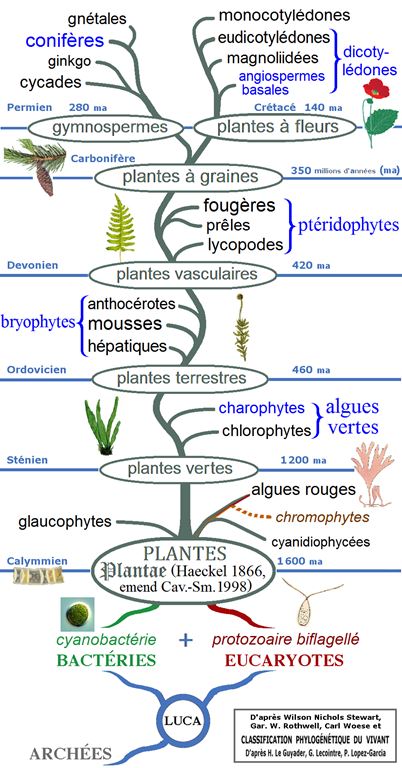
À droite, cet arbre phylogénétique des plantes montre les principaux clades et groupes traditionnels (monophylétiques en noir et paraphylétiques en bleu).
Dénominations
- Nom botanique : Zingiber zerumbet (L.) Roscoe ex Sm. (1806)
- Synonymes français : amome sauvage, zérumbet, gingembre shampooing (tp* de "shampoo ginger"), awapuhi
- Synonymes : Zingiber aromaticum Valeton 1918 ;
- Noms anglais et locaux : wild ginger, pine cone ginger, shampoo ginger
Description et culture
Tableau récapitulatif
Parties comes-tibles Note comest. (1-5) Note medic. (1-5) (Zones de) Rusticité Besoins en 
Besoins en  (1-3)
(1-3)Périodes de semis et récoltes Graines au gramme Durée de viabilité Profon-deur semis Espace-ment plants Espace-ment lignes Durée germi-native Durée avant récolte J F M A M J
J A S O N D
J F M A M J
J A S O N D
- dont infos de 0FPI ("FOOD PLANTS INTERNATIONAL", en anglais) :
Description :
Une herbe de la famille des gingembre grumeleuse dressée atteignant 0,4 à 1 m de haut. Le rhizome est épais et jaune. Les tiges sont robustes. Les feuilles n'ont pas de tige de feuille. Les feuilles sont largement en forme d'épée. La base est rétrécie. Ils se rétrécissent jusqu'à la pointe. Les feuilles sont plus courtes et plus grasses que le vrai gingembre. Ils mesurent 15 à 40 cm de long sur 3 à 8 cm de large. Le cône de fleurs est également plus long et plus fin que le vrai gingembre. La fleur provient du rhizome et est en forme de cône et mesure 6-15 cm de long sur 3,5-5 cm de large. La tige mesure 10 à 30 cm de long. Les gaines sont en forme d'échelle. Les bractées sont vertes quand elles sont jeunes et rouges quand elles sont vieilles. Le fruit est une capsule de 0,8 à 1,2 cm de diamètre. Les graines sont noires{{{0(+x) (traduction automatique).
Original : An upright clumpy ginger family herb up to 0.4-1 m high. The rhizome is thick and yellow. The stems are stout. The leaves do not have a leaf stalk. Leaves are broadly sword shaped. The base is narrowed. They taper to the tip. The leaves are shorter and fatter than true ginger. They are 15-40 cm long by 3-8 cm wide. The flower cone is also longer and thinner than true ginger. The flower comes from the rhizome and is cone shaped and 6-15 cm long by 3.5-5 cm wide. The stalk is 10-30 cm long. The sheaths are scale like. The bracts are green when young and red when old. The fruit is a capsule which is 0.8-1.2 cm across. The seeds are black{{{0(+x).
Culture :
Il pousse principalement à l'état sauvage dans les forêts de repousse. Il peut être cultivé à partir de sections du rhizome{{{0(+x) (traduction automatique).
Original : It mostly grows wild in regrowth forest. It can be grown from sections of the rhizome{{{0(+x).
 Consommation (rapports de comestibilité, parties utilisables et usages alimentaires correspondants)
Consommation (rapports de comestibilité, parties utilisables et usages alimentaires correspondants)Partie(s) comestible(s){{{0(+x) : rhizome, racine, feuilles, fleurs{{{0(+x).
Utilisation(s)/usage(s){{{0(+x) culinaire(s) :
-le rhizome et les feuilles sont consommées comme légume ou utilisées comme aromatisant en cuisine ;
-les fleurs sont cuites et consommées comme légume{{{0(+x).
Partie testée :
feuilles{{{0(+x) (traduction automatique). Original : Leaves{{{0(+x)| Taux d'humidité (%) | Énergie (kj) | Énergie (kcal) | Protéines (g) |
|---|---|---|---|
| / | 0 | 0 | 0 |
| Pro- vitamines A (µg) |
Vitamines C (mg) | Fer (mg) | Zinc (mg) |
| 0 | 19 | 0 | 0 |
 Risques et précautions à prendre
Risques et précautions à prendrenéant, inconnus ou indéterminés.
Autres infos
dont infos de 0FPI ("FOOD PLANTS INTERNATIONAL", en anglais) :
Statut :
En Papouasie-Nouvelle-Guinée, c'est une plante assez commune mais seulement une plante alimentaire mineure. C'est une plante cultivée{{{0(+x) (traduction automatique).
Original : In Papua New Guinea this is a quite common plant but only a minor food plant.It is cultivated plant{{{0(+x).
Distribution :
Une plante tropicale. Il pousse en Asie tropicale. Il se produit dans les zones côtières des Philippines. Il est le plus courant dans la forêt ouverte humide. Il convient aux climats saisonniers humides et secs. Il a besoin d'un sol fertile, riche en matières organiques et bien drainé. Il pousse dans le sud de la Chine. Il convient aux zones de rusticité 8-12. Au Yunnan{{{0(+x) (traduction automatique).
Original : A tropical plant. It grows in tropical Asia. It occurs in coastal areas in the Philippines. It is most common in damp open forest. It suits seasonally moist and dry climates. It needs a fertile, organically-rich, well-drained soil. It grows in S China. It suits hardiness zones 8-12. In Yunnan{{{0(+x).
Localisation :
Samoa américaines, Andaman Is., Asie, Australie, Bangladesh, Cambodge, Caraïbes, Chine, Chuuk, Timor oriental, Fidji, Guam, Hawaï, Himalaya, Inde, Indochine, Indonésie, Japon, Laos, Madagascar, Malaisie, Marquises, Micronésie, Myanmar, Nauru, Nouvelle-Calédonie, Niue, Amérique du Nord, Inde du Nord-Est, Pacifique, Palau, Papouasie-Nouvelle-Guinée, PNG, Philippines, Porto Rico, Samoa, Asie du Sud-Est, Sri Lanka, Taiwan, Thaïlande, Timor-Leste, Tonga, États-Unis, Vanuatu, Vietnam, Wallis-Futun{{{0(+x) (traduction automatique).
Original : American Samoa, Andaman Is., Asia, Australia, Bangladesh, Cambodia, Caribbean, China, Chuuk, East Timor, Fiji, Guam, Hawaii, Himalayas, India, Indochina, Indonesia, Japan, Laos, Madagascar, Malaysia, Marquesas, Micronesia, Myanmar, Nauru, New Caledonia, Niue, North America, Northeastern India, Pacific, Palau, Papua New Guinea, PNG, Philippines, Puerto Rico, Samoa, SE Asia, Sri Lanka, Taiwan, Thailand, Timor-Leste, Tonga, USA, Vanuatu, Vietnam, Wallis-Futuna{{{0(+x).
Notes :
Il existe environ 100 à 150 espèces de Zingiber{{{0(+x) (traduction automatique).
Original : There are about 100-150 Zingiber species{{{0(+x).
Liens, sources et/ou références
Liens :
/ ;Sources et/ou références :
bibliographie (liste des sources et/ou références de l'encyclopédie)
dont classification : TPL ("The Plant List", en anglais) ;
dont livres et bases de données : 0FPI ("FOOD PLANTS INTERNATIONAL", en anglais) ;
dont bibliographie/références de 0FPI ("FOOD PLANTS INTERNATIONAL", en anglais) :
Borrell, O.W., 1989, An Annotated Checklist of the Flora of Kairiru Island, New Guinea. Marcellin College, Victoria Australia. p 43 ; Bremness, L., 1994, Herbs. Collins Eyewitness Handbooks. Harper Collins. p 227 ; Burkill, I.H., 1966, A Dictionary of the Economic Products of the Malay Peninsula. Ministry of Agriculture and Cooperatives, Kuala Lumpur, Malaysia. Vol 2 (I-Z) p 2345 ; Burkill, I.H., 1966, A Dictionary of the Economic Products of the Malay Peninsula. Ministry of Agriculture and Cooperatives, Kuala Lumpur, Malaysia. Vol 2 (I-Z) p 2335 (As Zingiber amaricans) ; Cowie, I, 2006, A Survey of Flora and vegetation of the proposed Jaco-Tutuala-Lore National Park. Timor-Lests (East Timor) www.territorystories.nt/gov.au p 55 ; Cundall, P., (ed.), 2004, Gardening Australia: flora: the gardener's bible. ABC Books. p 1496 ; Exot. bot. 2:105, t. 112. 1806 ; Facciola, S., 1998, Cornucopia 2: a Source Book of Edible Plants. Kampong Publications, p 248 (As Zingiber amaricans) ; French, B.R., 1986, Food Plants of Papua New Guinea, A Compendium. Asia Pacific Science Foundation p 393 ; Hani Medicine of Xishuangbanna, 1999, p 159 ; Hedrick, U.P., 1919, (Ed.), Sturtevant's edible plants of the world. p 704 ; Hibbert, M., 2002, The Aussie Plant Finder 2002, Florilegium. p 311 ; Lavelle, M., 2008, Wild Flowers of Australia and Oceania. Southwater. p 109 ; Larsen, K., Ibrahim, H., Khaw, S.H., & Saw, L.G., 1999, Gingers of Peninsula Malaysia and Singapore. Natural History Publications (Borneo). p 9, 31 ; Lazarides, M. & Hince, B., 1993, Handbook of Economic Plants of Australia, CSIRO. p 251 ; Lembaga Biologi Nasional, 1977, Ubi-Ubian, Balai Pustaka, Jakarta. p 60 ; Lembaga Biologi Nasional, 1977, Ubi-Ubian, Balai Pustaka, Jakarta. p 58 (As Zingiber amaricans) ; Llamas, K.A., 2003, Tropical Flowering Plants. Timber Press. p 372 ; Low, T., 1992, Bush Tucker. Australia´s Wild Food Harvest. Angus & Robertson. p 184 ; Morton, ; Mot So Rau Dai an Duoc O Vietnam. Wild edible Vegetables. Ha Noi 1994, p 244 ; Niwano, Y. et al., 2009, Extensive Screening for Plant Foodstuffs in Okinawa, Japan with Anti-Obese Activity on Adipocytes, in vitro. Plant Foods in Human Nutrition 64:6-10 ; Ochse, ; Peekel, P.G., 1984, (Translation E.E.Henty), Flora of the Bismarck Archipelago for Naturalists, Division of Botany, Lae, PNG. p 101, 102 ; Phon, P., 2000, Plants used in Cambodia. © Pauline Dy Phon, Phnom Penh, Cambodia. p 645 ; Powell, J.M., Ethnobotany. In Paijmans, K., 1976, New Guinea Vegetation. Australian National University Press. p 112 ; Recher, P, 2001, Fruit Spirit Botanical Gardens Plant Index. www.nrg.com.au/~recher/ seedlist.html p 4 ; Smith, A.C., 1979, Flora Vitiensis Nova, Lawaii, Kuai, Hawaii, Volume 1 p 194 ; Staples, G.W. and Herbst, D.R., 2005, A tropical Garden Flora. Bishop Museum Press, Honolulu, Hawaii. p 769 ; Terra, G.J.A., 1973, Tropical Vegetables. Communication 54e Royal Tropical Institute, Amsterdam, p 83 ; Terra, G.J.A., 1973, Tropical Vegetables. Communication 54e Royal Tropical Institute, Amsterdam, p 83 (As Zingiber amaricans) ; Walter, A. & Lebot, V., 2007, Gardens of Oceania. ACIAR Monograph No. 122. p 296 ; Xu, Z., Tao, G. & Tan, J., 1988, Tropical Wild Flowers and Plants in Xishuangbanna, Agricultural Publishing House. photo 60 ; Xu, You-Kai, et al, 2004, Wild Vegetable Resources and Market Survey in Xishuangbanna, Southwest China. Economic Botany. 58(4): 647-667. ; Yuncker, T.G., 1959, Plants of Tonga, Bernice P. Bishop Museum, Hawaii, Bulletin 220. p 85
Recherche de/pour :
- "Zingiber zerumbet" sur Google (pages et
images) ;
IPNI ("International Plant Names Index", en anglais) ;
GRIN ("Germplasm Resources Information Network", en anglais) ;
TROPICOS (en anglais) ;
Tela Botanica ;
Pl@ntNet ;
Pl@ntUse ;
"Plants For A Future" (en anglais) ;
"Useful Tropical Plants" (en anglais) ou
"Useful Temperate Plants" (en anglais) ;
- "Gingembre sauvage" sur Google (pages, images et recettes) ;
- "Zingiber zerumbet" sur Google (pages et
images) ;
IPNI ("International Plant Names Index", en anglais) ;
GRIN ("Germplasm Resources Information Network", en anglais) ;
TROPICOS (en anglais) ;
Tela Botanica ;
Pl@ntNet ;
Pl@ntUse ;
"Plants For A Future" (en anglais) ;
"Useful Tropical Plants" (en anglais) ou
"Useful Temperate Plants" (en anglais) ;
Espèces du même genre (Zingiber)
28 taxons
- Zingiber bradleyanum Craib
- Zingiber cernuum Dalzell
- Zingiber chrysostachys Ridl.
- Zingiber corallinum Hance
- Zingiber densissimum S.Q.Tong & Y.M.Xia
- Zingiber fragile S.Q.Tong
- Zingiber gramineum Noronha ex Blume
- Zingiber griffithii Baker
- Zingiber kawagoii
- Zingiber kelabitianum Theilade & H.Chr.
- Zingiber longipedunculatum Ridl.
- Zingiber mioga (Thunb.) Roscoe (Mioga)
- Zingiber montanum (J. Koenig) Link ex A. Dietr. (Bangle)
- Zingiber neotruncatum T.L.Wu, K.Larsen & Turland
- Zingiber odoriferum Blume
- Zingiber officinale Roscoe (Gingembre)
- Zingiber oligophyllum K.Schum.
- Zingiber orbiculatum S.Q.Tong
- Zingiber ottensii Valeton
- Zingiber roseum
- Zingiber rubens Roxb. (Gingembre du bengale)
- Zingiber smilesianum Craib
- Zingiber spectabile Griff.
- Zingiber squarrosum Wight
- Zingiber striolatum Diels
- Zingiber tuanjuum Z.Y.Zhu
- Zingiber wightianum Thwaites
Espèces de la même famille (Zingiberaceae)
255 taxons
- Aframome blanc violacée (tp*)
- Alpinie pourprée
- Bangle
- Banjang
- Cardamome
- Cardamome brune
- Cardamome de Java
- Cardamome du cameroun
- Cardamome médicinale
- Cardamome naine
- Cardamome noire
- Curcuma
- Curcuma blanc
- Galanga
- Gingembre
- Gingembre coquille
- Gingembre d'ornement
- Gingembre du bengale
- Gingembre mangue
- Gingembre papillon
- Hédychie de Gardner
- Hédychie écarlate
- Kencur
- Korarima
- Korarima des singes
- Krachaï
- Longoza
- Maniguette
- Mbongo
- Mioga
- Munong
- Petit galanga
- Zédoaire
- Achasma loroglossum
- Aframomum albiflorum Lock
- Aframomum alboviolaceum (Ridl.) K.Schum. (Aframome blanc violacée (tp*))
- Aframomum angustifolium (Sonn.) K. Schum. (Longoza)
- Aframomum cereum
- Aframomum citratum (C.Pereira) K.Schum. (Mbongo)
- Aframomum corrorima (C. Pereira) P. C. M. Jansen (Korarima)
- Aframomum daniellii (Hook.f.) K.Schum. (Cardamome du cameroun)
- Aframomum elliotii
- Aframomum exscapum (Sims) Hepper (Maniguette)
- Aframomum giganteum
- Aframomum laurentii
- Aframomum letestuanum Gagnep.
- Aframomum longiscapum
- Aframomum luteoalbum
- Aframomum mala
- Aframomum melegueta (Rosc.) K. Schum. (Maniguette)
- Aframomum polyanthum
- Aframomum pruinosum Gagnep.
- Aframomum rostratum K.Schum.
- Aframomum strobilaceum (Sm.) Hepper (Maniguette)
- Aframomum subsericeum
- Aframomum sulcatum
- Aframomum thonneri De Wild.
- Aframomum verrucosum Lock
- Aframomum zambesiacum (Baker) K.Schum. (Korarima des singes)
- Alpinia aquatica
- Alpinia arundelliana
- Alpinia athroantha Valeton
- Alpinia beamanii R.M.Sm.
- Alpinia blepharocalyx K.Schum.
- Alpinia caerulea (R.Br.) Benth. (Gingembre d'ornement)
- Alpinia calcarata
- Alpinia capitellata Jack
- Alpinia chinensis
- Alpinia conchigera Griff.
- Alpinia coriandriodora D.Fang
- Alpinia elegans
- Alpinia emaculata S.Q.Tong
- Alpinia galanga (L.) Willd. (Galanga)
- Alpinia glabra Ridl.
- Alpinia globosa
- Alpinia hainanensis K.Schum.
- Alpinia japonica
- Alpinia javanica Blume
- Alpinia kawakamii Hayata
- Alpinia kusshakuensis Hayata
- Alpinia kwangsiensis T.L.Wu & S.J.Chen
- Alpinia latilabris Ridl.
- Alpinia ligulata K.Schum.
- ...







 donne accès au menu
  - encyclopédies des plantes alimentaires ;
 - page de recherche - reconnaissance (identification) de plantes ;
 - page du calendrier lunaire et son générateur (au format PDF et JPG) ;
 - tableau récapitulatif ;
 - générateur de potées (soupes), avec estimation des apports nutrionnels et du coût;
 - générateur de codes QR ;
 - page des archives avec de nombreux documents sur différents thèmes complémentaires comme la botanique, les légumes,
les champignons, la cuisine, le bien-être ainsi que différents MOOC mais également des liens vers les archives de l'association ;
- page des archives avec de nombreux documents sur différents thèmes complémentaires comme la botanique, les légumes,
les champignons, la cuisine, le bien-être ainsi que différents MOOC mais également des liens vers les archives de l'association ;

 ou
ou
 permettant de passer du format standard à l'AMP (et vice-versa), lequel est simplifié et donc plus rapide.
 pour le fruit (et/ou les graines, la pulpe, etc...),
 pour les fleurs (et/ou pétales, calice...),
 pour les feuilles (et/ou la tige, les pousses...),
 pour les racines,
 pour le tronc (et/ou l'écorce, la sève...), et enfin
 pour les champignons,
puis les notes alimentaires et médicinales (de 1 à 5 étoiles), la rusticité (résistance au froid/gel)
et pour finir un résumé.
pour les champignons,
puis les notes alimentaires et médicinales (de 1 à 5 étoiles), la rusticité (résistance au froid/gel)
et pour finir un résumé. menant ici 🙂
 ,
,  et
et





 ,
,


 Encyclopédie(s)
 Recherche-Reconnaissance
 Tableau récapitulatif
 Codes QR
 Archives
 Calendrier(s) lunaire(s)
  Potées
 Re-naturation/naturalisation
 Affichettes, herbiers &
co.
Affichettes, herbiers &
co. menu
menu galerie