Palmier-dattier sauvage
(Phoenix sylvestris)

 |
*
-
**
|
*
-
**
zone 9
Un grand palmier. Il est non ramifié jusqu'à 15 m de haut. Le tronc est rugueux avec des bases de feuilles persistantes. Le tronc mesure 60 à 75 cm de diamètre. La calotte ... (traduction automatique)
→suite


Affich., herbiers & co.
Palmier-dattier sauvage
Un grand palmier. Il est non ramifié jusqu'à 15 m de haut. Le tronc est rugueux avec des bases de feuilles persistantes. Le tronc mesure 60 à 75 cm de diamètre. La calotte est épaisse et semi-arrondie... (traduction automatique) →suite
Note alimentaire  médicinale

Pas d'illustration
pour le moment 😕
Phoenix sylvestris
Classification
- Classique : en haut de l'écran, sous le coeur.
- Phylogénétique :
- Clade 4 : Angiospermes ;
- Clade 3 : Monocotylédones ;
- Clade 2 : Commelinidées ;
- Ordre APN : Arecales ;
- Famille APN : Arecaceae ;
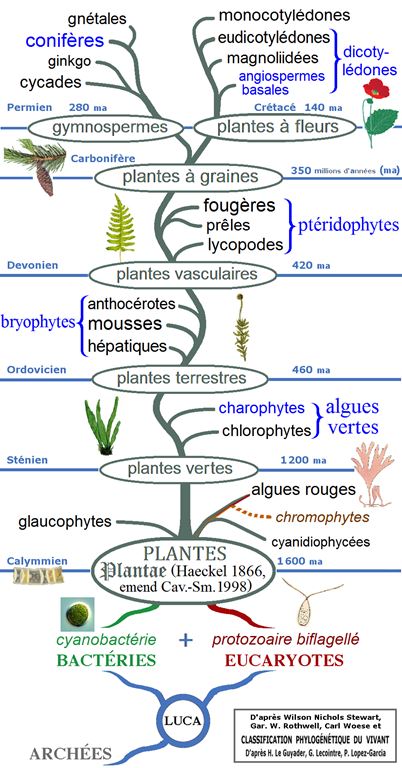
À droite, cet arbre phylogénétique des plantes montre les principaux clades et groupes traditionnels (monophylétiques en noir et paraphylétiques en bleu).
Dénominations
- Nom botanique : Phoenix sylvestris (L.) Roxb. (1832)
- Synonymes français : dattier sauvage
- Synonymes : Elate sylvestris L
- Noms anglais et locaux : India date
Description et culture
Tableau récapitulatif
Parties comes-tibles Note comest. (1-5) Note medic. (1-5) (Zones de) Rusticité Besoins en 
Besoins en  (1-3)
(1-3)Périodes de semis et récoltes Graines au gramme Durée de viabilité Profon-deur semis Espace-ment plants Espace-ment lignes Durée germi-native Durée avant récolte zone 9 J F M A M J
J A S O N D
J F M A M J
J A S O N D
- dont infos de 0FPI ("FOOD PLANTS INTERNATIONAL", en anglais) :
Description :
Un grand palmier. Il est non ramifié jusqu'à 15 m de haut. Le tronc est rugueux avec des bases de feuilles persistantes. Le tronc mesure 60 à 75 cm de diamètre. La calotte est épaisse et semi-arrondie à arrondie. Les feuilles sont gris-vert ou recouvertes d'une couche cireuse. Ils mesurent 2-3 m de long. Ils ont une apparence hérissée. Ils sont divisés en folioles le long de la tige. Les folioles mesurent 20-25 cm de long et sont pointues. Les épis fleuris sont entourés de bractées en forme de bateau. Ils mesurent 60 à 75 cm de long. Ils se produisent entre les feuilles. Les fleurs mâles sont blanc jaunâtre. Ils ont un parfum. Les fleurs femelles sont verdâtres avec une teinte brune. Les fruits sont jaunes à maturité. Ils sont comestibles. Les fleurs mâles et femelles se trouvent sur des plantes séparées. Les deux sont nécessaires pour les fruits{{{0(+x) (traduction automatique).
Original : A tall palm. It is unbranched up to 15 m high. The trunk is rough with persistent leaf bases. The trunk is 60-75 cm across. The crown is thick and half rounded to rounded. The leaves are grey-green or covered with a waxy layer. They are 2-3 m long. They have a spiky appearance. They are divided into leaflets along the stalk. The leaflets are 20-25 cm long and with a sharp point. The flowering spikes are enclosed by boat shaped bracts. They are 60-75 cm long. They occur between the leaves. The male flowers are yellowish-white. They have a scent. The female flowers are greenish with a brown tinge. The fruit are yellow when ripe. They are edible. Male and female flowers are on separate plants. Both are needed for fruit{{{0(+x).
Production :
C'est une croissance assez rapide. La sève peut être prélevée sur le côté de la couronne. Cela peut être commencé lorsque la paume a entre 7 et 10 ans et se poursuivre pendant 20 à 25 ans. Le rendement annuel par palme est de 100 l de jus. Cela peut être converti en 3 kg de sucre{{{0(+x) (traduction automatique).
Original : It is quite fast growing. Sap can be taken from the side of the crown. This can be started when the palm is 7-10 years old and continue for 20-25 years. The annual yield per palm is 100 l of juice. This can be converted to 3 kg of sugar{{{0(+x).
Culture :
Les plantes sont cultivées à partir de graines. Les graines germent facilement. La germination prend environ 3 mois. {{{0(+x) (traduction automatique).
Original : Plants are grown from seed. Seed germinate easily. Germination takes about 3 months{{{0(+x).
Consommation (rapports de comestibilité, parties utilisables et usages alimentaires correspondants)
Consommation (rapports de comestibilité, parties utilisables et usages alimentaires correspondants)Partie(s) comestible(s){{{0(+x) : fruit, sève, chou, tige intérieure, pousses, coeur de palmier{{{0(+x)µ.
Utilisation(s)/usage(s)µ{{{0(+x) culinaire(s) :
-la sève de la tige est utilisée pour une boisson ; elle est également fermentée ;
-les fruits sont consommés crus ; ils peuvent être utilisés pour les confitures ou gelées;
-les graines sont comestibles.
-la tige de la fleur est sucée pour la sève qui est réduite au sucre de date ; celui-ci est utilisé pour le jaggery (ou gur) et le sucre ;
-la pointe de végétation ou chou est mangée ;
-une sorte de sagou peut être extraite de la tige{{{0(+x).
Partie testée :
/ Risques et précautions à prendre
Risques et précautions à prendrenéant, inconnus ou indéterminés.
Autres infos
dont infos de 0FPI ("FOOD PLANTS INTERNATIONAL", en anglais) :
Statut :
Il est cultivé dans de grandes régions en Inde pour la sève. Les fruits sont vendus sur les marchés{{{0(+x) (traduction automatique).
Original : It is cultivated in large areas in India for sap. The fruit are sold in markets{{{0(+x).
Distribution :
Il pousse dans les régions tropicales et tempérées. Il peut pousser dans les districts intérieurs et côtiers. Il a besoin d'une position ensoleillée et d'un sol bien drainé. Il pousse sur des collines stériles en Inde. C'est souvent sur des sols sableux. Il pousse naturellement dans le bassin de l'Indus au Pakistan. Il peut atteindre 1500 m d'altitude en Asie du Sud-Est. Jardins botaniques de Melbourne. Dans XTBG Yunnan{{{0(+x) (traduction automatique).
Original : It grows in tropical and temperate regions. It can grow in inland and coastal districts. It needs a sunny position and a well drained soil. It grows on barren hills in India. It is often on sandy soils. It grows naturally in the Indus basin in Pakistan. It can grow up to 1500 m altitude in SE Asia. Melbourne Botanical gardens. In XTBG Yunnan{{{0(+x).
Localisation :
Asie, Australie, Bangladesh, Chine, Cuba, Fidji, Guam, Himalaya, Inde, Indochine, Indonésie, Maldives, Myanmar, Népal, Inde du nord-est, Inde du Nord-Ouest, Pacifique, Pakistan, Rotuma, Asie du Sud-Est, Sri Lanka, Thaïlande{{{0(+x) (traduction automatique).
Original : Asia, Australia, Bangladesh, China, Cuba, Fiji, Guam, Himalayas, India, Indochina, Indonesia, Maldives, Myanmar, Nepal, Northeastern India, NW India, Pacific, Pakistan, Rotuma, SE Asia, Sri Lanka, Thailand{{{0(+x).
Notes :
Il existe 17 espèces de phénix. Il est indigène à de nombreuses régions de l'Inde{{{0(+x) (traduction automatique).
Original : There are 17 Phoenix species. It is indigenous to many parts of India{{{0(+x).
Rusticité (résistance face au froid/gel, climat)
zone 9
Liens, sources et/ou références
Liens :
/ ;Sources et/ou références :
bibliographie (liste des sources et/ou références de l'encyclopédie)
dont classification : TPL ("The Plant List", en anglais) ; Tela Botanica ;
dont livres et bases de données : 5PFAF ("Plants For A Future", en anglais) ; 0FPI ("FOOD PLANTS INTERNATIONAL", en anglais) ;
dont bibliographie/références de 0FPI ("FOOD PLANTS INTERNATIONAL", en anglais) :
Ambasta, S.P. (Ed.), 2000, The Useful Plants of India. CSIR India. p 449 ; Balick, M.J. and Beck, H.T., (Ed.), 1990, Useful palms of the World. A Synoptic Bibliography. Colombia p 81, 200, 403, 435, 607, ; Bandyopadhyay, S. et al, 2009, Wild edible plants of Koch Bihar district, West Bengal. Natural Products Radiance 8(1) 64-72 ; Blomberry, A. & Rodd, T., 1982, Palms. An informative practical guide. Angus & Robertson. p 142 ; Bole, P.V., & Yaghani, Y., 1985, Field Guide to the Common Trees of India. OUP p 107 ; Burkill, I.H., 1966, A Dictionary of the Economic Products of the Malay Peninsula. Ministry of Agriculture and Cooperatives, Kuala Lumpur, Malaysia. Vol 2 (I-Z) p 1743 ; Facciola, S., 1998, Cornucopia 2: a Source Book of Edible Plants. Kampong Publications, p 30 ; Fl. ind. ed. 1832, 3:787. 1832 ; Flora of Pakistan. www.eFloras.org ; GAMMIE, ; Gibbons, M., 2003, A pocket guide to Palms. Chartwell Books. p 162 ; Haynes, J., & McLaughlin, J., 2000, Edible palms and Their Uses. University of Florida Fact sheet MCDE-00-50-1 p 11 ; Hedrick, U.P., 1919, (Ed.), Sturtevant's edible plants of the world. p 489 ; Johnson, D.V., 1998, Tropical palms. Non-wood Forest products 10. FAO Rome. p 42, 48, 123 ; Jones, D.L., 1994, Palms throughout the World. Smithtonian Institution, Washington. p 290 ; Jones, D.L., 2000, Palms of Australia 3rd edition. Reed/New Holland. p 197 ; Krishen P., 2006, Trees of Delhi, A Field Guide. DK Books. p 312 ; Oudejans, J.H.M., 1979, Date palm, in Simmonds, N.W., (ed), Crop Plant Evolution. Longmans. London. p 230 ; Parmar, C., & Kaushel, M. K., 1982, In Wild Fruits. Kalyani Publishers, New Delhi, India. p 58-61 ; PROSEA handbook Volume 9 Plants yielding non-seed carbohydrates. p 177 ; Purseglove, J.W., 1972, Tropical Crops. Monocotyledons. Longmans p 430 ; Rashid, H. E., 1977, Geography of Bangladesh. Westview. p 294 ; Reddy, K. N. et al, 2007, Traditional knowledge on wild food plants in Andhra Pradesh. Indian Journal of Traditional Knowledge. Vol. 6(1): 223-229 ; Reddy, K.R., 1989, Additional Notes on the Wild Edible Plants of India. J. Econ. Tax. Bot. Vol. 13 No. 1 pp 125-127 ; Riffle, R.L. & Craft, P., 2003, An Encyclopedia of Cultivated Palms. Timber Press. p 405 ; Shah, G.L., 1984, Some economically important plant of Salsette Island near Bombay. J. Econ. Tax. Bot. Vol. 5 No. 4 pp 753-765 ; Singh, H.B., Arora R.K.,1978, Wild edible Plants of India. Indian Council of Agricultural Research, New Delhi. p 68 ; Singh, V. and Singh, P., 1981, Edible Wild Plants of Eastern Rajasthan. J. Econ. Tax. Bot. Vol 2 pp 197-207 ; Swaminathan, M.S., and Kochnar, S.L., 2007, An Atlas of major Flowering Trees in India. Macmillan. p 276 ; USDA, ARS, National Genetic Resources Program. Germplasm Resources Information Network - (GRIN). [Online Database] National Germplasm Resources Laboratory, Beltsville, Maryland. Available: www.ars-grin.gov/cgi-bin/npgs/html/econ.pl (10 April 2000) ; WATT,
Recherche de/pour :
- "Phoenix sylvestris" sur Google (pages et
images) ;
IPNI ("International Plant Names Index", en anglais) ;
GRIN ("Germplasm Resources Information Network", en anglais) ;
TROPICOS (en anglais) ;
Pl@ntNet ;
Pl@ntUse ;
"Useful Tropical Plants" (en anglais) ou
"Useful Temperate Plants" (en anglais) ;
- "Palmier-dattier sauvage" sur Google (pages, images et recettes) ;
- "Phoenix sylvestris" sur Google (pages et
images) ;
IPNI ("International Plant Names Index", en anglais) ;
GRIN ("Germplasm Resources Information Network", en anglais) ;
TROPICOS (en anglais) ;
Pl@ntNet ;
Pl@ntUse ;
"Useful Tropical Plants" (en anglais) ou
"Useful Temperate Plants" (en anglais) ;
Espèces du même genre (Phoenix)
17 taxons
- Dattier
- Dattier du Sénégal
- Palmier-dattier
- Palmier-dattier des canaries
- Palmier-dattier des falaises
- Palmier-dattier nain
- Phénix de Loureiro
- Phoenix acaulis Roxb.
- Phoenix atlantica A.Chev. (Dattier)
- Phoenix caespitosa Chiov.
- Phoenix canariensis Chabaud (Palmier-dattier des canaries)
- Phoenix dactylifera L. (Palmier-dattier)
- Phoenix loureiroi Kunth (Phénix de Loureiro)
- Phoenix paludosa Roxb.
- Phoenix paludosa x rupicola
- Phoenix pusilla Lour.
- Phoenix reclinata Jacq. (Dattier du Sénégal)
- Phoenix roebelenii O'Brien (Palmier-dattier nain)
- Phoenix roebelenii x paludosa
- Phoenix rupicola T.Anderson (Palmier-dattier des falaises)
- Phoenix rupicola x canariensis
- Phoenix theophrasti Greuter (Dattier)
- Phoenix zeylanica Trimen
Espèces de la même famille (Arecaceae)
781 taxons
- Acanthophénix chevelu
- Bismarckie noble
- Borasse d'Éthiopie
- Butia argentin
- Cocotier
- Cocotier du chili
- Cocotier plumeux
- Dattier
- Dattier du Sénégal
- Dypsis de Madagascar
- Forest acai
- Palmier à bétel
- Palmier à huile d'afrique
- Palmier à huile d'amérique
- Palmier à sucre
- Palmier à vin
- Palmier açaï
- Palmier bleu du mexique
- Palmier butia pourpre
- Palmier chanvre
- Palmier de guadeloupe
- Palmier de juçara
- Palmier de palmyre
- Palmier du Brésil
- Palmier du mexique
- Palmier ébouriffé
- Palmier eleiodoxa
- Palmier jucum
- Palmier jupon
- Palmier laineux
- Palmier maraja
- Palmier nain
- Palmier pêche
- Palmier piassava
- Palmier tucuma
- Palmier-dattier
- Palmier-dattier des canaries
- Palmier-dattier des falaises
- Palmier-dattier nain
- Palmier-éventail d'Australie
- Palmier-éventail de Chine
- Palmiste blanc
- Palmiste rouge
- Phénix de Loureiro
- Pritchardie du Pacifique
- Pseudophénix de Sargent
- Sabal des Bermudes
- Sabal palmetto
- Sagouier farineux
- Salak
- Acanthophoenix crinita (Acanthophénix chevelu)
- Acanthophoenix rubra (Bory) H. Wendl. (Palmiste rouge)
- Acoelorrhaphe wrightii (Griseb. & H.Wendl.) H.Wendl. ex Becc.
- Acrocomia aculeata
- Acrocomia crispa
- Acrocomia media O.F.Cook
- Actinorhytis calapparia
- Adonidia merrillii
- Aiphanes deltoidea Burret
- Aiphanes eggersii Burret
- Aiphanes gelatinosa H.E.Moore
- Aiphanes grandis Borchs. & Balslev
- Aiphanes hirsuta Burret
- Aiphanes horrida (Jacq.) Burret (Palmier ébouriffé)
- Aiphanes lindeniana
- Aiphanes linearis Burret
- Aiphanes macroloba Burret
- Aiphanes minima
- Aiphanes ulei
- Aiphanes verrucosa Borchs. & Balslev
- Aiphanes weberbaueri Burret
- Allagoptera arenaria
- Allagoptera brevicalyx M.Moraes
- Allagoptera campestris
- Allagoptera caudescens
- Allagoptera leucocalyx
- Allagoptera maritimum
- Ammandra decasperma O.F.Cook
- Aphandra natalia
- Archontophoenix alexandrae
- Archontophoenix cunninghamiana
- Areca caliso Becc.
- Areca catechu L. (Palmier à bétel)
- Areca concinna Thwaites
- Areca glandiformis Lam.
- Areca hutchinsoniana Becc.
- Areca ipot Becc.
- Areca jobiensis Becc.
- Areca macrocalyx Zipp. ex Blume
- Areca macrocarpa Becc.
- Areca montana Ridl.
- Areca novohibernica
- Areca parens Becc.
- Areca triandra Roxb. ex Buch.-Ham.
- Areca vestiaria Giseke
- Areca whitfordii Becc.
- Arenga australasica
- Arenga brevipes Becc.
- Arenga engleri Becc.
- Arenga listeri Becc.
- ...







 donne accès au menu
  - encyclopédies des plantes alimentaires ;
 - page de recherche - reconnaissance (identification) de plantes ;
 - page du calendrier lunaire et son générateur (au format PDF et JPG) ;
 - tableau récapitulatif ;
 - générateur de potées (soupes), avec estimation des apports nutrionnels et du coût;
 - générateur de codes QR ;
 - page des archives avec de nombreux documents sur différents thèmes complémentaires comme la botanique, les légumes,
les champignons, la cuisine, le bien-être ainsi que différents MOOC mais également des liens vers les archives de l'association ;
- page des archives avec de nombreux documents sur différents thèmes complémentaires comme la botanique, les légumes,
les champignons, la cuisine, le bien-être ainsi que différents MOOC mais également des liens vers les archives de l'association ;

 ou
ou
 permettant de passer du format standard à l'AMP (et vice-versa), lequel est simplifié et donc plus rapide.
 pour le fruit (et/ou les graines, la pulpe, etc...),
 pour les fleurs (et/ou pétales, calice...),
 pour les feuilles (et/ou la tige, les pousses...),
 pour les racines,
 pour le tronc (et/ou l'écorce, la sève...), et enfin
 pour les champignons,
puis les notes alimentaires et médicinales (de 1 à 5 étoiles), la rusticité (résistance au froid/gel)
et pour finir un résumé.
pour les champignons,
puis les notes alimentaires et médicinales (de 1 à 5 étoiles), la rusticité (résistance au froid/gel)
et pour finir un résumé. menant ici 🙂
 ,
,  et
et





 ,
,


 Encyclopédie(s)
 Recherche-Reconnaissance
 Tableau récapitulatif
 Codes QR
 Archives
 Calendrier(s) lunaire(s)
  Potées
 Re-naturation/naturalisation
 Affichettes, herbiers &
co.
Affichettes, herbiers &
co. menu
menu galerie