Commelina forskaolii


Une herbe. Les tiges sont charnues et reposent au sol. Ils forment des racines au niveau des nœuds. Les tiges des feuilles forment une gaine autour de la tige. Les feuill ...
→suite


Affich., herbiers & co.
Commelina forskaolii
Une herbe. Les tiges sont charnues et reposent au sol. Ils forment des racines au niveau des nœuds. Les tiges des feuilles forment une gaine autour de la tige. Les feuilles sont petites. La fleur sort d'une poche telle une spathe... →suite

Pas d'illustration
pour le moment 😕
Classification
- Classique : en haut de l'écran, sous le coeur.
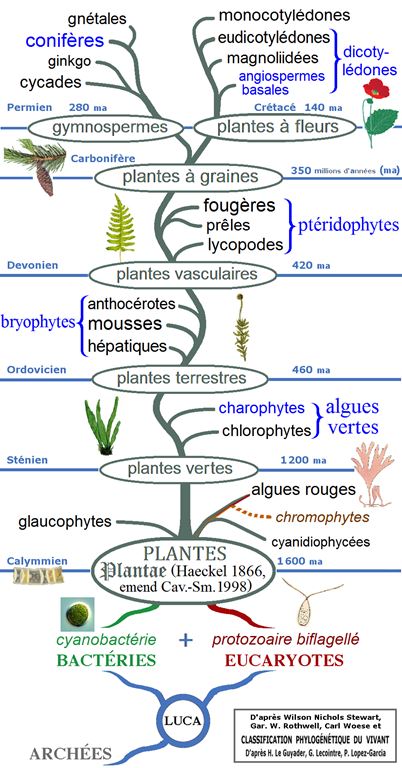
- Phylogénétique :
- Clade 4 : Angiospermes ;
- Clade 3 : Monocotylédones ;
- Clade 2 : Commelinidées ;
- Ordre APN : Commelinales ;
- Famille APN : Commelinaceae ;
À droite, cet arbre phylogénétique des plantes montre les principaux clades et groupes traditionnels (monophylétiques en noir et paraphylétiques en bleu).
Dénominations
- Nom botanique : Commelina forskaolii Vahl
- Synonymes : Commelina falcata Hassk.; ;
- Noms anglais et locaux : Dzadza, Goche, Goshe, Kikoe, Kikowe, Kimore, Nkwasia,
Description et culture
Tableau récapitulatif
Parties comes-tibles Note comest. (1-5) Note medic. (1-5) (Zones de) Rusticité Besoins en 
Besoins en  (1-3)
(1-3)Périodes de semis et récoltes Graines au gramme Durée de viabilité Profon-deur semis Espace-ment plants Espace-ment lignes Durée germi-native Durée avant récolte J F M A M J
J A S O N D
J F M A M J
J A S O N D
Description :
Une herbe. Les tiges sont charnues et reposent au sol. Ils forment des racines au niveau des nœuds. Les tiges des feuilles forment une gaine autour de la tige. Les feuilles sont petites. La fleur sort d'une poche telle une spathe. Les fleurs sont bleues.
- dont infos de 0FPI ("FOOD PLANTS INTERNATIONAL", en anglais) :
Production :
Les branches sont battues pour récolter les graines.{{{0(+x) (traduction automatique).
Original : The branches are threshed to collect the seeds{{{0(+x).
Culture :
Les plantes sont cultivées à partir de boutures de racines.{{{0(+x) (traduction automatique).
Original : Plants are grown from root cuttings{{{0(+x).
 Consommation (rapports de comestibilité, parties utilisables et usages alimentaires correspondants)
Consommation (rapports de comestibilité, parties utilisables et usages alimentaires correspondants)Parties comestibles :
Feuilles, graines, légumes,{{{0(+x) (traduction automatique). Original : Leaves, Seeds, Vegetable{{{0(+x).Détails :
Les graines sont utilisées pour faire de la farine pour le pain. Les feuilles sont cuites et consommées. Ils sont mous à la cuisson et sont donc souvent mélangés à des légumes grossiers ou au maïs.{{{0(+x) (traduction automatique).
Original : The seeds are used to make flour for bread. The leaves are cooked and eaten. They are soft when cooked so are often mixed with coarse vegetables or maize{{{0(+x).
Partie testée :
/ Risques et précautions à prendre
Risques et précautions à prendrenéant, inconnus ou indéterminés.
Autres infos
dont infos de 0FPI ("FOOD PLANTS INTERNATIONAL", en anglais) :
Statut :
Les feuilles sont largement utilisées. Ils sont d’appétence moyenne.{{{0(+x) (traduction automatique).
Original : The leaves are widely used. They are of average palatability{{{0(+x).
Distribution :
Une plante tropicale. Il pousse sur des sols graveleux. Il peut s'agir d'un sol sableux sur un matériau calcaire. Il pousse du niveau de la mer jusqu'à 1 700 m d'altitude. Il pousse dans les endroits chauds et arides et dans les endroits à saison sèche marquée. Il peut tolérer la sécheresse. Il peut pousser dans des endroits arides.{{{0(+x) (traduction automatique).
Original : A tropical plant. It grows on gravely soil. It can be on sandy soil over limestone material. It grows from sea level to 1,700 m above sea level. It grows in hot arid places and places with a marked dry season. It can tolerate drought. It can grow in arid places{{{0(+x).
Localisation :
Afrique, Asie, Bénin, Botswana, Burkina Faso, Cameroun, Afrique centrale, Congo, Afrique de l'Est, Gambie, Ghana, Guinée, Guinée, Guinée-Bissau, Inde, Kenya, Madagascar, Mali, Moyen-Orient, Mozambique, Namibie, Nigeria, Amérique du Nord, Arabie saoudite, Sénégal, Socotra, Somalie, Afrique du Sud, Afrique australe, Soudan du Sud, Soudan, Tanzanie, États-Unis, Afrique de l'Ouest, Zambie, Zimbabwe,{{{0(+x) (traduction automatique).
Original : Africa, Asia, Benin, Botswana, Burkina Faso, Cameroon, Central Africa, Congo, East Africa, Gambia, Ghana, Guinea, Guinée, Guinea-Bissau, India, Kenya, Madagascar, Mali, Middle East, Mozambique, Namibia, Nigeria, North America, Saudi Arabia, Senegal, Socotra, Somalia, South Africa, Southern Africa, South Sudan, Sudan, Tanzania, USA, West Africa, Zambia, Zimbabwe{{{0(+x).
Notes :
Il existe environ 230 espèces de Commelina.{{{0(+x) (traduction automatique).
Original : There are about 230 Commelina species{{{0(+x).
Liens, sources et/ou références
Liens :
/ ;Sources et/ou références :
bibliographie (liste des sources et/ou références de l'encyclopédie)
dont livres et bases de données :
dont bibliographie/références de 0FPI ("FOOD PLANTS INTERNATIONAL", en anglais) :
Enum. pl. 2:172. 1805 (As Commelina forskaolii)FAO, 1988, Traditional Food Plants, FAO Food and Nutrition Paper 42. FAO Rome p 214Fowler, D. G., 2007, Zambian Plants: Their Vernacular Names and Uses. Kew. p 86Gallagher, D. E., 2010, Farming beyond the escarpment: Society, Environment, and Mobility in Precolonial Southeastern Burkina Faso. PhD University of Michigan.Grivetti, L. E., 1980, Agricultural development: present and potential role of edible wild plants. Part 2: Sub-Saharan Africa, Report to the Department of State Agency for International Development. p 49GUPTA & KANODIA, Jardin, C., 1970, List of Foods Used In Africa, FAO Nutrition Information Document Series No 2.p 69Martin, F.W. & Ruberte, R.M., 1979, Edible Leaves of the Tropics. Antillian College Press, Mayaguez, Puerto Rico. p 183Maundu, P. et al, 1999, Traditional Food Plants of Kenya. National Museum of Kenya. 288pMutie, F. G., 2020, Conservation of Wild Food Plants and Their Potential for Combatting Food Insecurity in Kenya as Exemplified by the Drylands of Kitui County. Plants 2020, 9, 1017Mutie, F. M., et al, 2023, Important Medicinal and Food Taxa (Orders and Families) in Kenya, Based on Three Quantitative Approaches. Plants 2023, 12, 1145Ngugi, G., 2000, Case Study from Kenya on Indigenous Wild Vegetables. Paper 4 Workshop in Kenya 1999. p 34Patil, M. V. & Patil, D. A., 2000, Some More Wild Edible Plants of Nasik District (Maharashtra). Ancient Science of Life Vol. X1X (3&4): 102-104Pickering, H., & Roe, E., 2009, Wild Flowers of the Victoria Falls Area. Helen Pickering, London. p 51 (As Commelina forskaolii)Royal Botanic Gardens, Kew (1999). Survey of Economic Plants for Arid and Semi-Arid Lands (SEPASAL) database. Published on the Internet; http://www.rbgkew.org.uk/ceb/sepasal/internet [Accessed 10th April 2011]SAXENA, SHANKARNARAYAN & SAXENA, Vernon, R., 1983, Field Guide to Important Arable Weeds of Zambia. Dept of Agriculture, Chilanga, Zambia. p 102World Checklist of Useful Plant Species 2020. Royal Botanic Gardens, Kewwww.zimbabweflora.co.zw 2011
Recherche de/pour :
- "Commelina forskaolii" sur Google (pages et
images) ;
IPNI ("International Plant Names Index", en anglais) ;
TPL ("The Plant List", en anglais) ;
GRIN ("Germplasm Resources Information Network", en anglais) ;
TROPICOS (en anglais) ;
Tela Botanica ;
Pl@ntNet ;
Pl@ntUse ;
"Plants For A Future" (en anglais) ;
"Useful Tropical Plants" (en anglais) ou
"Useful Temperate Plants" (en anglais) ;
- "Commelina forskaolii" sur Google (pages et
images) ;
IPNI ("International Plant Names Index", en anglais) ;
TPL ("The Plant List", en anglais) ;
GRIN ("Germplasm Resources Information Network", en anglais) ;
TROPICOS (en anglais) ;
Tela Botanica ;
Pl@ntNet ;
Pl@ntUse ;
"Plants For A Future" (en anglais) ;
"Useful Tropical Plants" (en anglais) ou
"Useful Temperate Plants" (en anglais) ;
Espèces du même genre (Commelina)
32 taxons
- Comméline céleste
- Comméline commune
- Comméline de Virginie
- Comméline diffuse
- Comméline dressée
- Comméline du Bengale
- Comméline subulée
- Commélyne d'Afrique
- Commelina africana L. (Commélyne d'Afrique)
- Commelina attenuata B.Heyne ex Steud.
- Commelina benghalensis Forssk. (Comméline du Bengale)
- Commelina ciliata Stanley
- Commelina claessensii De Wild.
- Commelina clavata C.B.Clarke
- Commelina coelestis Willd. (Comméline céleste)
- Commelina communis F.Muell. (Comméline commune)
- Commelina cyanea R.Br.
- Commelina dianthifolia Redout
- Commelina diffusa Zoll. ex C.B.Clarke (Comméline diffuse)
- Commelina elliptica Kunth
- Commelina ensifolia F.Muell.
- Commelina erecta L. (Comméline dressée)
- Commelina foliacea Chiov.
- Commelina forsskalii
- Commelina imberbis Ehrenb. ex Hassk.
- Commelina lanceolata Benth.
- Commelina latifolia Hochst. ex C.B.Clarke
- Commelina modesta Oberm.
- Commelina obliqua Buch.-Ham. ex D.Don
- Commelina paleata Hassk.
- Commelina paludosa Blume
- Commelina petersii Hassk.
- Commelina subulata Roth (Comméline subulée)
- Commelina trilocularis
- Commelina tuberosa Lour.
- Commelina undulata G.Lodd.
- Commelina virginica L. (Comméline de Virginie)
- Commelina zambesica C.B.Clarke
- Commelina zeylanica Falkenb.
Espèces de la même famille (Commelinaceae)
91 taxons
- Comméline céleste
- Comméline commune
- Comméline de Virginie
- Comméline diffuse
- Comméline dressée
- Comméline du Bengale
- Comméline subulée
- Commélyne d'Afrique
- Éphémère de Rio
- Éphémérine à spathe
- Tradescantia
- Amischotolype mollissima (Blume) Hassk.
- Aneilema aequinoctiale (P.Beauv.) G.Don
- Aneilema beniniense (P.Beauv.) Kunth
- Aneilema dregeanum Kunth
- Aneilema lanceolatum Benth.
- Aneilema pedunculosum C.B.Clarke
- Aneilema siliculosum R.Br.
- Aneilema sp.
- Aneilema spekei C. B. Clarke
- Belosynapsis moluccana
- Callisia repens L.
- Cartonema parviflorum Hassk.
- Cartonema spicatum F.Muell.
- Commelina africana L. (Commélyne d'Afrique)
- Commelina attenuata B.Heyne ex Steud.
- Commelina benghalensis Forssk. (Comméline du Bengale)
- Commelina ciliata Stanley
- Commelina claessensii De Wild.
- Commelina clavata C.B.Clarke
- Commelina coelestis Willd. (Comméline céleste)
- Commelina communis F.Muell. (Comméline commune)
- Commelina cyanea R.Br.
- Commelina dianthifolia Redout
- Commelina diffusa Zoll. ex C.B.Clarke (Comméline diffuse)
- Commelina elliptica Kunth
- Commelina ensifolia F.Muell.
- Commelina erecta L. (Comméline dressée)
- Commelina foliacea Chiov.
- Commelina forsskalii
- Commelina imberbis Ehrenb. ex Hassk.
- Commelina lanceolata Benth.
- Commelina latifolia Hochst. ex C.B.Clarke
- Commelina modesta Oberm.
- Commelina obliqua Buch.-Ham. ex D.Don
- Commelina paleata Hassk.
- Commelina paludosa Blume
- Commelina petersii Hassk.
- Commelina subulata Roth (Comméline subulée)
- Commelina trilocularis
- Commelina tuberosa Lour.
- Commelina undulata G.Lodd.
- Commelina virginica L. (Comméline de Virginie)
- Commelina zambesica C.B.Clarke
- Commelina zeylanica Falkenb.
- Cyanotis axillaris (L.) D.Don ex Sweet
- Cyanotis barbata D.Don
- Cyanotis cristata (L.) D.Don
- Cyanotis speciosa (L.f.) Hassk.
- Cyanotis tuberosa (Roxb.) Schult. & Schult.f.
- Cyanotis vaga (Lour.) J. A. & J. H. Schult.
- ...







 donne accès au menu
  - encyclopédies des plantes alimentaires ;
 - page de recherche - reconnaissance (identification) de plantes ;
 - page du calendrier lunaire et son générateur (au format PDF et JPG) ;
 - tableau récapitulatif ;
 - générateur de potées (soupes), avec estimation des apports nutrionnels et du coût;
 - générateur de codes QR ;
 - page des archives avec de nombreux documents sur différents thèmes complémentaires comme la botanique, les légumes,
les champignons, la cuisine, le bien-être ainsi que différents MOOC mais également des liens vers les archives de l'association ;
- page des archives avec de nombreux documents sur différents thèmes complémentaires comme la botanique, les légumes,
les champignons, la cuisine, le bien-être ainsi que différents MOOC mais également des liens vers les archives de l'association ;

 ou
ou
 permettant de passer du format standard à l'AMP (et vice-versa), lequel est simplifié et donc plus rapide.
 pour le fruit (et/ou les graines, la pulpe, etc...),
 pour les fleurs (et/ou pétales, calice...),
 pour les feuilles (et/ou la tige, les pousses...),
 pour les racines,
 pour le tronc (et/ou l'écorce, la sève...), et enfin
 pour les champignons,
puis les notes alimentaires et médicinales (de 1 à 5 étoiles), la rusticité (résistance au froid/gel)
et pour finir un résumé.
pour les champignons,
puis les notes alimentaires et médicinales (de 1 à 5 étoiles), la rusticité (résistance au froid/gel)
et pour finir un résumé. menant ici 🙂
 ,
,  et
et





 ,
,


 Encyclopédie(s)
 Recherche-Reconnaissance
 Tableau récapitulatif
 Codes QR
 Archives
 Calendrier(s) lunaire(s)
  Potées
 Re-naturation/naturalisation
 Affichettes, herbiers &
co.
Affichettes, herbiers &
co. menu
menu galerie