Cognassier à fleurs
(Chaenomeles speciosa)
 |
***
-
**
|
***
-
**
Un arbuste ou un petit arbre. Il atteint une hauteur de 1,8 à 2,5 m et une largeur de 2,5 à 3,7 m. Les feuilles mesurent 10 cm de long et 3,5 cm de large. Les fleurs sont ro ... (traduction automatique)
→suite


Affich., herbiers & co.
Cognassier à fleurs
Un arbuste ou un petit arbre. Il atteint une hauteur de 1,8 à 2,5 m et une largeur de 2,5 à 3,7 m. Les feuilles mesurent 10 cm de long et 3,5 cm de large. Les fleurs sont rouges et se produisent individu... (traduction automatique) →suite
Note alimentaire  médicinale
autre utilité 

Pas d'illustration
pour le moment 😕
Chaenomeles speciosa
Classification
- Classique : en haut de l'écran, sous le coeur.
- Phylogénétique :
- Clade 4 : Angiospermes ;
- Clade 3 : Dicotylédones_vraies ;
- Clade 2 : Rosidées ;
- Clade 1 : Fabidées ;
- Ordre APN : Rosales ;
- Famille APN : Rosaceae ;
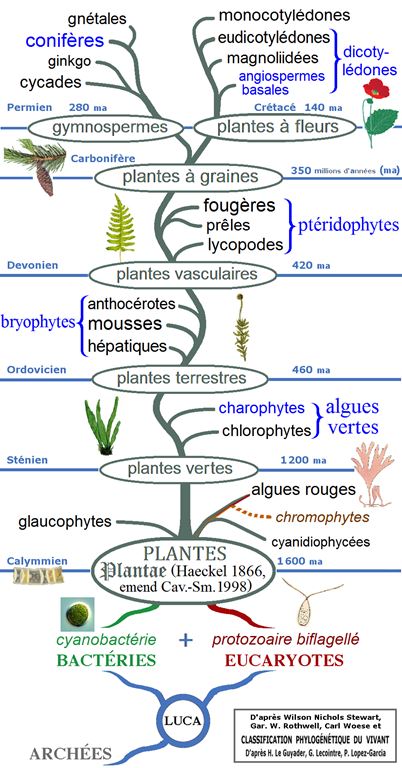
À droite, cet arbre phylogénétique des plantes montre les principaux clades et groupes traditionnels (monophylétiques en noir et paraphylétiques en bleu).
Dénominations
- Nom botanique : Chaenomeles speciosa (Sweet) Nakai
- Synonymes : Chaenomeles lagenaria auct, Cydonia speciosa Sweet, Pyrus japonica
- Noms anglais et locaux : Japanese Quince, Flowering quince
Description et culture
Tableau récapitulatif
Parties comes-tibles Note comest. (1-5) Note medic. (1-5) (Zones de) Rusticité Besoins en 
Besoins en  (1-3)
(1-3)Périodes de semis et récoltes Graines au gramme Durée de viabilité Profon-deur semis Espace-ment plants Espace-ment lignes Durée germi-native Durée avant récolte Zones de rusticité : 4, 5, 6, 7, 8 J F M A M J
J A S O N D
J F M A M J
J A S O N D
Types de feuillage :
Caduque
- dont infos de 0FPI ("FOOD PLANTS INTERNATIONAL", en anglais) :
Description :
Un arbuste ou un petit arbre. Il atteint une hauteur de 1,8 à 2,5 m et une largeur de 2,5 à 3,7 m. Les feuilles mesurent 10 cm de long et 3,5 cm de large. Les fleurs sont rouges et se produisent individuellement. Ils mesurent 3 à 5 cm de diamètre. Les fleurs et les fruits ont des tiges courtes. Le fruit est petit. Ils mesurent 4 à 7 cm de long. Ça sent le coing. Le fruit se forme sur le bois plus ancien. Il existe quelques variétés cultivées nommées{{{0(+x) (traduction automatique).
Original : A shrub or small tree. It grows 1.8-2.5 m tall and spreads 2.5-3.7 m wide. The leaves are 10 cm long and 3.5 cm wide. The flowers are red and occur singly. They are 3-5 cm across. The flowers and fruit have short stalks. The fruit is small. They are 4-7 cm long. It smells like a quince. The fruit form on the older wood. There are some named cultivated varieties{{{0(+x).
Production :
Au Yunnan, les fruits sont récoltés en septembre et octobre{{{0(+x) (traduction automatique).
Original : In Yunnan fruit are harvested in September and October{{{0(+x).
Culture :
Les plantes peuvent être cultivées par graines. Ils peuvent également être cultivés par boutures semi-mûres ou par couches{{{0(+x) (traduction automatique).
Original : Plants can be grown by seed. They can also be grown by semi-ripe cuttings or by layering{{{0(+x).
Consommation (rapports de comestibilité, parties utilisables et usages alimentaires correspondants)
Consommation (rapports de comestibilité, parties utilisables et usages alimentaires correspondants)Parties comestibles :
fruit{{{0(+x) (traduction automatique). Original : Fruit{{{0(+x).Détails :
Les fruits sont normalement transformés en gelée ou en confiture. Ils peuvent être utilisés pour aromatiser les tartes aux fruits. Ils peuvent être étuvés ou cuits et écrasés une fois les graines retirées, puis le miel et le gingembre ajoutés pour faire une boisson. Les fruits sont utilisés comme épice et pour préparer le vin. {{{0(+x) (traduction automatique).
Original : The fruit are normally made into jelly or jam. They can be used to flavour fruit pies. They can be parboiled or cooked and mashed after the seeds are removed then honey and ginger added to make a drink. The fruit are used as a spice and to prepare wine{{{0(+x).
Partie testée :
/ Risques et précautions à prendre
Risques et précautions à prendrenéant, inconnus ou indéterminés.
Autres infos
dont infos de 0FPI ("FOOD PLANTS INTERNATIONAL", en anglais) :
Distribution :
C'est une plante tempérée. Il est résistant au gel. Il fait de mieux dans un climat chaud pour mûrir complètement le fruit. Les plantes fructifient mieux au soleil. Il convient aux zones de rusticité 6-9. Au Sichuan et au Yunnan{{{0(+x) (traduction automatique).
Original : It is a temperate plant. It is frost hardy. It does best in a warm climate to fully ripen the fruit. Plants fruit best in the sun. It suits hardiness zones 6-9. In Sichuan and Yunnan{{{0(+x).
Localisation :
Afrique, Asie, Australie, Bhoutan, Grande-Bretagne, Chine *, Himalaya, Indochine, Japon, Madagascar, Myanmar, Asie du Sud-Est, Slovénie, Tibet, USA{{{0(+x) (traduction automatique).
Original : Africa, Asia, Australia, Bhutan, Britain, China*, Himalayas, Indochina, Japan, Madagascar, Myanmar, SE Asia, Slovenia, Tibet, USA{{{0(+x).
Notes :
Il existe environ 3 espèces de Chaenomeles{{{0(+x) (traduction automatique).
Original : There are about 3 Chaenomeles species{{{0(+x).
Rusticité (résistance face au froid/gel, climat)
Zones de rusticité : 4, 5, 6, 7, 8
Liens, sources et/ou références
Liens :
/ ;Sources et/ou références :
bibliographie (liste des sources et/ou références de l'encyclopédie)
dont livres et bases de données : 5PFAF ("Plants For A Future", en anglais) ; 0FPI ("FOOD PLANTS INTERNATIONAL", en anglais) ;
dont bibliographie/références de 0FPI ("FOOD PLANTS INTERNATIONAL", en anglais) :
Arora, R. K., 2014, Diversity in Underutilized Plant Species - An Asia-Pacific Perspective. Bioversity International. p 62 ; Bodkin, F., 1991, Encyclopedia Botanica. Cornstalk publishing, p 244 ; Bodkin, F., 1991, Encyclopedia Botanica. Cornstalk publishing, p 244 (As Chaenomeles lagenaria) ; Brickell, C. (Ed.), 1999, The Royal Horticultural Society A-Z Encyclopedia of Garden Plants. Convent Garden Books. p 251 ; Brown, D., 2002, The Royal Horticultural Society encyclopedia of Herbs and their uses. DK Books. p 163 ; Cundall, P., (ed.), 2004, Gardening Australia: flora: the gardener's bible. ABC Books. p 363 ; Etherington, K., & Imwold, D., (Eds), 2001, Botanica's Trees & Shrubs. The illustrated A-Z of over 8500 trees and shrubs. Random House, Australia. p 202 ; Facciola, S., 1998, Cornucopia 2: a Source Book of Edible Plants. Kampong Publications, p 196 ; Flora of China. www.eFloras.org Volume 9 ; Glowinski, L., 1999, The Complete Book of Fruit Growing in Australia. Lothian. p 42 ; Heywood, V.H., Brummitt, R.K., Culham, A., and Seberg, O. 2007, Flowering Plant Families of the World. Royal Botanical Gardens, Kew. p 282 ; Hibbert, M., 2002, The Aussie Plant Finder 2002, Florilegium. p 64 ; Jackes, D. A., Edible Forest Gardens ; Jap. J. Bot. 4:331. 1929 ; John, L., & Stevenson, V., 1979, The Complete Book of Fruit. Angus & Robertson p 163 (As Chaenomeles lagenaria) ; Joyce, D., 1998, The Garden Plant Selector. Ryland, Peters and Small. p 131 ; Ju, Y., et al, 2013, Eating from the wild: diversity of wild edible plants used by Tibetans in Shangri-la region, Yunnan, China, Journal of Ethnobiology and Ethno medicine 9:28 ; Kermath, B. M., et al, 2014, Food Plants in the Americas: A survey of the domesticated, cultivated and wild plants used for Human food in North, Central and South America and the Caribbean. On line draft. p 210 ; Kiple, K.F. & Ornelas, K.C., (eds), 2000, The Cambridge World History of Food. CUP p 1792 ; Lord, E.E., & Willis, J.H., 1999, Shrubs and Trees for Australian gardens. Lothian. p 213 ; Lyle, S., 2006, Discovering fruit and nuts. Land Links. p 173 ; Morley, B. & Everard, B., 1970, Wild Flowers of the World. Ebury press. Plate 92 ; Plants for a Future database, The Field, Penpol, Lostwithiel, Cornwall, PL22 0NG, UK. http://www.scs.leeds.ac.uk/pfaf/ ; Ryan, S., 2008, Dicksonia. Rare Plants Manual. Hyland House. p 14 ; USDA, ARS, National Genetic Resources Program. Germplasm Resources Information Network - (GRIN). [Online Database] National Germplasm Resources Laboratory, Beltsville, Maryland. Available: www.ars-grin.gov/cgi-bin/npgs/html/econ.pl (10 April 2000) ; Valder, P., 1999, The Garden Plants of China. Florilegium. p 153 ; van Wyk, B., 2005, Food Plants of the World. An illustrated guide. Timber press. p 168 ; Yeshi, K. et al, 2017, Taxonomical Identification of Himalayan Edible Medicinal Plants in Bhutan and the Phenolic Contents and Antioxidant Activity of Selected Plants. TBAP 7 (2) 2017 pp 89 - 106 (As Chaenomeles lagenaria) ; Young, J., (Ed.), 2001, Botanica's Pocket Trees and Shrubs. Random House. p 230 ; Zhang, L., et al, 2016, Ethnobotanical study of traditional edible plants used by the Naxi people during droughts. Journal of Ethnobiology and Ethnomedicine. 12:39
Recherche de/pour :
- "Chaenomeles speciosa" sur Google (pages et
images) ;
IPNI ("International Plant Names Index", en anglais) ;
TPL ("The Plant List", en anglais) ;
GRIN ("Germplasm Resources Information Network", en anglais) ;
TROPICOS (en anglais) ;
Pl@ntNet ;
Pl@ntUse ;
"Useful Tropical Plants" (en anglais) ou
"Useful Temperate Plants" (en anglais) ;
- "Cognassier à fleurs" sur Google (pages, images et recettes) ;
- "Chaenomeles speciosa" sur Google (pages et
images) ;
IPNI ("International Plant Names Index", en anglais) ;
TPL ("The Plant List", en anglais) ;
GRIN ("Germplasm Resources Information Network", en anglais) ;
TROPICOS (en anglais) ;
Pl@ntNet ;
Pl@ntUse ;
"Useful Tropical Plants" (en anglais) ou
"Useful Temperate Plants" (en anglais) ;
Espèces du même genre (Chaenomeles)
7 taxons
Espèces de la même famille (Rosaceae)
1223 taxons
- Abricot prune
- Abricotier
- Abricotier du japon
- Aigremoine eupatoire
- Alchémille à folioles soudées
- Alchémille brillante
- Alchémille commune
- Alchémille des champs
- Alchémille fendue
- Alchémille glabre
- Alchémille hybride
- Alchémille molle
- Alisier
- Alisier de Mougeot
- Alisier de suède
- Alouchier
- Amandier
- Amandier nain
- Amandier-nain trilobé
- Amélanchier à feuilles d'aulne
- Amélanchier à feuilles ovales
- Amélanchier à grappes
- Amélanchier de lamarck
- Amélanchier du canada
- Amélanchier glabre
- Aronie à fruits noirs
- Aronie pourpre
- Aronie rouge
- Aubépine
- Aubépine à feuilles de tanaisie
- Aubépine d'Orient
- Aubépine de Lavallée
- Aubépine du Kansas
- Aubépine du lac Champlain
- Aubépine du Sinaï
- Aubépine noire
- Aubépine orientale
- Aubépine russe
- Aubépine subsoyeuse
- Aubépine succulente
- Azerole
- Barbe-de-bouc
- Benoîte à fruits variables
- Benoîte à grandes feuilles
- Benoîte aquatique
- Benoîte commune ou benoite commune
- Benoîte des montagnes
- Buisson ardent
- Cenellier de l'est
- Cenellier de l'ouest
- Acaena anserinifolia (Forst. & Forst.f.) Druce
- Agrimonia coreana Nakai
- Agrimonia eupatoria L. (Aigremoine eupatoire)
- Agrimonia odorata Mill.
- Agrimonia pilosa Kitam.
- Alchemilla alpina L. (Satinée)
- Alchemilla conjuncta Bab. (Alchémille à folioles soudées)
- Alchemilla fissa Hornem. (Alchémille fendue)
- Alchemilla glabra Buser (Alchémille glabre)
- Alchemilla hybrida Brgger (Alchémille hybride)
- Alchemilla mollis (Alchémille molle)
- Alchemilla plicatula Gand.
- Alchemilla splendens Christ (Alchémille brillante)
- Alchemilla vulgaris L. (Alchémille commune)
- Alchemilla xanthoclora
- Amelanchier alnifolia (Nutt.) Nutt. ex M. Roem. (Amélanchier à feuilles d'aulne)
- Amelanchier amabilis Wiegand
- Amelanchier arborea
- Amelanchier asiatica
- Amelanchier bartramiana
- Amelanchier basalticola Piper
- Amelanchier canadensis (L.) Medik. (Amélanchier du canada)
- Amelanchier confusa
- Amelanchier cretica
- Amelanchier cusickii Fernald
- Amelanchier humilis Wiegand
- Amelanchier huroensis
- Amelanchier interior E.L.Nielsen
- Amelanchier intermedia Blanch.
- Amelanchier laevis Wiegand (Amélanchier glabre)
- Amelanchier lamarckii F. G. Schroed. (Amélanchier de lamarck)
- Amelanchier oblongifolia Wiegand
- Amelanchier obovalis
- Amelanchier obovata Knowlt.
- Amelanchier ovalis Medik. (Amélanchier à feuilles ovales)
- Amelanchier pallida Greene
- Amelanchier parviflora Douglas ex Hook.
- Amelanchier pumila
- Amelanchier sanguinea Decne.
- Amelanchier spicata Decne. (Amélanchier à grappes)
- Amelanchier stolonifera Wiegand
- Amelanchier utahensis Koehne
- Amelanchier weigandii
- Amelanchier x grandiflora Rehder
- Amelanchier x grandiflora
- Amelasorbus jackii
- Amygdalus andersonii
- Amygdalus communis L.
- Amygdalus graeca Lindl.
- Amygdalus lycioides Spach
- ...







 donne accès au menu
  - encyclopédies des plantes alimentaires ;
 - page de recherche - reconnaissance (identification) de plantes ;
 - page du calendrier lunaire et son générateur (au format PDF et JPG) ;
 - tableau récapitulatif ;
 - générateur de potées (soupes), avec estimation des apports nutrionnels et du coût;
 - générateur de codes QR ;
 - page des archives avec de nombreux documents sur différents thèmes complémentaires comme la botanique, les légumes,
les champignons, la cuisine, le bien-être ainsi que différents MOOC mais également des liens vers les archives de l'association ;
- page des archives avec de nombreux documents sur différents thèmes complémentaires comme la botanique, les légumes,
les champignons, la cuisine, le bien-être ainsi que différents MOOC mais également des liens vers les archives de l'association ;

 ou
ou
 permettant de passer du format standard à l'AMP (et vice-versa), lequel est simplifié et donc plus rapide.
 pour le fruit (et/ou les graines, la pulpe, etc...),
 pour les fleurs (et/ou pétales, calice...),
 pour les feuilles (et/ou la tige, les pousses...),
 pour les racines,
 pour le tronc (et/ou l'écorce, la sève...), et enfin
 pour les champignons,
puis les notes alimentaires et médicinales (de 1 à 5 étoiles), la rusticité (résistance au froid/gel)
et pour finir un résumé.
pour les champignons,
puis les notes alimentaires et médicinales (de 1 à 5 étoiles), la rusticité (résistance au froid/gel)
et pour finir un résumé. menant ici 🙂
 ,
,  et
et





 ,
,


 Encyclopédie(s)
 Recherche-Reconnaissance
 Tableau récapitulatif
 Codes QR
 Archives
 Calendrier(s) lunaire(s)
  Potées
 Re-naturation/naturalisation
 Affichettes, herbiers &
co.
Affichettes, herbiers &
co. menu
menu galerie







 (en bas à gauche).
