Solandra grandiflora

Une vigne grimpante ou ligneuse. Il grimpe sur la végétation à proximité. Les vignes peuvent mesurer 30 m de long. Des vrilles et des racines peuvent se former à partir d ... (traduction automatique)
→suite


Affich., herbiers & co.
Solandra grandiflora
Une vigne grimpante ou ligneuse. Il grimpe sur la végétation à proximité. Les vignes peuvent mesurer 30 m de long. Des vrilles et des racines peuvent se former à partir de chaque nœud. Les feuilles s... (traduction automatique) →suite

Pas d'illustration
pour le moment 😕
Classification
- Classique : en haut de l'écran, sous le coeur.
- Phylogénétique :
- Clade 4 : Angiospermes ;
- Clade 3 : Dicotylédones_vraies ;
- Clade 2 : Astéridées ;
- Clade 1 : Lamiidées ;
- Ordre APN : Solanales ;
- Famille APN : Solanaceae ;
À droite, cet arbre phylogénétique des plantes montre les principaux clades et groupes traditionnels (monophylétiques en noir et paraphylétiques en bleu).
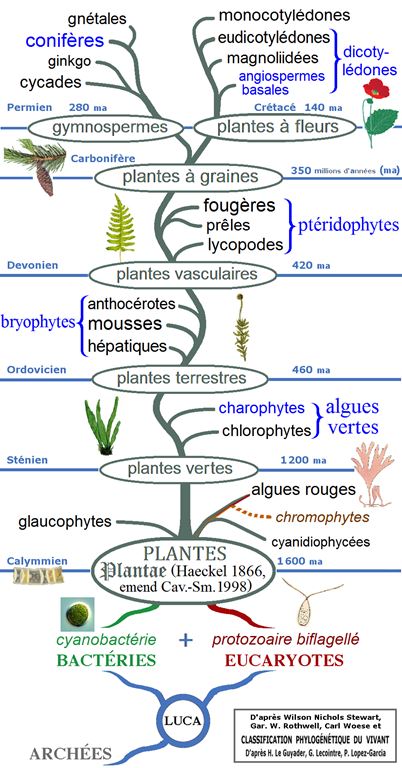
Dénominations
- Nom botanique : Solandra grandiflora Sw.
- Synonymes : Swartzia grandiflora (Sw.) J. F. Gmel
- Noms anglais et locaux : Showy chalicevine, Silver cup
Description et culture
Tableau récapitulatif
Parties comes-tibles Note comest. (1-5) Note medic. (1-5) (Zones de) Rusticité Besoins en 
Besoins en  (1-3)
(1-3)Périodes de semis et récoltes Graines au gramme Durée de viabilité Profon-deur semis Espace-ment plants Espace-ment lignes Durée germi-native Durée avant récolte J F M A M J
J A S O N D
J F M A M J
J A S O N D
- dont infos de 0FPI ("FOOD PLANTS INTERNATIONAL", en anglais) :
Description :
Une vigne grimpante ou ligneuse. Il grimpe sur la végétation à proximité. Les vignes peuvent mesurer 30 m de long. Des vrilles et des racines peuvent se former à partir de chaque nœud. Les feuilles sont sur la vigne principale et les branches latérales. Ils sont épais et vert foncé. Ils peuvent mesurer 15 cm de long sur 7 cm de large. Les fleurs sont grandes. Ils peuvent mesurer 25 cm de long et sont en forme de cloche. Les plantes fleurissent la nuit et dégagent un fort parfum. Les fruits sont gros et jaunes avec de nombreuses graines{{{0(+x) (traduction automatique).
Original : A climber or woody vine. It climbs over vegetation nearby. The vines can be 30 m long. Tendrils and roots can form from each node. Leaves are on the main vine and side branches. They are thick and dark green. They can be 15 cm long by 7 cm wide. The flowers are large. They can be 25 cm long and are bell shaped. Plants flower at night and have a strong scent. The fruit are large and yellow with many seeds{{{0(+x).
Production :
Il pousse rapidement{{{0(+x) (traduction automatique).
Original : It grows quickly{{{0(+x).
Culture :
Les plantes issues de boutures fleurissent rarement{{{0(+x) (traduction automatique).
Original : Plants grown from cuttings rarely flower{{{0(+x).
 Consommation (rapports de comestibilité, parties utilisables et usages alimentaires correspondants)
Consommation (rapports de comestibilité, parties utilisables et usages alimentaires correspondants)Parties comestibles :
fruits, attention{{{0(+x) (traduction automatique). Original : Fruit, Caution{{{0(+x).Détails :
Les fruits sont mangés. Ils ne devraient probablement pas être mangés. ATTENTION: certains Solandra sont toxiques. Ils contiennent des drogues hallucinogènes{{{0(+x) (traduction automatique).
Original : The fruit are eaten. They probably should not be eaten. CAUTION: Some Solandra are poisonous. They contain hallucinogenic drugs{{{0(+x).
Partie testée :
/ Risques et précautions à prendre
Risques et précautions à prendrecf. consommation
Autres infos
dont infos de 0FPI ("FOOD PLANTS INTERNATIONAL", en anglais) :
Distribution :
C'est une plante tropicale. Il pousse près de la côte{{{0(+x) (traduction automatique).
Original : It is a tropical plant. It grows near the coast{{{0(+x).
Localisation :
Antilles, Asie, Australie, Brésil, Inde, Jamaïque *, Mexique, Panama, Porto Rico, Amérique du Sud *, Venezuela{{{0(+x) (traduction automatique).
Original : Antilles, Asia, Australia, Brazil, India, Jamaica*, Mexico, Panama, Puerto Rico, South America*, Venezuela{{{0(+x).
Notes :
Il existe environ 8 à 10 espèces de Solandra. Ils poussent en Amérique tropicale. Les fruits sont considérés comme magiques et aphrodisiaques. Ils contiennent des alcaloïdes{{{0(+x) (traduction automatique).
Original : There are about 8-10 Solandra species. They grow in tropical America. The fruit are considered magical and aphrodisiac. They contain alkaloids{{{0(+x).
Liens, sources et/ou références
Liens :
/ ;Sources et/ou références :
bibliographie (liste des sources et/ou références de l'encyclopédie)
dont classification : IPNI ("International Plant Names Index", en anglais) ; Kew (POWO - "Plant Of the World Online", "Royal Botanical Garden", en anglais) ;
dont livres et bases de données : 0FPI ("FOOD PLANTS INTERNATIONAL", en anglais) ;
Warning: Undefined variable $prex in /home/waso5761/public_html/inc/fiches.php on line 2607
dont bibliographie/références de 0FPI ("FOOD PLANTS INTERNATIONAL", en anglais) :
Ambasta, S.P. (Ed.), 2000, The Useful Plants of India. CSIR India. p 579 ; Hibbert, M., 2002, The Aussie Plant Finder 2002, Florilegium. p 291 ; http://www.botanic-gardens-ljubljana.com/en/plants ; Kermath, B. M., et al, 2014, Food Plants in the Americas: A survey of the domesticated, cultivated and wild plants used for Human food in North, Central and South America and the Caribbean. On line draft. p 813 ; Kongl. Vetensk. Acad. Nya Handl. 8:300, t. 11. 1787
Recherche de/pour :
- "Solandra grandiflora" sur Google (pages et
images) ;
TPL ("The Plant List", en anglais) ;
GRIN ("Germplasm Resources Information Network", en anglais) ;
TROPICOS (en anglais) ;
Tela Botanica ;
Pl@ntNet ;
Pl@ntUse ;
"Plants For A Future" (en anglais) ;
"Useful Tropical Plants" (en anglais) ou
"Useful Temperate Plants" (en anglais) ;
- "Solandra grandiflora" sur Google (pages et
images) ;
TPL ("The Plant List", en anglais) ;
GRIN ("Germplasm Resources Information Network", en anglais) ;
TROPICOS (en anglais) ;
Tela Botanica ;
Pl@ntNet ;
Pl@ntUse ;
"Plants For A Future" (en anglais) ;
"Useful Tropical Plants" (en anglais) ou
"Useful Temperate Plants" (en anglais) ;
Espèces de la même famille (Solanaceae)
563 taxons
- Aji
- Alkékenge
- Alkékenge doux
- Ashwagandha
- Aubergine
- Aubergine africaine
- Aubergine pois
- Baquicha
- Belladone
- Bolivian bird pepper
- Bringellier marron
- Casana
- Cerise de terre
- Cestreau nocturne
- Cobincho
- Cocona
- Coconilla
- Coqueret anguleux
- Coqueret du pérou
- Coqueret hétérophylle
- Coqueret visqueux
- Damsah
- Douce-amère
- Fruit for wolves
- Goji
- Goji sauvage
- Goyave tamarillo
- Herbe à Sitarane
- Jaltomate
- Jusquiame
- Jusquiame blanche
- Jusquiame noire
- Kanta kari
- Lyciet
- Lyciet commun
- Lyciet d'Afrique
- Lyciet d'Europe
- Mandragore
- Métel
- Mini tamarillo
- Morelle
- Morelle à feuilles de chalef
- Morelle asymétrique
- Morelle d'amérique ou américaine
- Morelle de balbis
- Morelle de Buenos Aires
- Morelle de guinée
- Morelle de Linné
- Morelle de Wright
- Morelle des Oiseaux
- Atropa acuminata Royle ex Lindl.
- Atropa belladonna L. (Belladone)
- Brachistus solanaceus
- Brunfelsia chocoensis Plowman
- Brunfelsia macrocarpa Plowman
- Calliphysalis carpenteri
- Capsicum annuum L. (Piment)
- Capsicum annuum x chinense (Piment de neyde)
- Capsicum baccatum L. (Aji)
- Capsicum buforum Hunz.
- Capsicum caatingae Barboza & Agra
- Capsicum caballeroi M. Nee
- Capsicum campylopodium Sendtn.
- Capsicum cardenasii Heiser & P.G.Sm.
- Capsicum cardenasii x pubescens
- Capsicum ceratocalyx M.Nee
- Capsicum chacoense Hunz.
- Capsicum chinense Jacq. (Piment habanero)
- Capsicum chinense x frutescens (Naga jolokia)
- Capsicum coccineum (Rusby) Hunz.
- Capsicum conoides Mill.
- Capsicum cornutum (Hiern) Hunz.
- Capsicum dimorphum (Miers) O.K.
- Capsicum dusenii Bitter
- Capsicum eshbaughii Barboza
- Capsicum eshbaugii Barboza
- Capsicum exile (Cobincho)
- Capsicum eximium Hunz. (Bolivian bird pepper)
- Capsicum flexuosum Sendtn.
- Capsicum friburgense Barboza & Bianchetti
- Capsicum frutescens L. (Piment enragé)
- Capsicum frutescens x eximium
- Capsicum galapagoense Hunz. (Piment des îles galapagos)
- Capsicum geminifolium (Dammer) Hunz.
- Capsicum grandiflorum Kuntze
- Capsicum havanense Kunth
- Capsicum hispidum Dunal
- Capsicum hookerianum (Miers) O.K.
- Capsicum hunzikerianum Barboza & Bianchetti
- Capsicum lanceolatum (Greenm.) C.V.Morton & Standl.
- Capsicum leptopodum (Dunal) Kuntze
- Capsicum longidentatum Agra & Barboza
- Capsicum lycianthoides Bitter
- Capsicum melongena
- Capsicum minutiflorum (Rusby) Hunz.
- Capsicum mirabile Mart ex. Sendt
- Capsicum mositicum Toledo ex Handro
- Capsicum parvifolium Sendt.
- Capsicum pereirae Barboza & Bianch.
- Capsicum praetermissum Heiser & P.G.Sm.
- ...







 donne accès au menu
  - encyclopédies des plantes alimentaires ;
 - page de recherche - reconnaissance (identification) de plantes ;
 - page du calendrier lunaire et son générateur (au format PDF et JPG) ;
 - tableau récapitulatif ;
 - générateur de potées (soupes), avec estimation des apports nutrionnels et du coût;
 - générateur de codes QR ;
 - page des archives avec de nombreux documents sur différents thèmes complémentaires comme la botanique, les légumes,
les champignons, la cuisine, le bien-être ainsi que différents MOOC mais également des liens vers les archives de l'association ;
- page des archives avec de nombreux documents sur différents thèmes complémentaires comme la botanique, les légumes,
les champignons, la cuisine, le bien-être ainsi que différents MOOC mais également des liens vers les archives de l'association ;

 ou
ou
 permettant de passer du format standard à l'AMP (et vice-versa), lequel est simplifié et donc plus rapide.
 pour le fruit (et/ou les graines, la pulpe, etc...),
 pour les fleurs (et/ou pétales, calice...),
 pour les feuilles (et/ou la tige, les pousses...),
 pour les racines,
 pour le tronc (et/ou l'écorce, la sève...), et enfin
 pour les champignons,
puis les notes alimentaires et médicinales (de 1 à 5 étoiles), la rusticité (résistance au froid/gel)
et pour finir un résumé.
pour les champignons,
puis les notes alimentaires et médicinales (de 1 à 5 étoiles), la rusticité (résistance au froid/gel)
et pour finir un résumé. menant ici 🙂
 ,
,  et
et





 ,
,


 Encyclopédie(s)
 Recherche-Reconnaissance
 Tableau récapitulatif
 Codes QR
 Archives
 Calendrier(s) lunaire(s)
  Potées
 Re-naturation/naturalisation
 Affichettes, herbiers &
co.
Affichettes, herbiers &
co. menu
menu galerie