Ochna pulchra
Pas d'illustration
pour le moment 😕

Un arbre de taille petite ou moyenne. Il atteint une hauteur de 3 à 8 m. Il a une couronne étalée. Le tronc peut mesurer 15 à 20 cm de diamètre. Le tronc est souvent blan ... (traduction automatique)
→suite


Affich., herbiers & co.
Ochna pulchra

Un arbre de taille petite ou moyenne. Il atteint une hauteur de 3 à 8 m. Il a une couronne étalée. Le tronc peut mesurer 15 à 20 cm de diamètre. Le tronc est souvent blanc avec une écorce grise qui p... (traduction automatique) →suite
Pas d'illustration
pour le moment 😕
Pas d'illustration
pour le moment 😕
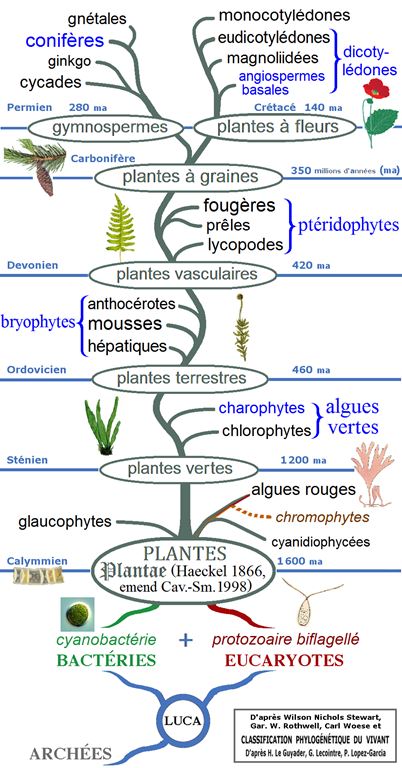
Classification
- Classique : en haut de l'écran, sous le coeur.
- Phylogénétique :
- Clade 4 : Angiospermes ;
- Clade 3 : Dicotylédones_vraies ;
- Clade 2 : Rosidées ;
- Clade 1 : Fabidées ;
- Ordre APN : Malpighiales ;
- Famille APN : Ochnaceae ;
À droite, cet arbre phylogénétique des plantes montre les principaux clades et groupes traditionnels (monophylétiques en noir et paraphylétiques en bleu).
Dénominations
- Nom botanique : Ochna pulchra Hook.
- Synonymes : Ochna rehmanii Szyszyl, Ochna achersoniana Schinz, Ochna antunesii Engl. & Gilg, Ochna pulchra forma integra Suesseng, Ochna fuscescens Heine, Polythecium pulchrum (Hook.) Van Tiegh
- Noms anglais et locaux : Peeling-bark ochna, Peeling plane
Description et culture
Tableau récapitulatif
Parties comes-tibles Note comest. (1-5) Note medic. (1-5) (Zones de) Rusticité Besoins en 
Besoins en  (1-3)
(1-3)Périodes de semis et récoltes Graines au gramme Durée de viabilité Profon-deur semis Espace-ment plants Espace-ment lignes Durée germi-native Durée avant récolte J F M A M J
J A S O N D
J F M A M J
J A S O N D
- dont infos de 0FPI ("FOOD PLANTS INTERNATIONAL", en anglais) :
Description :
Un arbre de taille petite ou moyenne. Il atteint une hauteur de 3 à 8 m. Il a une couronne étalée. Le tronc peut mesurer 15 à 20 cm de diamètre. Le tronc est souvent blanc avec une écorce grise qui pèle. Les jeunes branches et pousses sont blanches. L'arbre perd ses feuilles au cours de l'année. Les feuilles sont simples et alternes. Ils mesurent 3 à 10 cm de long et 2 à 5 cm de large. Ils sont larges et en forme d'épée. Ils sont jaune-vert et avec des veines faciles à voir. Les tiges des feuilles sont courtes et épaisses. Les fleurs sont jaunes. Ils ont une odeur douce. Ils se produisent autant ensemble dans des arrangements jusqu'à 13 cm de long. Les fruits sont généralement 3 carpelles en forme de rein. Chacun mesure 1,4 cm de long. Ils sont noirs à maturité{{{0(+x) (traduction automatique).
Original : A small or medium sized tree. It grows 3-8 m high. It has a spreading crown. The trunk can be 15-20 cm across. The trunk is often white with grey peeling bark. The young branches and shoots are white. The tree loses its leaves during the year. The leaves are simple and alternate. They are 3-10 cm long and 2-5 cm wide. They are wide and sword shaped. They are yellow-green and with easy to see veins. The leaf stalks are short and thick. The flowers are yellow. They have a sweet smell. They occur as many together in arrangements up to 13 cm long. The fruit are usually 3 kidney shaped carpels. Each is 1.4 cm long. They are black when mature{{{0(+x).
Production :
Les fruits mettent 1 mois à mûrir. Un arbre peut donner 7 kg de fruits. 10 tonnes de fruits donneraient environ 3 tonnes d'huile{{{0(+x) (traduction automatique).
Original : Fruit take 1 month to ripen. One tree can yield 7 kg of fruit. 10 tons of fruit would yield about 3 tons of oil{{{0(+x).
Culture :
Les graines germent mal. Les jeunes plants sont difficiles à transplanter. Les graines fraîches plantées là où elles doivent pousser sont les meilleures. Les racines ne sont que peu profondes{{{0(+x) (traduction automatique).
Original : Seeds germinate poorly. Young plants are hard to transplant. Fresh seed planted where they are to grow is the best. The roots are only shallow{{{0(+x).
 Consommation (rapports de comestibilité, parties utilisables et usages alimentaires correspondants)
Consommation (rapports de comestibilité, parties utilisables et usages alimentaires correspondants)Parties comestibles :
pulpe de fruit, graines - huile{{{0(+x) (traduction automatique). Original : Fruit pulp, Seeds - oil{{{0(+x).Détails :
Les fruits verts sont rôtis et consommés mais les graines sont toxiques. Les fruits mûrs sont bouillis dans l'eau pour libérer de la graisse qui est comestible. Les graines ont été signalées comme étant consommées en Zambie. Les graines sont séchées et bouillies et l'huile écrémée{{{0(+x) (traduction automatique).
Original : The green fruit are roasted and eaten but the seeds are poisonous. Ripe fruit are boiled in water to release fat which is edible.The seeds have been reported as being eaten in Zambia. The seeds are dried and boiled and the oil skimmed off{{{0(+x).
Partie testée :
fruit{{{0(+x) (traduction automatique). Original : Fruit{{{0(+x)| Taux d'humidité (%) | Énergie (kj) | Énergie (kcal) | Protéines (g) |
|---|---|---|---|
| 63.2 | 735 | 176 | 6.3 |
| Pro- vitamines A (µg) |
Vitamines C (mg) | Fer (mg) | Zinc (mg) |
| 0 | 0 | 1.0 | 1.9 |
 Risques et précautions à prendre
Risques et précautions à prendrecf. consommation
Autres infos
dont infos de 0FPI ("FOOD PLANTS INTERNATIONAL", en anglais) :
Statut :
C'est un aliment majeur des Bushmen{{{0(+x) (traduction automatique).
Original : It is a major food of the Bushmen{{{0(+x).
Distribution :
Une plante tropicale. Il pousse dans la brousse ouverte. C'est souvent sur un sol sableux. Il peut pousser dans des endroits arides. Au Zimbabwe, il pousse entre 1 000 et 1 560 m au-dessus du niveau de la mer. Il convient aux zones de rusticité 9-10{{{0(+x) (traduction automatique).
Original : A tropical plant. It grows in open bushland. It is often on sandy soil. It can grow in arid places. In Zimbabwe it grows between 1,000-1,560 m above sea level. It suits hardiness zones 9-10{{{0(+x).
Localisation :
Afrique, Angola, Australie, Botswana, Afrique centrale, RD Congo, Afrique de l'Est, Mozambique, Namibie, Afrique du Sud, Afrique australe, Zambie, Zimbabwe{{{0(+x) (traduction automatique).
Original : Africa, Angola, Australia, Botswana, Central Africa, Congo DR, East Africa, Mozambique, Namibia, South Africa, Southern Africa, Zambia, Zimbabwe{{{0(+x).
Notes :
Il existe 90 espèces d'Ochna{{{0(+x) (traduction automatique).
Original : There are 90 Ochna species{{{0(+x).
Liens, sources et/ou références
Liens :
/ ;Sources et/ou références :
bibliographie (liste des sources et/ou références de l'encyclopédie)
dont classification : IPNI ("International Plant Names Index", en anglais) ; Kew (POWO - "Plant Of the World Online", "Royal Botanical Garden", en anglais) ;
dont livres et bases de données : 0FPI ("FOOD PLANTS INTERNATIONAL", en anglais) ;
Warning: Undefined variable $prex in /home/waso5761/public_html/inc/fiches.php on line 2607
dont bibliographie/références de 0FPI ("FOOD PLANTS INTERNATIONAL", en anglais) :
Cundall, P., (ed.), 2004, Gardening Australia: flora: the gardener's bible. ABC Books. p 943 ; Drummond, R. B., 1981, Common Trees of the Central Watershed Woodlands of Zimbabwe, National Herbarium Salisbury. p 144 ; Etherington, K., & Imwold, D., (Eds), 2001, Botanica's Trees & Shrubs. The illustrated A-Z of over 8500 trees and shrubs. Random House, Australia. p 496 ; Exell, A.W. et al, (Ed), 1963, Flora Zambesiaca Vol 2 Part 1 Crown Agents, London. p 229 ; Fowler, D. G., 2007, Zambian Plants: Their Vernacular Names and Uses. Kew. p 51 ; Fox, F. W. & Young, M. E. N., 1982, Food from the Veld. Delta Books. p 279 ; Icon. Pl. 6: T. 588. 1843 ; INFOODS:FAO/INFOODS Databases ; Lee, 1979, ; Leger, S., 1997, A Description of Today's Use of Plants in West Bushmanland (Namibia). German Development Service. PO Box 220035, 14061 Berlin, Germany. http://www.sigridleger.de/book/ ; Maguire, 1978, ; Mannheimer, C. A. & Curtis. B.A. (eds), 2009, Le Roux and Muller's Field Guide to the Trees and Shrubs of Namibia. Windhoek: Macmillan Education Namibia. p 342 ; Mokganya, M. G. et al, 2018, An evaluation of additional uses of some wild edible fruit plants of the Vhembe District Municipality in the Limpopo Province, South Africa. Indian Journal of Traditional Knowledge. Vol 17(2) April 2018, pp 276-281 ; Palgrave, K.C., 1996, Trees of Southern Africa. Struik Publishers. p 607 ; Palmer, E and Pitman, N., 1972, Trees of Southern Africa. Vol. 3. A.A. Balkema, Cape Town p 1503 ; Peters, C. R., O'Brien, E. M., and Drummond, R.B., 1992, Edible Wild plants of Sub-saharan Africa. Kew. p 156 ; Pickering, H., & Roe, E., 2009, Wild Flowers of the Victoria Falls Area. Helen Pickering, London. p 86 ; Rodin, 1985, ; Roodt, V., 1998, Trees & Shrubs of the Okavango Delta. Medicinal Uses and Nutritional value. The Shell Field Guide Series: Part 1. Shell Botswana. p 196 ; Royal Botanic Gardens, Kew (1999). Survey of Economic Plants for Arid and Semi-Arid Lands (SEPASAL) database. Published on the Internet; http://www.rbgkew.org.uk/ceb/sepasal/internet [Accessed 4th May 2011] ; Schmidt, E., Lotter, M., & McCleland, W., 2007, Trees and shrubs of Mpumalanga and Kruger National Park. Jacana Media p 422 ; Silberbauer, 1981, ; Tanaka, 1980, ; van Wyk, B, van Wyk, P, and van Wyk B., 2000, Photographic guide to Trees of Southern Africa. Briza. p 213 ; Wehmeyer, A. S, 1986, Edible Wild Plants of Southern Africa. Data on the Nutrient Contents of over 300 species ; www.zimbabweflora.co.zw 2011
Recherche de/pour :
- "Ochna pulchra" sur Google (pages et
images) ;
TPL ("The Plant List", en anglais) ;
GRIN ("Germplasm Resources Information Network", en anglais) ;
TROPICOS (en anglais) ;
Tela Botanica ;
Pl@ntNet ;
Pl@ntUse ;
"Plants For A Future" (en anglais) ;
"Useful Tropical Plants" (en anglais) ou
"Useful Temperate Plants" (en anglais) ;
- "Ochna pulchra" sur Google (pages et
images) ;
TPL ("The Plant List", en anglais) ;
GRIN ("Germplasm Resources Information Network", en anglais) ;
TROPICOS (en anglais) ;
Tela Botanica ;
Pl@ntNet ;
Pl@ntUse ;
"Plants For A Future" (en anglais) ;
"Useful Tropical Plants" (en anglais) ou
"Useful Temperate Plants" (en anglais) ;
Espèces du même genre (Ochna)
10 taxons
Espèces de la même famille (Ochnaceae)
38 taxons
- Cespedezia spathulata
- Gomphia flavum
- Lacunaria crenata (Tul.) A.C.Sm.
- Lacunaria jenmanii (Oliv.) Ducke
- Lacunaria macrostachya
- Lophira alata Banks ex C.F.Gaertn.
- Lophira lanceolata Tiegh. ex Keay
- Ochna afzelii R.Br. ex Oliv.
- Ochna atropurpurea DC.
- Ochna cinnabarina Engl. & Gilg
- Ochna katangensis De Wild.
- Ochna leptoclada Oliv.
- Ochna leucophloeos Hochst. ex A.Rich.
- Ochna mossambicensis Klotzsch
- Ochna obtusata DC.
- Ochna schweinfurthiana F.Hoffm.
- Ouratea arnoldiana De Wild. & T.Durand
- Ouratea brunneopurpurea Gilg
- Ouratea floribunda De Wild.
- Ouratea jabotapita
- Ouratea laxiflora De Wild. & T.Durand
- Ouratea myrioneura Gilg
- Ouratea nitida (Sw.) Engl.
- Ouratea parviflora (DC.) Baill.
- Ouratea welwitschii
- Quiina florida Tul.
- Quiina grandifolia Mildbr.
- Quiina integrifolia Pulle
- Quiina macrophylla Ule
- Quiina obovata Tul.
- Quiina oiapocensis Pires
- Quiina rhytidopus Tul.
- Quiina rigidifolia Pires
- Rhabdophyllum affine (Hook.f.) Tiegh.
- Rhabdophyllum calophyllum (Hook.f.) Tiegh.
- Sauvagesia erecta L.
- Touroulia guianensis Aubl.







 donne accès au menu
  - encyclopédies des plantes alimentaires ;
 - page de recherche - reconnaissance (identification) de plantes ;
 - page du calendrier lunaire et son générateur (au format PDF et JPG) ;
 - tableau récapitulatif ;
 - générateur de potées (soupes), avec estimation des apports nutrionnels et du coût;
 - générateur de codes QR ;
 - page des archives avec de nombreux documents sur différents thèmes complémentaires comme la botanique, les légumes,
les champignons, la cuisine, le bien-être ainsi que différents MOOC mais également des liens vers les archives de l'association ;
- page des archives avec de nombreux documents sur différents thèmes complémentaires comme la botanique, les légumes,
les champignons, la cuisine, le bien-être ainsi que différents MOOC mais également des liens vers les archives de l'association ;

 ou
ou
 permettant de passer du format standard à l'AMP (et vice-versa), lequel est simplifié et donc plus rapide.
 pour le fruit (et/ou les graines, la pulpe, etc...),
 pour les fleurs (et/ou pétales, calice...),
 pour les feuilles (et/ou la tige, les pousses...),
 pour les racines,
 pour le tronc (et/ou l'écorce, la sève...), et enfin
 pour les champignons,
puis les notes alimentaires et médicinales (de 1 à 5 étoiles), la rusticité (résistance au froid/gel)
et pour finir un résumé.
pour les champignons,
puis les notes alimentaires et médicinales (de 1 à 5 étoiles), la rusticité (résistance au froid/gel)
et pour finir un résumé. menant ici 🙂
 ,
,  et
et





 ,
,


 Encyclopédie(s)
 Recherche-Reconnaissance
 Tableau récapitulatif
 Codes QR
 Archives
 Calendrier(s) lunaire(s)
  Potées
 Re-naturation/naturalisation
 Affichettes, herbiers &
co.
Affichettes, herbiers &
co. menu
menu galerie