Commelina cyanea
Pas d'illustration
pour le moment 😕

Une herbe faible en difficulté. C'est une plante à feuilles persistantes. Il atteint 30 cm de haut et s'étend sur 2 m de diamètre. Les tiges sont faibles et charnues, repo ... (traduction automatique)
→suite


Affich., herbiers & co.
Commelina cyanea

Une herbe faible en difficulté. C'est une plante à feuilles persistantes. Il atteint 30 cm de haut et s'étend sur 2 m de diamètre. Les tiges sont faibles et charnues, reposent le long du sol et forment... (traduction automatique) →suite
Pas d'illustration
pour le moment 😕
Pas d'illustration
pour le moment 😕
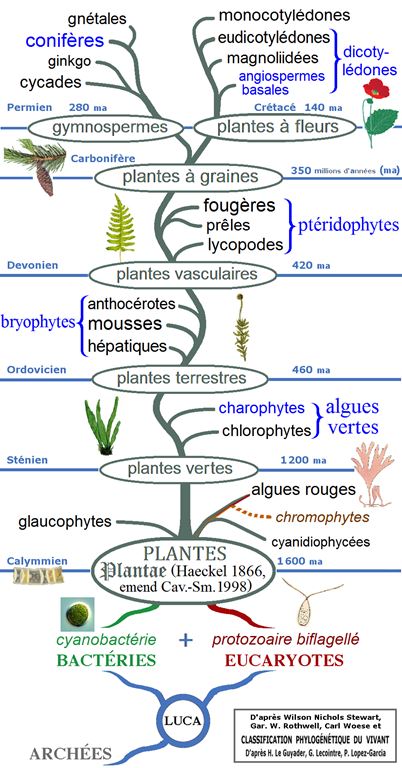
Classification
- Classique : en haut de l'écran, sous le coeur.
- Phylogénétique :
- Clade 4 : Angiospermes ;
- Clade 3 : Monocotylédones ;
- Clade 2 : Commelinidées ;
- Ordre APN : Commelinales ;
- Famille APN : Commelinaceae ;
À droite, cet arbre phylogénétique des plantes montre les principaux clades et groupes traditionnels (monophylétiques en noir et paraphylétiques en bleu).
Dénominations
- Nom botanique : Commelina cyanea R.Br.
- Noms anglais et locaux : scurvy weed, wandering jew
Description et culture
Tableau récapitulatif
Parties comes-tibles Note comest. (1-5) Note medic. (1-5) (Zones de) Rusticité Besoins en 
Besoins en  (1-3)
(1-3)Périodes de semis et récoltes Graines au gramme Durée de viabilité Profon-deur semis Espace-ment plants Espace-ment lignes Durée germi-native Durée avant récolte J F M A M J
J A S O N D
J F M A M J
J A S O N D
- dont infos de 0FPI ("FOOD PLANTS INTERNATIONAL", en anglais) :
Description :
Une herbe faible en difficulté. C'est une plante à feuilles persistantes. Il atteint 30 cm de haut et s'étend sur 2 m de diamètre. Les tiges sont faibles et charnues, reposent le long du sol et forment des racines aux nœuds. Les feuilles sont vertes ou bleues et en forme d'épée. Ils mesurent 3 à 7 cm de long sur 2 cm de diamètre. Ils forment une gaine à la base. Les fleurs sont bleu vif, à 3 pétales. Ils mesurent 1,5 cm de diamètre. Les fleurs sont portées sur une tige florale ramifiée. Les fleurs s'ouvrent le matin et s'effondrent l'après-midi{{{0(+x) (traduction automatique).
Original : A weak straggling herb. It is an evergreen plant. It grows to 30 cm high and spreads to 2 m across. The stems are weak and fleshy, and lie along the ground, and form roots at the nodes. The leaves are green or blue, and sword shaped. They are 3-7 cm long, by 2 cm across. They form a sheath at the base. The flowers are bright blue, with 3 petals. They are 1.5 cm across. The flowers are carried on a branched flower stalk. The flowers open in the morning and collapse by afternoon{{{0(+x).
Culture :
Les plantes sont cultivées en divisant la touffe ou en utilisant des boutures de tige{{{0(+x) (traduction automatique).
Original : Plants are grown by dividing the clump or using stem cuttings{{{0(+x).
 Consommation (rapports de comestibilité, parties utilisables et usages alimentaires correspondants)
Consommation (rapports de comestibilité, parties utilisables et usages alimentaires correspondants)Bourgeons0(+x) ; jeunes feuilles et pousses comestibles{{{27(+x).
Partie testée :
bourgeon{{{0(+x) (traduction automatique). Original : Bud{{{0(+x)| Taux d'humidité (%) | Énergie (kj) | Énergie (kcal) | Protéines (g) |
|---|---|---|---|
| 86.7 | 0 | 0 | 1.6 |
| Pro- vitamines A (µg) |
Vitamines C (mg) | Fer (mg) | Zinc (mg) |
| 0 | 1 | 0 | 0 |
 Risques et précautions à prendre
Risques et précautions à prendrenéant, inconnus ou indéterminés.
Autres infos
dont infos de 0FPI ("FOOD PLANTS INTERNATIONAL", en anglais) :
Distribution :
C'est tropical et subtropical. Il pousse dans un sol humide. Il convient à une position abritée, partiellement ombragée. Il est sensible à la sécheresse et au gel{{{0(+x) (traduction automatique).
Original : It is tropical and subtropical. It grows in moist soil. It suits a sheltered, partly shaded position. It is drought and frost tender{{{0(+x).
Localisation :
Australie *, Île Norfolk, Pacifique, Papouasie-Nouvelle-Guinée, PNG{{{0(+x) (traduction automatique).
Original : Australia*, Norfolk Island, Pacific, Papua New Guinea, PNG{{{0(+x).
Notes :
Il existe environ 230 espèces de Commelina{{{0(+x) (traduction automatique).
Original : There are about 230 Commelina species{{{0(+x).
Liens, sources et/ou références
Liens :
/ ;Sources et/ou références :
bibliographie (liste des sources et/ou références de l'encyclopédie)
dont classification : IPNI ("International Plant Names Index", en anglais) ; Kew (POWO - "Plant Of the World Online", "Royal Botanical Garden", en anglais) ;
dont livres et bases de données : 0FPI ("FOOD PLANTS INTERNATIONAL", en anglais) ;
dont bibliographie/références de 0FPI ("FOOD PLANTS INTERNATIONAL", en anglais) :
Bodkin, F., 1991, Encyclopedia Botanica. Cornstalk publishing, p 274 ; Caton, J.M. & Hardwick, R. J., 2016, Field Guide to Useful Native Plants from Temperate Australia. Harbour Publishing House. p 88 ; Cribb, A.B. & J.W., 1976, Wild Food in Australia, Fontana. p 118 ; Cronin, L., 1989, The Concise Australian Flora. Reed. p 77 ; Elliot, W.R., & Jones, D.L., 1984, Encyclopedia of Australian Plants suitable for cultivation. Vol 3. Lothian. p 62 ; Flora of Australia Volume 49, Oceanic Islands 1, Australian Government Publishing Service, Canberra. (1994) p 417 ; Hibbert, M., 2002, The Aussie Plant Finder 2002, Florilegium. p 72 ; Jones, D.L. & Gray, B., 1977, Australian Climbing Plants. Reed. p 93 ; Jones D, L, 1986, Ornamental Rainforest Plants in Australia, Reed Books, p 260 ; Lazarides, M. & Hince, B., 1993, Handbook of Economic Plants of Australia, CSIRO. p 63 ; Low, T., 1991, Wild Herbs of Australia and New Zealand. Angus & Robertson. p 102 ; Powell, J.M., Ethnobotany. In Paijmans, K., 1976, New Guinea Vegetation. Australian National University Press. p 109 ; Ratcliffe D & P., 1987, Australian Native Plants for Indoors. Little Hills press. p 72 ; Recher, P, 2001, Fruit Spirit Botanical Gardens Plant Index. www.nrg.com.au/~recher/ seedlist.html p 2 ; Romanowski, N., 2007, Edible Water Gardens. Hyland House. p 106
Recherche de/pour :
- "Commelina cyanea" sur Google (pages et
images) ;
TPL ("The Plant List", en anglais) ;
GRIN ("Germplasm Resources Information Network", en anglais) ;
TROPICOS (en anglais) ;
Tela Botanica ;
Pl@ntNet ;
Pl@ntUse ;
"Plants For A Future" (en anglais) ;
"Useful Tropical Plants" (en anglais) ou
"Useful Temperate Plants" (en anglais) ;
- "Commelina cyanea" sur Google (pages et
images) ;
TPL ("The Plant List", en anglais) ;
GRIN ("Germplasm Resources Information Network", en anglais) ;
TROPICOS (en anglais) ;
Tela Botanica ;
Pl@ntNet ;
Pl@ntUse ;
"Plants For A Future" (en anglais) ;
"Useful Tropical Plants" (en anglais) ou
"Useful Temperate Plants" (en anglais) ;
Espèces du même genre (Commelina)
31 taxons
- Comméline céleste
- Comméline commune
- Comméline de Virginie
- Comméline diffuse
- Comméline dressée
- Comméline du Bengale
- Comméline subulée
- Commélyne d'Afrique
- Commelina africana L. (Commélyne d'Afrique)
- Commelina attenuata B.Heyne ex Steud.
- Commelina benghalensis Forssk. (Comméline du Bengale)
- Commelina ciliata Stanley
- Commelina claessensii De Wild.
- Commelina clavata C.B.Clarke
- Commelina coelestis Willd. (Comméline céleste)
- Commelina communis F.Muell. (Comméline commune)
- Commelina dianthifolia Redout
- Commelina diffusa Zoll. ex C.B.Clarke (Comméline diffuse)
- Commelina elliptica Kunth
- Commelina ensifolia F.Muell.
- Commelina erecta L. (Comméline dressée)
- Commelina foliacea Chiov.
- Commelina forsskalii
- Commelina imberbis Ehrenb. ex Hassk.
- Commelina lanceolata Benth.
- Commelina latifolia Hochst. ex C.B.Clarke
- Commelina modesta Oberm.
- Commelina obliqua Buch.-Ham. ex D.Don
- Commelina paleata Hassk.
- Commelina paludosa Blume
- Commelina petersii Hassk.
- Commelina subulata Roth (Comméline subulée)
- Commelina trilocularis
- Commelina tuberosa Lour.
- Commelina undulata G.Lodd.
- Commelina virginica L. (Comméline de Virginie)
- Commelina zambesica C.B.Clarke
- Commelina zeylanica Falkenb.
Espèces de la même famille (Commelinaceae)
85 taxons
- Comméline céleste
- Comméline commune
- Comméline de Virginie
- Comméline diffuse
- Comméline dressée
- Comméline du Bengale
- Comméline subulée
- Commélyne d'Afrique
- Éphémère de Rio
- Éphémérine à spathe
- Tradescantia
- Amischotolype mollissima (Blume) Hassk.
- Aneilema aequinoctiale (P.Beauv.) G.Don
- Aneilema beniniense (P.Beauv.) Kunth
- Aneilema dregeanum Kunth
- Aneilema lanceolatum Benth.
- Aneilema pedunculosum C.B.Clarke
- Aneilema siliculosum R.Br.
- Aneilema sp.
- Belosynapsis moluccana
- Cartonema parviflorum Hassk.
- Cartonema spicatum F.Muell.
- Commelina africana L. (Commélyne d'Afrique)
- Commelina attenuata B.Heyne ex Steud.
- Commelina benghalensis Forssk. (Comméline du Bengale)
- Commelina ciliata Stanley
- Commelina claessensii De Wild.
- Commelina clavata C.B.Clarke
- Commelina coelestis Willd. (Comméline céleste)
- Commelina communis F.Muell. (Comméline commune)
- Commelina dianthifolia Redout
- Commelina diffusa Zoll. ex C.B.Clarke (Comméline diffuse)
- Commelina elliptica Kunth
- Commelina ensifolia F.Muell.
- Commelina erecta L. (Comméline dressée)
- Commelina foliacea Chiov.
- Commelina forsskalii
- Commelina imberbis Ehrenb. ex Hassk.
- Commelina lanceolata Benth.
- Commelina latifolia Hochst. ex C.B.Clarke
- Commelina modesta Oberm.
- Commelina obliqua Buch.-Ham. ex D.Don
- Commelina paleata Hassk.
- Commelina paludosa Blume
- Commelina petersii Hassk.
- Commelina subulata Roth (Comméline subulée)
- Commelina trilocularis
- Commelina tuberosa Lour.
- Commelina undulata G.Lodd.
- Commelina virginica L. (Comméline de Virginie)
- Commelina zambesica C.B.Clarke
- Commelina zeylanica Falkenb.
- Cyanotis axillaris (L.) D.Don ex Sweet
- Cyanotis barbata D.Don
- Cyanotis cristata (L.) D.Don
- Cyanotis speciosa (L.f.) Hassk.
- Cyanotis tuberosa (Roxb.) Schult. & Schult.f.
- Cyanotis villosa (Spreng.) Schult. & Schult.f.
- Floscopa scandens Lour.
- Floscopa schweinfurthii C.B.Clarke
- Murdannia angustifolia
- ...







 donne accès au menu
  - encyclopédies des plantes alimentaires ;
 - page de recherche - reconnaissance (identification) de plantes ;
 - page du calendrier lunaire et son générateur (au format PDF et JPG) ;
 - tableau récapitulatif ;
 - générateur de potées (soupes), avec estimation des apports nutrionnels et du coût;
 - générateur de codes QR ;
 - page des archives avec de nombreux documents sur différents thèmes complémentaires comme la botanique, les légumes,
les champignons, la cuisine, le bien-être ainsi que différents MOOC mais également des liens vers les archives de l'association ;
- page des archives avec de nombreux documents sur différents thèmes complémentaires comme la botanique, les légumes,
les champignons, la cuisine, le bien-être ainsi que différents MOOC mais également des liens vers les archives de l'association ;

 ou
ou
 permettant de passer du format standard à l'AMP (et vice-versa), lequel est simplifié et donc plus rapide.
 pour le fruit (et/ou les graines, la pulpe, etc...),
 pour les fleurs (et/ou pétales, calice...),
 pour les feuilles (et/ou la tige, les pousses...),
 pour les racines,
 pour le tronc (et/ou l'écorce, la sève...), et enfin
 pour les champignons,
puis les notes alimentaires et médicinales (de 1 à 5 étoiles), la rusticité (résistance au froid/gel)
et pour finir un résumé.
pour les champignons,
puis les notes alimentaires et médicinales (de 1 à 5 étoiles), la rusticité (résistance au froid/gel)
et pour finir un résumé. menant ici 🙂
 ,
,  et
et





 ,
,


 Encyclopédie(s)
 Recherche-Reconnaissance
 Tableau récapitulatif
 Codes QR
 Archives
 Calendrier(s) lunaire(s)
  Potées
 Re-naturation/naturalisation
 Affichettes, herbiers &
co.
Affichettes, herbiers &
co. menu
menu galerie