Arjona tuberosa

Une herbe. Elle pousse 20 cm de haut. Il continue de croître d'année en année. Les feuilles enserrent la tige (traduction automatique)
→suite


Affich., herbiers & co.
Arjona tuberosa
Une herbe. Elle pousse 20 cm de haut. Il continue de croître d'année en année. Les feuilles enserrent la tige (traduction automatique)

Pas d'illustration
pour le moment 😕
Classification
- Classique : en haut de l'écran, sous le coeur.
- Phylogénétique :
- Clade 4 : Angiospermes ;
- Clade 3 : Dicotylédones_vraies ;
- Ordre APN : Santalales ;
- Famille APN : Schoepfiaceae ;
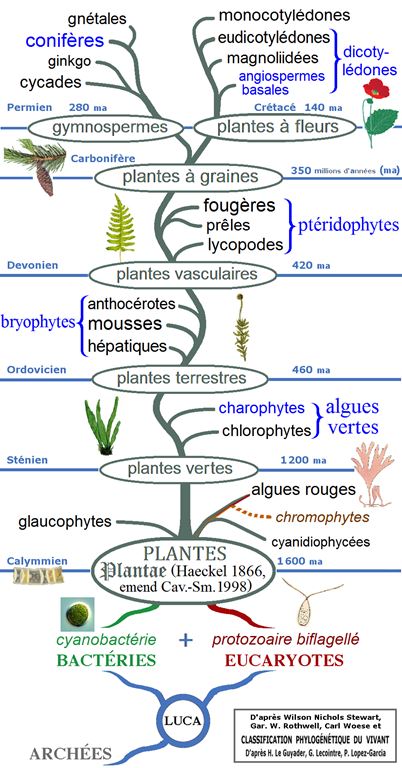
À droite, cet arbre phylogénétique des plantes montre les principaux clades et groupes traditionnels (monophylétiques en noir et paraphylétiques en bleu).
Dénominations
- Nom botanique : Arjona tuberosa Cav.
- Synonymes : Arjona apressa Phil, Arjona pungens Phil, et d'autres
- Noms anglais et locaux : Chaquil, Macachin
Description et culture
Tableau récapitulatif
Parties comes-tibles Note comest. (1-5) Note medic. (1-5) (Zones de) Rusticité Besoins en 
Besoins en  (1-3)
(1-3)Périodes de semis et récoltes Graines au gramme Durée de viabilité Profon-deur semis Espace-ment plants Espace-ment lignes Durée germi-native Durée avant récolte J F M A M J
J A S O N D
J F M A M J
J A S O N D
- dont infos de 0FPI ("FOOD PLANTS INTERNATIONAL", en anglais) :
 Consommation (rapports de comestibilité, parties utilisables et usages alimentaires correspondants)
Consommation (rapports de comestibilité, parties utilisables et usages alimentaires correspondants)Parties comestibles :
tubercules, racine{{{0(+x) (traduction automatique). Original : Tubers, Root{{{0(+x).Détails :
Les tubercules sont consommés crus, bouillis ou écrasés{{{0(+x) (traduction automatique).
Original : The tubers are eaten raw, boiled or mashed{{{0(+x).
Partie testée :
/ Risques et précautions à prendre
Risques et précautions à prendrenéant, inconnus ou indéterminés.
Autres infos
dont infos de 0FPI ("FOOD PLANTS INTERNATIONAL", en anglais) :
Statut :
C'est une plante alimentaire cultivée{{{0(+x) (traduction automatique).
Original : It is a cultivated food plant{{{0(+x).
Distribution :
C'est une plante tempérée. Il pousse dans la steppe de Patagonie en Argentine. Il passe du niveau de la mer à 1 500 m d'altitude{{{0(+x) (traduction automatique).
Original : It is a temperate plant. It grows on the Patagonian steppe in Argentina. It grows from sea level to 1,500 m above sea level{{{0(+x).
Localisation :
Argentine, Chili, Amérique du Sud, Uruguay{{{0(+x) (traduction automatique).
Original : Argentina, Chile, South America, Uruguay{{{0(+x).
Liens, sources et/ou références
Liens :
/ ;Sources et/ou références :
bibliographie (liste des sources et/ou références de l'encyclopédie)
dont classification : IPNI ("International Plant Names Index", en anglais) ; Kew (POWO - "Plant Of the World Online", "Royal Botanical Garden", en anglais) ;
dont livres et bases de données : 0FPI ("FOOD PLANTS INTERNATIONAL", en anglais) ;
dont bibliographie/références de 0FPI ("FOOD PLANTS INTERNATIONAL", en anglais) :
Bircher, A. G. & Bircher, W. H., 2000, Encyclopedia of Fruit Trees and Edible Flowering Plants in Egypt and the Subtropics. AUC Press. p 41 ; Ladio, A. H., 2001, The Maintenance of Wild Edible Plant Gatherings in a Mapuche Community of Patagonia. Economic Botany, Vol. 55, No. 2, pp. 243-254 ; Ladio, A. H. and Lozada, M., 2004, Patterns of use and knowledge of wild edible plants in distinct ecological environments: a case study of a Mapuche community from northwestern Patagonia. Biodiversity and Conservation 13:1153-1173 ; Ladio, A., Lozada, M. & M. Weigandt, 2007, Comparison of traditional wild plant knowledge between aboriginal communities inhabiting arid and forest environments in Patagonia, Argentina. Journal of Arid Environments 69 (2007) 695–715 ; Malezas Comestibles del Cono Sur, INTA, 2009, Buernos Aires ; Mansfeld, ; Ochoa, J. S., & Ladio, A, H, 2015, Current use of wild plants with edible underground storage organs in a rural population of Patogonia: between tradition and change. Journal of Ethnobiology and Ethnomedicine 11:70 ; Rapoport, E. H. & Ladio, A. H., 1999, Plantas comestibles. Bosque Volume 20 No. 2. ISSN 0314-8799 ; Uphof, 1968, ; Usher, 1974,
Recherche de/pour :
- "Arjona tuberosa" sur Google (pages et
images) ;
TPL ("The Plant List", en anglais) ;
GRIN ("Germplasm Resources Information Network", en anglais) ;
TROPICOS (en anglais) ;
Tela Botanica ;
Pl@ntNet ;
Pl@ntUse ;
"Plants For A Future" (en anglais) ;
"Useful Tropical Plants" (en anglais) ou
"Useful Temperate Plants" (en anglais) ;
- "Arjona tuberosa" sur Google (pages et
images) ;
TPL ("The Plant List", en anglais) ;
GRIN ("Germplasm Resources Information Network", en anglais) ;
TROPICOS (en anglais) ;
Tela Botanica ;
Pl@ntNet ;
Pl@ntUse ;
"Plants For A Future" (en anglais) ;
"Useful Tropical Plants" (en anglais) ou
"Useful Temperate Plants" (en anglais) ;
Espèces de la même famille (Schoepfiaceae)
3 taxons







 donne accès au menu
  - encyclopédies des plantes alimentaires ;
 - page de recherche - reconnaissance (identification) de plantes ;
 - page du calendrier lunaire et son générateur (au format PDF et JPG) ;
 - tableau récapitulatif ;
 - générateur de potées (soupes), avec estimation des apports nutrionnels et du coût;
 - générateur de codes QR ;
 - page des archives avec de nombreux documents sur différents thèmes complémentaires comme la botanique, les légumes,
les champignons, la cuisine, le bien-être ainsi que différents MOOC mais également des liens vers les archives de l'association ;
- page des archives avec de nombreux documents sur différents thèmes complémentaires comme la botanique, les légumes,
les champignons, la cuisine, le bien-être ainsi que différents MOOC mais également des liens vers les archives de l'association ;

 ou
ou
 permettant de passer du format standard à l'AMP (et vice-versa), lequel est simplifié et donc plus rapide.
 pour le fruit (et/ou les graines, la pulpe, etc...),
 pour les fleurs (et/ou pétales, calice...),
 pour les feuilles (et/ou la tige, les pousses...),
 pour les racines,
 pour le tronc (et/ou l'écorce, la sève...), et enfin
 pour les champignons,
puis les notes alimentaires et médicinales (de 1 à 5 étoiles), la rusticité (résistance au froid/gel)
et pour finir un résumé.
pour les champignons,
puis les notes alimentaires et médicinales (de 1 à 5 étoiles), la rusticité (résistance au froid/gel)
et pour finir un résumé. menant ici 🙂
 ,
,  et
et





 ,
,


 Encyclopédie(s)
 Recherche-Reconnaissance
 Tableau récapitulatif
 Codes QR
 Archives
 Calendrier(s) lunaire(s)
  Potées
 Re-naturation/naturalisation
 Affichettes, herbiers &
co.
Affichettes, herbiers &
co. menu
menu galerie