Nymphaea tetragona


 |
**
|
**
Une herbe. Elle pousse dans l'eau. Les rhizomes ou tiges souterraines sont dressés et non ramifiés. Le limbe de la feuille est en forme de cœur à ovale et mesure de 5 à 1 ... (traduction automatique)
→suite


Affich., herbiers & co.
Nymphaea tetragona
Une herbe. Elle pousse dans l'eau. Les rhizomes ou tiges souterraines sont dressés et non ramifiés. Le limbe de la feuille est en forme de cœur à ovale et mesure de 5 à 12 cm de long sur 3,5 à 9 cm d... (traduction automatique) →suite
Note alimentaire 

Pas d'illustration
pour le moment 😕
Classification
- Classique : en haut de l'écran, sous le coeur.
- Phylogénétique :
- Clade 4 : Angiospermes ;
- Ordre APN : Nymphaeales ;
- Famille APN : Nymphaeaceae ;
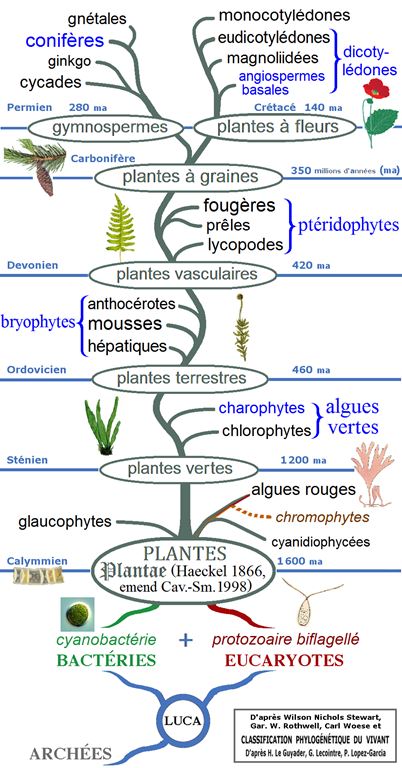
À droite, cet arbre phylogénétique des plantes montre les principaux clades et groupes traditionnels (monophylétiques en noir et paraphylétiques en bleu).
Dénominations
- Nom botanique : Nymphaea tetragona Georgi
- Synonymes : Nymphaea pygmaea Ait
- Noms anglais et locaux : Pygmy Water Lily
Description et culture
Tableau récapitulatif
Parties comes-tibles Note comest. (1-5) Note medic. (1-5) (Zones de) Rusticité Besoins en 
Besoins en  (1-3)
(1-3)Périodes de semis et récoltes Graines au gramme Durée de viabilité Profon-deur semis Espace-ment plants Espace-ment lignes Durée germi-native Durée avant récolte J F M A M J
J A S O N D
J F M A M J
J A S O N D
- dont infos de 0FPI ("FOOD PLANTS INTERNATIONAL", en anglais) :
Description :
Une herbe. Elle pousse dans l'eau. Les rhizomes ou tiges souterraines sont dressés et non ramifiés. Le limbe de la feuille est en forme de cœur à ovale et mesure de 5 à 12 cm de long sur 3,5 à 9 cm de large. C'est du papier. Il est lisse en dessous. La base est profondément en forme de cœur et les lobes à la base sont parallèles ou presque se touchent. La fleur flotte. Il mesure 3-6 cm de diamètre. La connexion à la prise est à 4 côtés. Il y a 8 à 15 pétales blancs. Le fruit est rond et mesure 2 à 2,5 cm de diamètre. Les graines sont étroitement ovales et mesurent 2-3 mm de long. Ils sont lisses{{{0(+x) (traduction automatique).
Original : A herb. It grows in water. The rhizomes or underground stems are erect and unbranched. The leaf blade is heart shaped to oval and 5-12 cm long by 3.5-9 cm wide. It is papery. It is smooth underneath. The base is deeply heart shaped and the lobes at the base are parallel or almost touching. The flower is floating. It is 3-6 cm across. The connection to the receptacle is 4 sided. There are 8-15 petals which are white. The fruit is round and 2-2.5 cm across. The seeds are narrowly oval and 2-3 mm long. They are smooth{{{0(+x).
Consommation (rapports de comestibilité, parties utilisables et usages alimentaires correspondants)
Consommation (rapports de comestibilité, parties utilisables et usages alimentaires correspondants)Parties comestibles :
graines, bourgeons de feuilles, rhizome, racine, fleurs{{{0(+x) (traduction automatique). Original : Seeds, Leaf buds, Rhizome, Root, Flowers{{{0(+x).Détails :
Le rhizome est utilisé pour la nourriture{{{0(+x) (traduction automatique).
Original : The rhizome is used for food{{{0(+x).
Partie testée :
/ Risques et précautions à prendre
Risques et précautions à prendrenéant, inconnus ou indéterminés.
Autres infos
dont infos de 0FPI ("FOOD PLANTS INTERNATIONAL", en anglais) :
Distribution :
C'est une plante tempérée. Il pousse dans les étangs et les lacs du niveau de la mer proche à 4000 m en Chine. Il pousse dans les zones humides. Il convient aux zones de rusticité 3-9. Au Sichuan et au Yunnan{{{0(+x) (traduction automatique).
Original : It is a temperate plant. It grows in ponds and lakes from near sea level to 4000 m in China. It grows in wetlands. It suits hardiness zones 3-9. In Sichuan and Yunnan{{{0(+x).
Localisation :
Asie, Australie, Canada, Asie centrale, Chine, Europe, Finlande, Inde, Indochine, Japon, Cachemire, Kazakhstan, Corée, Myanmar, Amérique du Nord, Russie, Scandinavie, Asie du Sud-Est, Taiwan, USA, Vietnam{{{0(+x) (traduction automatique).
Original : Asia, Australia, Canada, Central Asia, China, Europe, Finland, India, Indochina, Japan, Kashmir, Kazakhstan, Korea, Myanmar, North America, Russia, Scandinavia, SE Asia, Taiwan, USA, Vietnam{{{0(+x).
Notes :
Il existe environ 50 espèces de Nymphaea{{{0(+x) (traduction automatique).
Original : There are about 50 Nymphaea species{{{0(+x).
Liens, sources et/ou références
Liens :
/ ;Sources et/ou références :
bibliographie (liste des sources et/ou références de l'encyclopédie)
dont classification : IPNI ("International Plant Names Index", en anglais) ; Kew (POWO - "Plant Of the World Online", "Royal Botanical Garden", en anglais) ;
dont livres et bases de données : 5PFAF ("Plants For A Future", en anglais) ; 0FPI ("FOOD PLANTS INTERNATIONAL", en anglais) ;
dont bibliographie/références de 0FPI ("FOOD PLANTS INTERNATIONAL", en anglais) :
Ambasta, S.P. (Ed.), 2000, The Useful Plants of India. CSIR India. p 402 ; Bemerk. Reise Russ. Reich 1:220. 1775 ; Bodkin, F., 1991, Encyclopedia Botanica. Cornstalk publishing, p 731 ; Brickell, C. (Ed.), 1999, The Royal Horticultural Society A-Z Encyclopedia of Garden Plants. Convent Garden Books. p 713 ; Cherikoff V. & Isaacs, J., The Bush Food Handbook. How to gather, grow, process and cook Australian Wild Foods. Ti Tree Press, Australia p 128 ; Cundall, P., (ed.), 2004, Gardening Australia: flora: the gardener's bible. ABC Books. p 938 ; Fu Dezhi, Wiersma, J.H., Nymphaceae in Flora of China. ; Hibbert, M., 2002, The Aussie Plant Finder 2002, Florilegium. p 112 ; Hu, Shiu-ying, 2005, Food Plants of China. The Chinese University Press. p 388 ; Lim, T. K., 2015, Edible Medicinal and Non Medicinal Plants. Volume 9, Modified Stems, Roots, Bulbs. Springer p 59 ; Liu, Yi-tao, & Long, Chun-Lin, 2002, Studies on Edible Flowers Consumed by Ethnic Groups in Yunnan. Acta Botanica Yunnanica. 24(1):41-56 ; Plants for a Future database, The Field, Penpol, Lostwithiel, Cornwall, PL22 0NG, UK. http://www.scs.leeds.ac.uk/pfaf/ ; Singh, H.B., Arora R.K.,1978, Wild edible Plants of India. Indian Council of Agricultural Research, New Delhi. p 82 ; Slocum, P.D. & Robinson, P., 1999, Water Gardening. Water Lilies and Lotuses. Timber Press. p 164, 217 ; Valder, P., 1999, The Garden Plants of China. Florilegium. p 233 ; Zhang, Y., et al, 2014, Diversity of wetland plants used traditionally in China: a literature review. Journal of Ethnobiology and Ethnomedicine. 10:72
Recherche de/pour :
- "Nymphaea tetragona" sur Google (pages et
images) ;
TPL ("The Plant List", en anglais) ;
GRIN ("Germplasm Resources Information Network", en anglais) ;
TROPICOS (en anglais) ;
Tela Botanica ;
Pl@ntNet ;
Pl@ntUse ;
"Useful Tropical Plants" (en anglais) ou
"Useful Temperate Plants" (en anglais) ;
- "Nymphaea tetragona" sur Google (pages et
images) ;
TPL ("The Plant List", en anglais) ;
GRIN ("Germplasm Resources Information Network", en anglais) ;
TROPICOS (en anglais) ;
Tela Botanica ;
Pl@ntNet ;
Pl@ntUse ;
"Useful Tropical Plants" (en anglais) ou
"Useful Temperate Plants" (en anglais) ;
Espèces du même genre (Nymphaea)
30 taxons
- Lotier d'Égypte
- Lotus bleu d'Égypte
- Nénuphar blanc
- Nénuphar blanc boréal
- Nénuphar rouge
- Nymphéa parfumé
- Nymphéa tubéreux
- Nymphaea advena Aiton
- Nymphaea alba L. (Nénuphar blanc)
- Nymphaea amazonum Mart. & Zucc.
- Nymphaea ampla (Salisb.) DC.
- Nymphaea caerulea Savigny (Lotus bleu d'Égypte)
- Nymphaea candida C.Presl (Nénuphar blanc boréal)
- Nymphaea capensis Thunb.
- Nymphaea edulis
- Nymphaea elegans Hook.
- Nymphaea flava Leitn. ex Audubon
- Nymphaea gigantea Hook.
- Nymphaea guineensis Schumach. & Thonn.
- Nymphaea hastifolia Domin
- Nymphaea immutabilis S.W.L.Jacobs
- Nymphaea jamesoniana Planch.
- Nymphaea lotus L. (Lotier d'Égypte)
- Nymphaea macrosperma Merr. & L.M.Perry
- Nymphaea maculata Raf.
- Nymphaea micrantha Perr. & Guill.
- Nymphaea nouchali Burm.f.
- Nymphaea odorata Aiton (Nymphéa parfumé)
- Nymphaea ondinea Lhne, Wiersema & Borsch
- Nymphaea petersiana Klotzsch
- Nymphaea pubescens Willd.
- Nymphaea rubescens Guill. et Perr.
- Nymphaea rubra Roxb. ex Andrews (Nénuphar rouge)
- Nymphaea rudgeana G.Mey.
- Nymphaea tuberosa Paine (Nymphéa tubéreux)
- Nymphaea violacea Lehm.
Espèces de la même famille (Nymphaeaceae)
41 taxons
- Gorgon
- Lotier d'Égypte
- Lotus bleu d'Égypte
- Nénufar jaune
- Nénufar nain
- Nénuphar blanc
- Nénuphar blanc boréal
- Nénuphar rouge
- Nymphéa parfumé
- Nymphéa tubéreux
- Barclaya motleyi Hook.f.
- Euryale ferox Salisb. (Gorgon)
- Nuphar advena (Aiton) W. T. Aiton
- Nuphar japonica DC.
- Nuphar lutea (L.) Sm. (Nénufar jaune)
- Nuphar multisepalum Engelm.
- Nuphar polysepala Engelm.
- Nuphar pumila (Timm) DC. (Nénufar nain)
- Nuphar variegata Engelm. ex Durand
- Nymphaea advena Aiton
- Nymphaea alba L. (Nénuphar blanc)
- Nymphaea amazonum Mart. & Zucc.
- Nymphaea ampla (Salisb.) DC.
- Nymphaea caerulea Savigny (Lotus bleu d'Égypte)
- Nymphaea candida C.Presl (Nénuphar blanc boréal)
- Nymphaea capensis Thunb.
- Nymphaea edulis
- Nymphaea elegans Hook.
- Nymphaea flava Leitn. ex Audubon
- Nymphaea gigantea Hook.
- Nymphaea guineensis Schumach. & Thonn.
- Nymphaea hastifolia Domin
- Nymphaea immutabilis S.W.L.Jacobs
- Nymphaea jamesoniana Planch.
- Nymphaea lotus L. (Lotier d'Égypte)
- Nymphaea macrosperma Merr. & L.M.Perry
- Nymphaea maculata Raf.
- Nymphaea micrantha Perr. & Guill.
- Nymphaea nouchali Burm.f.
- Nymphaea odorata Aiton (Nymphéa parfumé)
- Nymphaea ondinea Lhne, Wiersema & Borsch
- Nymphaea petersiana Klotzsch
- Nymphaea pubescens Willd.
- Nymphaea rubescens Guill. et Perr.
- Nymphaea rubra Roxb. ex Andrews (Nénuphar rouge)
- Nymphaea rudgeana G.Mey.
- Nymphaea tuberosa Paine (Nymphéa tubéreux)
- Nymphaea violacea Lehm.
- Victoria amazonica (Poepp.) Klotzsch
- Victoria cruziana A.D.Orb.







 donne accès au menu
  - encyclopédies des plantes alimentaires ;
 - page de recherche - reconnaissance (identification) de plantes ;
 - page du calendrier lunaire et son générateur (au format PDF et JPG) ;
 - tableau récapitulatif ;
 - générateur de potées (soupes), avec estimation des apports nutrionnels et du coût;
 - générateur de codes QR ;
 - page des archives avec de nombreux documents sur différents thèmes complémentaires comme la botanique, les légumes,
les champignons, la cuisine, le bien-être ainsi que différents MOOC mais également des liens vers les archives de l'association ;
- page des archives avec de nombreux documents sur différents thèmes complémentaires comme la botanique, les légumes,
les champignons, la cuisine, le bien-être ainsi que différents MOOC mais également des liens vers les archives de l'association ;

 ou
ou
 permettant de passer du format standard à l'AMP (et vice-versa), lequel est simplifié et donc plus rapide.
 pour le fruit (et/ou les graines, la pulpe, etc...),
 pour les fleurs (et/ou pétales, calice...),
 pour les feuilles (et/ou la tige, les pousses...),
 pour les racines,
 pour le tronc (et/ou l'écorce, la sève...), et enfin
 pour les champignons,
puis les notes alimentaires et médicinales (de 1 à 5 étoiles), la rusticité (résistance au froid/gel)
et pour finir un résumé.
pour les champignons,
puis les notes alimentaires et médicinales (de 1 à 5 étoiles), la rusticité (résistance au froid/gel)
et pour finir un résumé. menant ici 🙂
 ,
,  et
et





 ,
,


 Encyclopédie(s)
 Recherche-Reconnaissance
 Tableau récapitulatif
 Codes QR
 Archives
 Calendrier(s) lunaire(s)
  Potées
 Re-naturation/naturalisation
 Affichettes, herbiers &
co.
Affichettes, herbiers &
co. menu
menu galerie