Encyclopédie(s)
 Recherche-Reconnaissance
 Tableau récapitulatif
 Codes QR
 Archives
 Calendrier(s) lunaire(s)
  Potées
 Re-naturation/naturalisation
 Affichettes, herbiers &
co.
Affichettes, herbiers &
co. menu
menu galerie


Raphia hookeri
 |
***
-
**
|
***
-
**
Un palmier. C'est souvent un palmier solitaire mais peut aussi avoir des ventouses. Il atteint 10 à 15 m de haut. Les troncs mesurent 30 cm de diamètre. La partie supérieur ... (traduction automatique)
→suite


Affich., herbiers & co.
Raphia hookeri
Un palmier. C'est souvent un palmier solitaire mais peut aussi avoir des ventouses. Il atteint 10 à 15 m de haut. Les troncs mesurent 30 cm de diamètre. La partie supérieure du tronc est recouverte de b... (traduction automatique) →suite
Note alimentaire  médicinale

Classification
- Classique : en haut de l'écran, sous le coeur.
- Phylogénétique :
- Clade 4 : Angiospermes ;
- Clade 3 : Monocotylédones ;
- Clade 2 : Commelinidées ;
- Ordre APN : Arecales ;
- Famille APN : Arecaceae ;
À droite, cet arbre phylogénétique des plantes montre les principaux clades et groupes traditionnels (monophylétiques en noir et paraphylétiques en bleu).

Dénominations
- Nom botanique : Raphia hookeri G.Mann & H.Wendl.
- Synonymes : Raphia gigantea A. Chev, Raphia sassandrensis A. Chev
- Noms anglais et locaux : Giant raffia palm
Description et culture
Tableau récapitulatif
Parties comes-tibles Note comest. (1-5) Note medic. (1-5) (Zones de) Rusticité Besoins en 
Besoins en  (1-3)
(1-3)Périodes de semis et récoltes Graines au gramme Durée de viabilité Profon-deur semis Espace-ment plants Espace-ment lignes Durée germi-native Durée avant récolte J F M A M J
J A S O N D
J F M A M J
J A S O N D
- dont infos de 0FPI ("FOOD PLANTS INTERNATIONAL", en anglais) :
Description :
Un palmier. C'est souvent un palmier solitaire mais peut aussi avoir des ventouses. Il atteint 10 à 15 m de haut. Les troncs mesurent 30 cm de diamètre. La partie supérieure du tronc est recouverte de bases de feuilles et de fibres épineuses noirâtres. Les feuilles sont d'un vert foncé brillant. Ils peuvent mesurer 12 m de long. Les feuilles sont comme des plumes. Les dépliants sont rigides. La tige fleurie mesure 2,5 m de long. Ils pendent. La couronne meurt après la floraison. Les fleurs sont de couleur brunâtre. Les fruits sont bruns et en forme de sommet. Ils mesurent 12 cm de long sur 5 cm de large. Ils ont un bec robuste. Ils sont brun clair, durs et brillants. Ils ont des échelles qui se chevauchent{{{0(+x) (traduction automatique).
Original : A palm. It is often a solitary palm but can also have some suckers. It grows to 10-15 m high. The trunks are 30 cm across. The upper part of the trunk is covered with leaf bases and blackish spiny fibres. The leaves are shiny dark green. They can be 12 m long. The leaves are feather like. The leaflets are rigid. The flowering stalk is 2.5 m long. They hang down. The crown dies after flowering. The flowers are brownish in colour. The fruit are brown and shaped like a top. They are 12 cm long by 5 cm wide. They have a stout beak. They are light brown, hard and shiny. They have overlapping scales{{{0(+x).
Production :
Les fleurs de palmier meurent ensuite après environ 15 ans{{{0(+x) (traduction automatique).
Original : The palm flowers then dies after about 15 years{{{0(+x).
Culture :
Les plantes peuvent être cultivées à partir de graines{{{0(+x) (traduction automatique).
Original : Plants can be grown from seeds{{{0(+x).
Consommation (rapports de comestibilité, parties utilisables et usages alimentaires correspondants)
Consommation (rapports de comestibilité, parties utilisables et usages alimentaires correspondants)Parties comestibles :
noyau, sève, noix, graines, fruits, cœur de palmier, chou, légumes{{{0(+x) (traduction automatique). Original : Kernel, Sap, Nuts, Seed, Fruit, Palm heart, Cabbage, Vegetable{{{0(+x).Détails :
La sève de la tige florale est collectée et utilisée pour le grog ou le vin. Les tiges peuvent être utilisées pour l'amidon. Le bourgeon central se mange comme un chou de palme{{{0(+x) (traduction automatique).
Original : The sap from the flower stalk is collected and used for toddy or wine. The stems can be used for starch.The central bud is eaten as a palm cabbage{{{0(+x).
Partie testée :
noyau{{{0(+x) (traduction automatique). Original : Kernel{{{0(+x)| Taux d'humidité (%) | Énergie (kj) | Énergie (kcal) | Protéines (g) |
|---|---|---|---|
| 10.6 | 1363 | 326 | 7.8 |
| Pro- vitamines A (µg) |
Vitamines C (mg) | Fer (mg) | Zinc (mg) |
| 0 | 0 | 0 | 0 |
 Risques et précautions à prendre
Risques et précautions à prendrenéant, inconnus ou indéterminés.
Galerie(s)
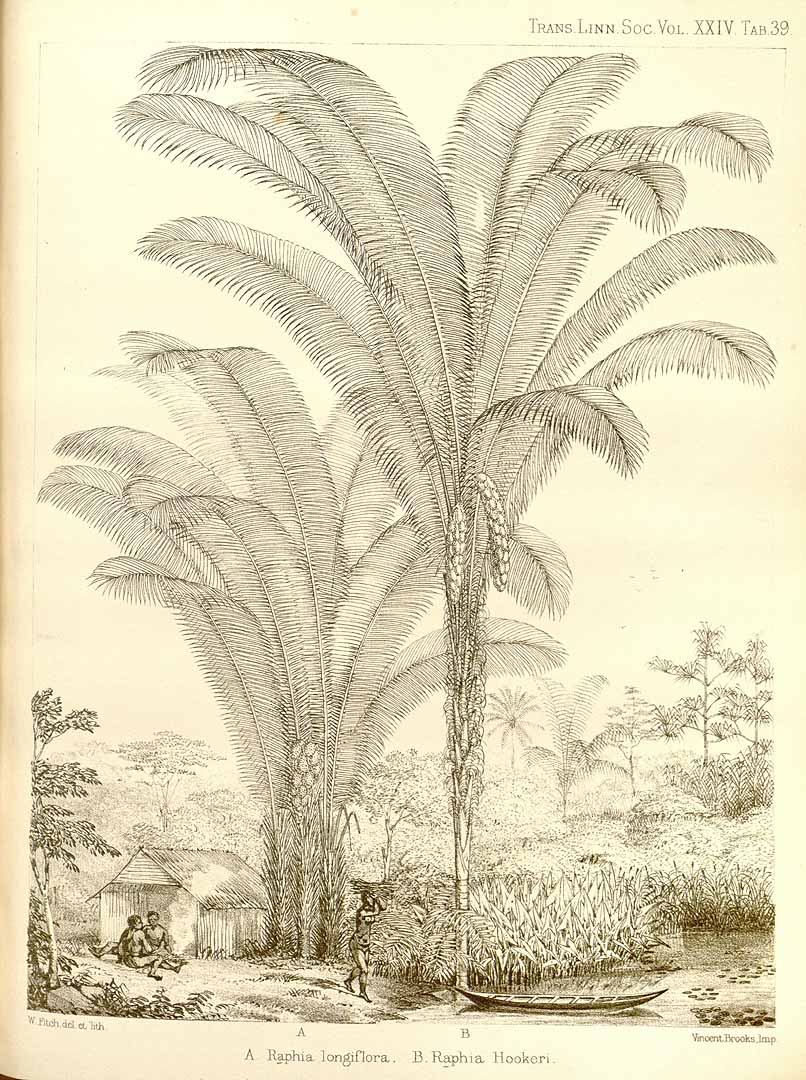
Par Transactions of the Linnean Society of London (1791-1875) Trans. Linn. Soc. London vol. 24 (1864) t. 39 f. B , via plantillustrations
✖
Autres infos
dont infos de 0FPI ("FOOD PLANTS INTERNATIONAL", en anglais) :
Statut :
Il est cultivé dans les zones marécageuses pour ses nombreux produits utiles{{{0(+x) (traduction automatique).
Original : It is grown in swampy areas for its many useful products{{{0(+x).
Distribution :
Une plante tropicale. Il pousse naturellement dans les marais. Il se produit dans la forêt pluviale des basses terres. Il convient aux endroits humides{{{0(+x) (traduction automatique).
Original : A tropical plant. It grows naturally in swamps. It occurs in lowland rainforest. It suits humid locations{{{0(+x).
Localisation :
Afrique, Asie, Australie, Bénin, Cameroun, Afrique centrale, République centrafricaine, RCA, RD Congo, Congo R, Côte d'Ivoire, Guinée équatoriale, Gabon, Gambie, Ghana, Guinée, Guinée, Inde, Indonésie , Côte d'Ivoire, Liberia, Nigeria, Asie du Sud-Est, Sierra Leone, Togo, Afrique de l'Ouest{{{0(+x) (traduction automatique).
Original : Africa, Asia, Australia, Benin, Cameroon, Central Africa, Central African Republic, CAR, Congo DR, Congo R, Côte d'Ivoire, Equatorial Guinea, Gabon, Gambia, Ghana, Guinea, Guinée, India, Indonesia, Ivory Coast, Liberia, Nigeria, SE Asia, Sierra Leone, Togo, West Africa{{{0(+x).
Liens, sources et/ou références
Liens :
/ ;Sources et/ou références :
bibliographie (liste des sources et/ou références de l'encyclopédie)
dont classification : IPNI ("International Plant Names Index", en anglais) ; Kew (POWO - "Plant Of the World Online", "Royal Botanical Garden", en anglais) ;
dont livres et bases de données : 5PFAF ("Plants For A Future", en anglais) ; 0FPI ("FOOD PLANTS INTERNATIONAL", en anglais) ;
dont bibliographie/références de 0FPI ("FOOD PLANTS INTERNATIONAL", en anglais) :
Abbiw, D.K., 1990, Useful Plants of Ghana. West African uses of wild and cultivated plants. Intermediate Technology Publications and the Royal Botanic Gardens, Kew. p 41 ; Ambasta S.P. (Ed.), 2000, The Useful Plants of India. CSIR India. p 515 ; Balick, M.J. and Beck, H.T., (Ed.), 1990, Useful palms of the World. A Synoptic Bibliography. Colombia p 238, 298, 383, ; Blomberry, A. & Rodd, T., 1982, Palms. An informative practical guide. Angus & Robertson. p 155 ; Burkill, H. M., 1985, The useful plants of west tropical Africa, Vol. 4. Kew. ; Dalziel, J. M., 1937, The Useful plants of west tropical Africa. Crown Agents for the Colonies London. ; Danforth, R.M., & Boren, P.D., 1997, Congo Native fruits. Twenty-five of the best. Privately published. p 69 (As Raphia gigantea) ; Facciola, S., 1998, Cornucopia 2: a Source Book of Edible Plants. Kampong Publications, p 30 ; FAO Corporate Document Repository. The Major Significance of 'Minor' Forest Products. Appendix 3 ; Grubben, G. J. H. and Denton, O. A. (eds), 2004, Plant Resources of Tropical Africa 2. Vegetables. PROTA, Wageningen, Netherlands. p 564 ; Hawthorne, W.& Marshall, C., 2013, Nimba Western Area Iron Ore Concentrator Mining Project Environmental and Social Impact Assessment. AcelorMittel Liberia. p 505 ; Haynes, J., & McLaughlin, J., 2000, Edible palms and Their Uses. University of Florida Fact sheet MCDE-00-50-1 p 12 ; Hedrick, U.P., 1919, (Ed.), Sturtevant's edible plants of the world. p 554 ; Jardin, C., 1970, List of Foods Used In Africa, FAO Nutrition Information Document Series No 2.p 36 ; Jones, D.L., 1994, Palms throughout the World. Smithtonian Institution, Washington. p 326 ; Manvell, A., 2011, Use of Non-Timber Forest Products around Sapo National Park, Liberia (Report B) p 52 ; Nkeoua, G. & Boundzanga, G. C., 1999, Donnees sur les produits forestieres non ligneux en Republique du Congo. FAO. p 35 ; Ogbuagu, M. N., 2008, Vitamins, phytochemicals and toxic elements in the pulp and seed of raphia palm fruit (Raphia hookeri). Fruits, Vol. 63, p. 297-302 ; Peters, C. R., O'Brien, E. M., and Drummond, R.B., 1992, Edible Wild plants of Sub-saharan Africa. Kew. p 39 ; Purseglove, J.W., 1972, Tropical Crops. Monocotyledons. Longmans p 431 ; Riffle, R.L. & Craft, P., 2003, An Encyclopedia of Cultivated Palms. Timber Press. p 430 ; Sukarya, D. G., (Ed.) 2013, 3,500 Plant Species of the Botanic Gardens of Indonesia. LIPI p 812 ; Trans. Linn. Soc. London 24:438. 1864
Recherche de/pour :
- "Raphia hookeri" sur Google (pages et
images) ;
TPL ("The Plant List", en anglais) ;
GRIN ("Germplasm Resources Information Network", en anglais) ;
TROPICOS (en anglais) ;
Tela Botanica ;
Pl@ntNet ;
Pl@ntUse ;
"Useful Tropical Plants" (en anglais) ou
"Useful Temperate Plants" (en anglais) ;
- "Raphia hookeri" sur Google (pages et
images) ;
TPL ("The Plant List", en anglais) ;
GRIN ("Germplasm Resources Information Network", en anglais) ;
TROPICOS (en anglais) ;
Tela Botanica ;
Pl@ntNet ;
Pl@ntUse ;
"Useful Tropical Plants" (en anglais) ou
"Useful Temperate Plants" (en anglais) ;
Espèces du même genre (Raphia)
16 taxons
- Raphia africana Otedoh
- Raphia australis Oberm. & Strey
- Raphia bandamensis A.Chev.
- Raphia farinifera
- Raphia gentiliana De Wild.
- Raphia gilletii
- Raphia humilis A.Chev.
- Raphia laurentii De Wild.
- Raphia mambillensis Otedoh
- Raphia palma-pinus
- Raphia regalis Becc.
- Raphia sese De Wild.
- Raphia sudanica A.Chev.
- Raphia taedigera
- Raphia vinifera P.Beauv.
Espèces de la même famille (Arecaceae)
781 taxons
- Acanthophénix chevelu
- Bismarckie noble
- Borasse d'Éthiopie
- Butia argentin
- Cocotier
- Cocotier du chili
- Cocotier plumeux
- Dattier
- Dattier du Sénégal
- Dypsis de Madagascar
- Forest acai
- Palmier à bétel
- Palmier à huile d'afrique
- Palmier à huile d'amérique
- Palmier à sucre
- Palmier à vin
- Palmier açaï
- Palmier bleu du mexique
- Palmier butia pourpre
- Palmier chanvre
- Palmier de guadeloupe
- Palmier de juçara
- Palmier de palmyre
- Palmier du Brésil
- Palmier du mexique
- Palmier ébouriffé
- Palmier eleiodoxa
- Palmier jucum
- Palmier jupon
- Palmier laineux
- Palmier maraja
- Palmier nain
- Palmier pêche
- Palmier piassava
- Palmier tucuma
- Palmier-dattier
- Palmier-dattier des canaries
- Palmier-dattier des falaises
- Palmier-dattier nain
- Palmier-dattier sauvage
- Palmier-éventail d'Australie
- Palmier-éventail de Chine
- Palmiste blanc
- Palmiste rouge
- Phénix de Loureiro
- Pritchardie du Pacifique
- Pseudophénix de Sargent
- Sabal des Bermudes
- Sabal palmetto
- Sagouier farineux
- Acanthophoenix crinita (Acanthophénix chevelu)
- Acanthophoenix rubra (Bory) H. Wendl. (Palmiste rouge)
- Acoelorrhaphe wrightii (Griseb. & H.Wendl.) H.Wendl. ex Becc.
- Acrocomia aculeata
- Acrocomia crispa
- Acrocomia media O.F.Cook
- Actinorhytis calapparia
- Adonidia merrillii
- Aiphanes deltoidea Burret
- Aiphanes eggersii Burret
- Aiphanes gelatinosa H.E.Moore
- Aiphanes grandis Borchs. & Balslev
- Aiphanes hirsuta Burret
- Aiphanes horrida (Jacq.) Burret (Palmier ébouriffé)
- Aiphanes lindeniana
- Aiphanes linearis Burret
- Aiphanes macroloba Burret
- Aiphanes minima
- Aiphanes ulei
- Aiphanes verrucosa Borchs. & Balslev
- Aiphanes weberbaueri Burret
- Allagoptera arenaria
- Allagoptera brevicalyx M.Moraes
- Allagoptera campestris
- Allagoptera caudescens
- Allagoptera leucocalyx
- Allagoptera maritimum
- Ammandra decasperma O.F.Cook
- Aphandra natalia
- Archontophoenix alexandrae
- Archontophoenix cunninghamiana
- Areca caliso Becc.
- Areca catechu L. (Palmier à bétel)
- Areca concinna Thwaites
- Areca glandiformis Lam.
- Areca hutchinsoniana Becc.
- Areca ipot Becc.
- Areca jobiensis Becc.
- Areca macrocalyx Zipp. ex Blume
- Areca macrocarpa Becc.
- Areca montana Ridl.
- Areca novohibernica
- Areca parens Becc.
- Areca triandra Roxb. ex Buch.-Ham.
- Areca vestiaria Giseke
- Areca whitfordii Becc.
- Arenga australasica
- Arenga brevipes Becc.
- Arenga engleri Becc.
- Arenga listeri Becc.
- ...





 - page de recherche - reconnaissance (identification) de plantes ;
 - page des archives avec de nombreux documents sur différents thèmes complémentaires comme la botanique, les légumes,
les champignons, la cuisine, le bien-être ainsi que différents MOOC mais également des liens vers les archives de l'association ;
- page des archives avec de nombreux documents sur différents thèmes complémentaires comme la botanique, les légumes,
les champignons, la cuisine, le bien-être ainsi que différents MOOC mais également des liens vers les archives de l'association ;

 pour poser des question à l'IA (Terra) ou discuter avec elle/lui, et ce
 ou
ou
 permettant de passer du format standard à l'AMP (et vice-versa), lequel est simplifié et donc plus rapide.
 pour les fleurs (et/ou pétales, calice...),
 pour les feuilles (et/ou la tige, les pousses...),
 pour les racines,
 pour le tronc (et/ou l'écorce, la sève...), et enfin
 pour les champignons,
puis les notes alimentaires et médicinales (de 1 à 5 étoiles), la rusticité (résistance au froid/gel)
et pour finir un résumé.
pour les champignons,
puis les notes alimentaires et médicinales (de 1 à 5 étoiles), la rusticité (résistance au froid/gel)
et pour finir un résumé. menant ici 🙂
 et
et

 ,
,
 ,
,
 ,
,





 ,
,